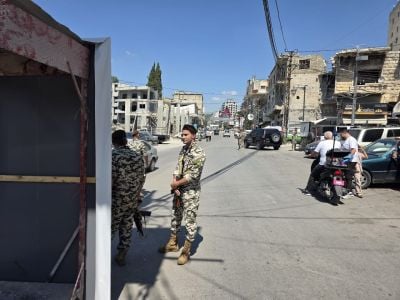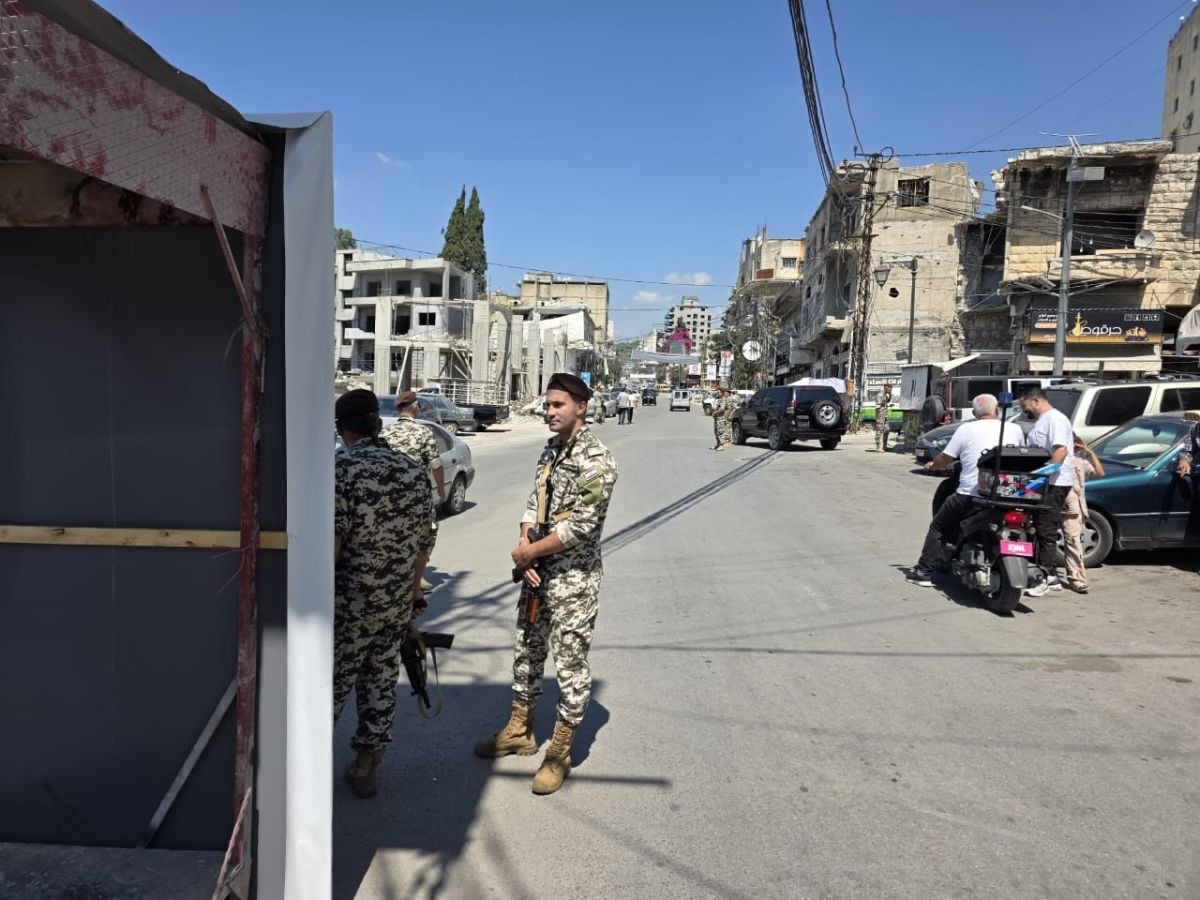
General Security personnel deploy on a road in Nabatieh, southern Lebanon, Sept. 10, 2026. (Credit: Muntasser Abdallah)






BEIRUT — Interior Minister Ahmad Hajjar’s promise to Nabatieh, made after a high-level security meeting at the Presidential Palace in Baabda, is so far being fulfilled. After calling the city’s mayor, Abbas Fakhereddine, and assuring him that the state would not “abandon” Nabatieh, General Security and State Security units deployed onto roads of this largely destroyed southern city.
The move marks a new visible mobilization of security forces following the Lebanese Army’s reinforced deployment earlier this week.
Personnel from both security agencies took up positions on several main roads, according to our southern Lebanon correspondent. However, the agencies still face difficulties returning to their headquarters in Nabatieh because of the continued fears following Israel's latest deadly escalation.
The General Security center is in the University District, an area repeatedly targeted by Israeli strikes and shelling, while the State Security center, in the Grand Serail, was destroyed in a deadly Israeli strike in April that caused numerous casualties among its employees.
Presence of Lebanese Army 'encourages people to stay at home,' says Nabatieh's mayor
Abbas Fakhreddine nevertheless told our correspondent in the region on Thursday that he was pleased with the State Security patrols on the town’s streets. This initiative “complements the measures taken by the Lebanese Army in recent times,” which have “helped to instill a sense of security and tranquillity amongst the population following the latest escalation and the deadly strikes on Kfar Roummane,” he added.
Fakhreddine pointed out that the presence of the armed forces “encourages people to stay at home,” but at the same time questioned whether the patrols are sufficient to prevent Israeli attacks. “I received a call from Prime Minister Nawaf Salam, who assured me that the security forces would remain in place,” the mayor continued.
He said he had asked Salam, as well as Interior Minister Ahmad Hajjar, to strengthen the presence of the armed forces and to revitalize the work of official institutions in the town, so that they would be able to provide the population with basic services.
Earlier, Hajjar had assured residents that the state “would not abandon” the city, which was targeted by deadly bombardment last weekend after Israel captured neighboring Ali Taher hill. He said he planned to strengthen the city’s security presence, calling it a “national responsibility at this stage, in order to ensure the protection of citizens and guarantee the continuity of administrative operations and services.”
“The presence of institutions and services will therefore be reinforced, notably that of the Internal Security Forces [ISF] and those under the Interior Ministry, as soon as restoration work on the government serail is completed,” he promised.
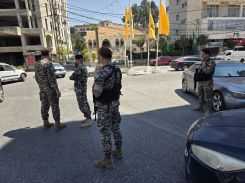
In recent days, Nabatieh’s fate has prompted reactions from residents, activists and political leaders who fear the city could meet the same fate as border towns razed by Israel, such as Bint Jbeil and Khiam. The fears emerged after Israel announced that it had taken “operational control” of neighboring Ali Taher hill, where Hezbollah has tunnels and a base that the Israeli army aims to demolish.
Residents and officials subsequently demanded that the army deploy in the city to disarm the party and remove “any pretext” for an Israeli offensive. The Lebanese Army reinforced its units, whose patrols were warmly welcomed by residents.
The U.S. Embassy interpreted the response as “popular support for the Lebanese state.”
“Every day, the Lebanese people make it clear they prefer Lebanese state institutions over Hezbollah’s weapons. Southern Lebanon does not belong to regional actors or militias,” the embassy wrote on X, referring to Iran’s support for Hezbollah.
“The United States applauds these communities and supports the government of Lebanon in its stated goal to assert sovereignty, enforced by the [Lebanese Army], and ensure that the decisions of war and peace lie exclusively with the Lebanese state,” it added.
For his part, Kataeb Party leader MP Samy Gemayel urged authorities to proceed with disarming Hezbollah, calling on them to “quell the rebellion” of the party, which refuses to disarm north of the Litani River. At a news conference, Gemayel said a “crucial question” had arisen over the concrete implementation of executive decisions to restore the state’s monopoly on arms. He also warned of the risk that Israeli attacks could spread beyond the South.
“The existence of another Ali Taher in the Bekaa, in Beirut, in Metn or in Kesrouan means that everyone is under threat,” he said.
Massive Israeli demolitions in Mansouri, Beni Hayan
Elsewhere in the South, the Israeli army continues to demolish villages in the occupied border area at an accelerated pace, with explosions heard constantly along the frontier. Israel has particularly targeted two villages since Thursday morning: Mansouri (Sour), one of its most frequent targets for weeks, and Beni Hayan (Marjayoun). Dozens of demolition operations have taken place in the two villages since the morning. More than 40 explosions had already shaken Mansouri the previous day.
Mais al-Jabal (Marjayoun) was also targeted. Around 12:30 p.m., the Israeli army carried out a massive demolition that destroyed a waste treatment plant, several houses, and industrial and agricultural sites.
Israeli attacks also continued elsewhere, including a midday airstrike on an area between Zebqine and Shihine. In Kfar Shuba (Hasbaya), an incursion accompanied by heavy machine-gun and artillery fire sparked a blaze. Near Braasheet (Bint Jbeil), a Merkava tank was seen taking up a position on a hill overlooking the village.
The day had been tense since morning. Around 7 a.m., artillery fire targeted Wadi Zebqine (Sour), Zawtar Sharqieh (Nabatieh), Braasheet (Bint Jbeil) and the heights of Halta (Hasbaya). Heavy machine-gun fire also targeted Haddatha (Bint Jbeil) and, again, Halta.
Israel also targeted Nabatieh Fawqa with artillery fire and then with two air strikes, one at around 2.30 p.m. and the other at around 3 p.m. One of the three people injured in Wednesday’s Israeli strike on Zibdin (Nabatieh), identified as Haidar Tabaja, succumbed to his injuries on Thursday. According to an updated toll, Wednesday’s strike killed one person and injured two others.
Reporting contributed by our correspondent in southern Lebanon, Muntasser Abdallah.