






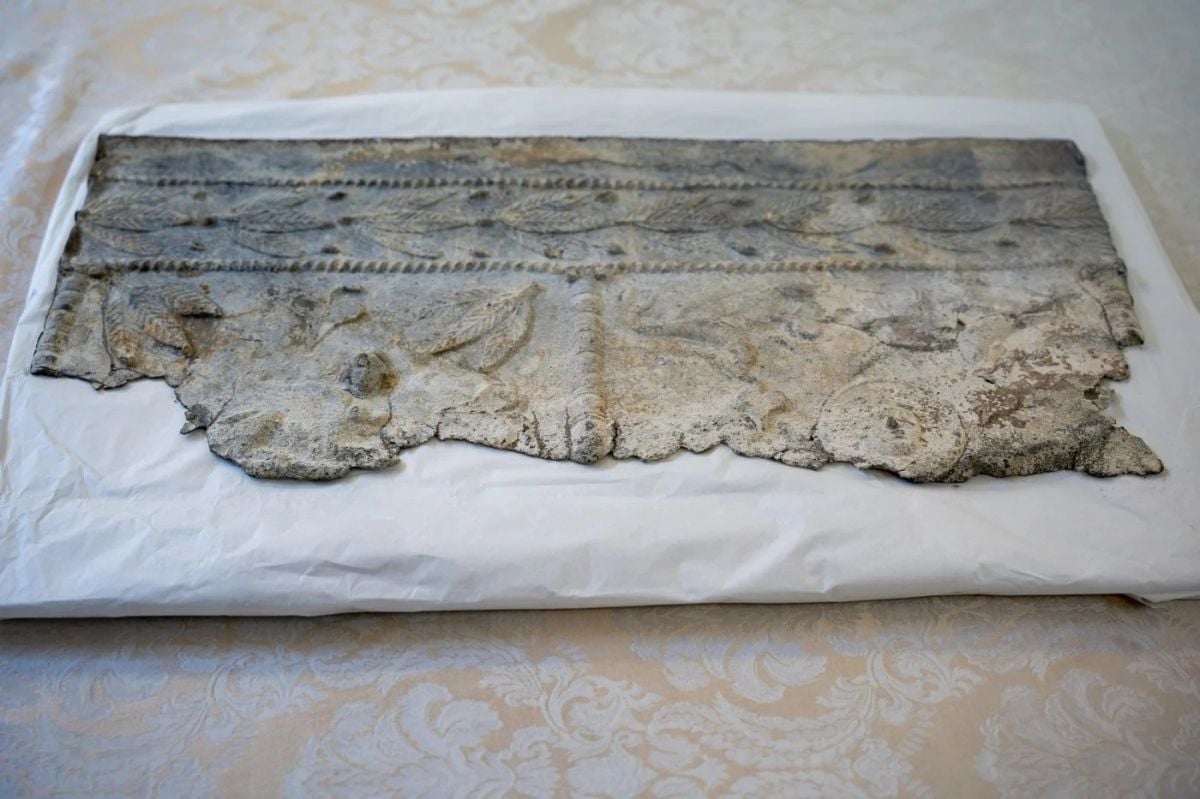
A bronze sarcophagus panel dating from the 2nd or 3rd century AD, part of Lebanese cultural heritage, returned to Lebanon after being recovered by the FBI. (Photo taken by the New York City Police Department and published on the FBI website)






SOUTH LEBANON — Three fragments of lead sarcophagi dating back to the Roman period, which were apparently looted from Sour and illegally exported out of Lebanon, were handed over by the U.S. FBI in Beirut on Wednesday, according to the United States' domestic intelligence and security service.
An official ceremony was held in New York for the occasion, in the presence of Lebanon's consul general in the city, Talal Daher, and the special agent in charge of the FBI's art crime program, Jake Archer. According to the statement released by the security agency, the three artifacts date back approximately to the 2nd and 3rd centuries AD and "have distinctive features typical of workshops in [Sour]," identifying them as belonging to Lebanon's cultural heritage. The FBI specified that they were "stolen during illegal excavations" in the large southern city or its surrounding area and then "illegally exported" out of the country, without providing the date of the alleged looting. The fragments were found in sales catalogs from Arte Primitivo, a New York-based antiquities dealer, and Lebanon said it decided to pursue the matter with U.S. authorities.
‘Finally home!’
According to Culture Minister Ghassan Salameh, "these sarcophagi feature artistic, decorative, and technical characteristics typical of the lead coffin workshops in the city of Sour, which were particularly active in antiquity." The official recalled that the region of Sour, "particularly rich in archaeological heritage," has "recently suffered significant destruction" following relentless Israeli strikes on southern Lebanon. Sour, an ancient Phoenician city, was added to UNESCO's list of World Heritage in Danger in July.
🏛️ Home at last! The U.S. Embassy Beirut celebrates the successful return of Roman-era lead sarcophagus fragments to Lebanon, handed over at a special ceremony on September 2 at the Lebanese Consulate in New York. 🇺🇸 🇱🇧
— U.S. Embassy Beirut (@usembassybeirut) September 3, 2026
This achievement reflects the strong U.S.-Lebanon… pic.twitter.com/h2NNsxsG41
The U.S. Embassy reported on this restitution on X, with the note "Finally home!", although the fragments still need to be repatriated to Lebanon. It added that this process "reflects the strong partnership between the United States and Lebanon in the fight against the illicit trafficking of cultural property."
At the ceremony, Daher welcomed the fact that the return of the panels "affirms that Lebanon's heritage is part of world heritage and that its protection is a responsibility we all share." "Protecting cultural heritage means preserving identity and community history around the world," said James Barnacle, deputy director in charge of the FBI’s New York office.
Lebanon has banned unauthorized excavations as well as the sale and export of antiquities since 1933. In this context, the U.S. and Lebanese governments have long cooperated in combating illicit trafficking in cultural property, with several such restitutions announced over the years, as the trafficking of looted antiquities is widespread in the Near and Middle East.
In December 2017, three ancient works were returned to Lebanon, including a Greek bull's head that had been displayed at the Met and valued at $1.2 million. The following year, Lebanon celebrated the return of a windowed Phoenician axe dating from 2000-1500 BCE, which resurfaced on the antiquities market in Washington, after recovering, a few months earlier, five pieces of antiquity more than 2,400 years old that had disappeared in 1981 from the archaeological warehouses of Jbeil, north of Beirut, discovered at the site of Eshmoun, the Phoenician healing god. Among the five pieces was a white marble bull's head lent by a private collector to the Metropolitan Museum of Art (MET) in New York.

 8 p.m. recap: Israel again threatens Beirut’s south suburbs; 2 ships hit near Hormuz; Riyadh football matches canceled