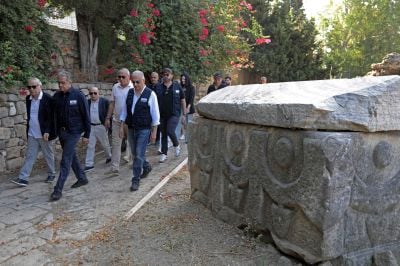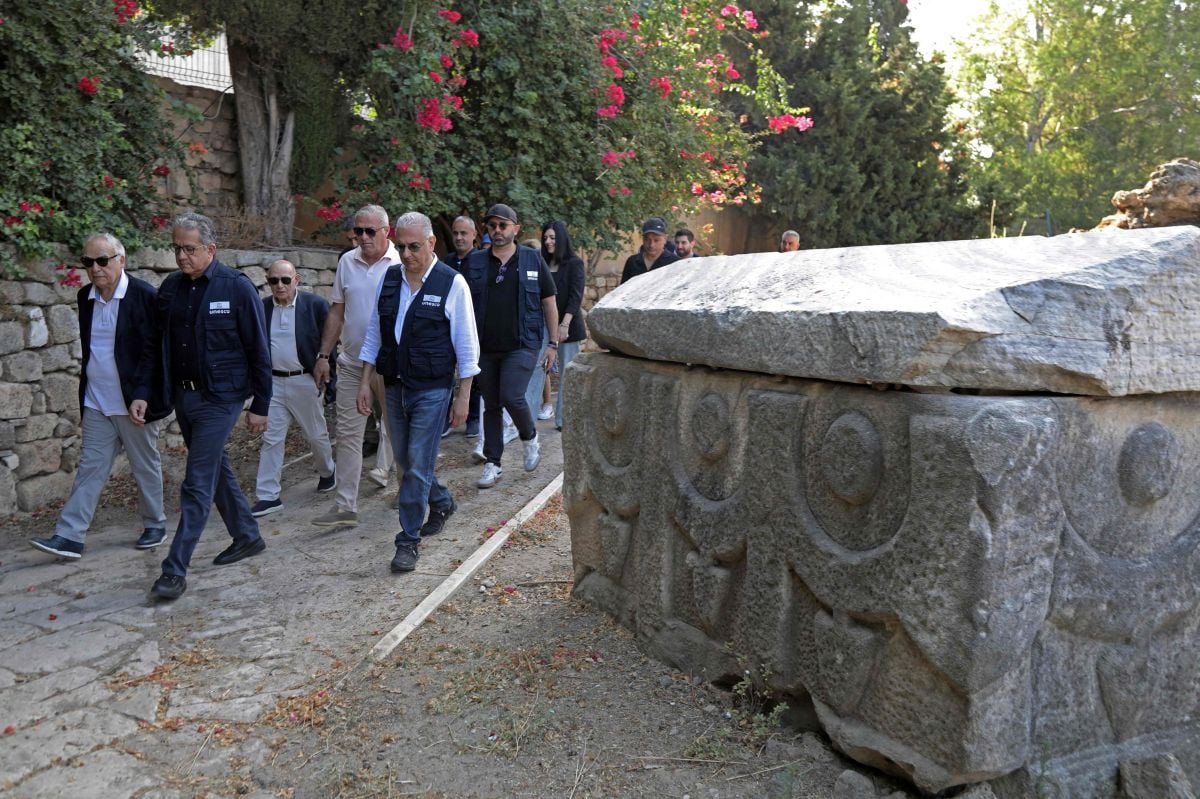
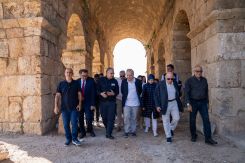
Khaled El-Enany (2L), the Director-General of the United Nations Educational, Scientific and Cultural Organization (UNESCO) along with Lebanon's Culture Minister Ghassan Salam? (L), visits the UNESCO's world heritage site of Al-Bass Archaeological Site in the southern Lebanese coastal city of Tyre on August 20, 2026. (Credit: KAWNAT HAJU/AFP)






For his first official visit to Lebanon since his election, UNESCO Director-General Khaled al-Enany chose to highlight one of the areas in which the United Nations Educational, Scientific and Cultural Organization intends to intensify its efforts: the safeguarding and enhancement of Lebanese heritage.
In a gesture of great symbolic significance, the head of the U.N. agency presented President Joseph Aoun with the certificate officially recognizing the listing of five Crusader fortresses in Jabal Amel* on UNESCO’s World Heritage List and List of World Heritage in Danger — including Shaqif, also known as Beaufort Castle, which is currently under Israeli bombardment.
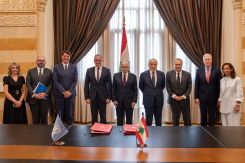
Received by President Aoun, as well as Parliament Speaker Nabih Berri, Prime Minister Nawaf Salam, Culture Minister Ghassan Salameh and several members of the government, the UNESCO director-general also signed a new memorandum of understanding with the relevant Lebanese authorities, establishing a framework for reinforced cooperation until 2029.
“As Lebanon continues to face evolving crises, UNESCO stands in solidarity with its people and recognizes the extraordinary cultural heritage of Lebanon,” Enany stated, reaffirming the organization’s commitment to supporting national priorities in heritage, education and access to reliable information.
Sour, heritage emergency a priority
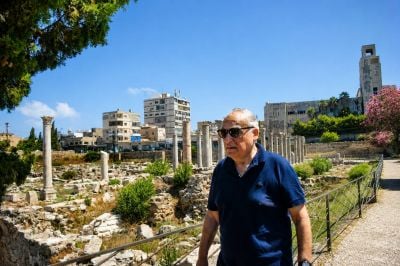
Another highlight of his visit was a trip to Sour, whose archaeological site has just been added to the List of World Heritage in Danger. Enany announced a contribution of $100,000 from the heritage emergency fund. Aimed at meeting the most urgent needs, this funding will allow for damage assessment, reinforcement of weakened structures and protection of archaeological remains and mosaics. It will also support the training of young Lebanese heritage professionals and reconstruction initiatives led by local communities.
This is one way UNESCO is combining emergency action with the transfer of know-how in a country where preserving heritage is directly linked to opportunities for recovery and local development.
The director-general also traveled to the north of the country. In Tripoli, he visited Khan al-Askar, highlighting its potential to host vocational training and skills development programs aimed at employment. He then visited the iconic Rachid Karami International Fair, designed in the 1960s and ’70s by modernist architect Oscar Niemeyer and listed as a UNESCO World Heritage site. The organization intends to continue supporting conservation efforts at this site, including by implementing a conservation management plan, strengthening the expertise of Lebanese professionals and financing — with $76,000 — the restoration of the water tower.
Education and press freedom
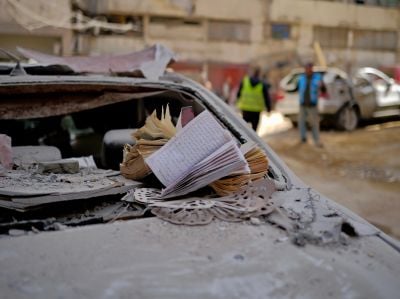
UNESCO’s action in Lebanon, however, is not limited to built heritage. Enany emphasized this during his visit to the Mohammad Chamel Mixed Public Primary School in Beirut, where he met students and teachers involved in the Summer Learning Program, designed to help children affected by conflict and displacement catch up on their education.
The director-general announced a new $1 million grant from the Global Partnership for Education, intended to strengthen national planning and the resilience of the education system. This will bring the organization’s targeted support for the revival of education in Lebanon to $1.8 million.

Another aspect of the visit was UNESCO’s commitment to information integrity and media freedom. The director-general welcomed the launch, on Aug. 13, of the National Campaign Against Hate Speech, led by the Information Ministry with the organization’s support. He also announced a new contribution from the Loops Foundation to the Libraries for Resilience initiative, which has mobilized $650,000 with the help of the MCN Build Foundation and Norway.
From Sour to Tripoli by way of Beirut, Enany’s visit thus outlined a commitment to combine the preservation of heritage, transmission of knowledge and community resilience. Support that the UNESCO director-general wants to make long-term, as Lebanon seeks to safeguard its sites of memory, now more than ever at risk of being erased.
*This refers to Beaufort Castle (Shaqif), located near Yohmor al-Shaqif, in the Nabatieh district; the castles of Toron, in Tibnin (Bint Jbeil), and Doubieh, in Shaqra, in the Bint Jbeil district; the castle of Maron, in Deir Kifa; and the citadel of Shamaa, in the Sour district.
This article was translated from L'Orient-Le Jour.