







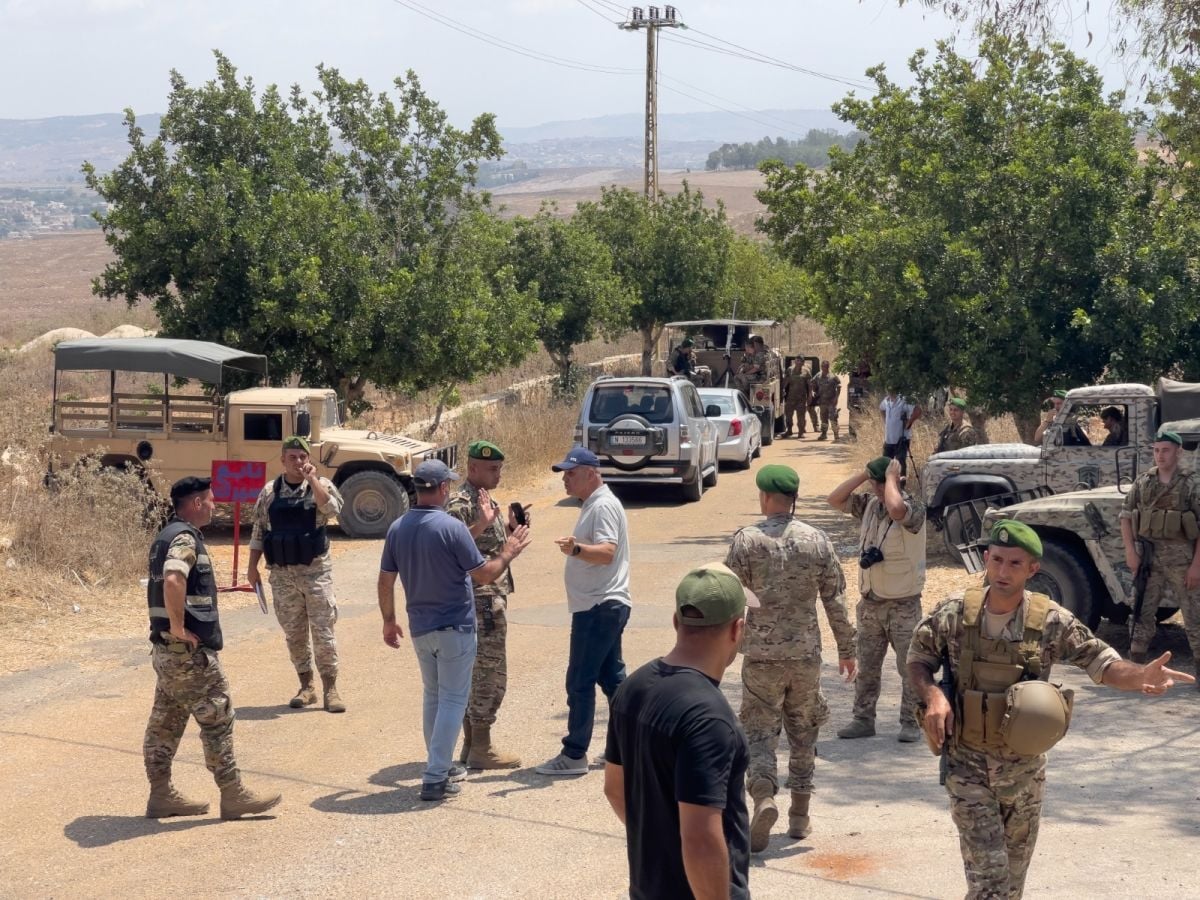
Residents of Zawtar Gharbieh enter the designated "pilot zone" accompanied by the Lebanese Army on July 24, 2026. (Credit: Mohammad Yassine/L'Orient-Le Jour)






SOUTH LEBANON — Lebanese authorities organized the return of residents to Zawtar Gharbieh on Friday afternoon in the Nabatieh district, a town that is part of the second "pilot zone" under the agreement between Beirut and Tel Aviv governing the Israeli withdrawal and the cease-fire.
Residents thus began returning to their village in waves, depending on the neighborhood, our correspondent in southern Lebanon reported. The process was briefly disrupted by a dispute at the village entrance over the access procedures. Residents demanded that everyone be allowed to enter in their own vehicles after security checks, while another proposal called for allowing only one representative per household to enter the village in Lebanese Army vehicles to inspect the homes.

Before the Lebanese deployment in the area north of the Litani River, Israeli forces positioned on the outskirts of the town prevented residents from returning to their homes. Since July 16, they had carried out several incursions into the village and demolished buildings.
Furthermore, Israeli artillery fire struck Markaba (Marjayoun) on Friday, whilst a drone dropped a stun grenade on Mansouri (Sour). Israeli Merkava tanks were also spotted on the road linking Tiri to Haddatha (Bint Jbeil). The Israeli army carried out demolitions and set fire to homes in this village, whilst it was being pounded by artillery fire. It also demolished homes in the Baidar al-Fakaani area, in the town of Taybeh (Marjayoun).
Israeli overnight demolitions
Israel carried out numerous demolitions on the night between Thursday to Friday, according to our local correspondent. Around 10 p.m., Israeli army drones and fighter jets flew over numerous towns in south Lebanon. The occupying forces also set fire to a house near the al-Mabarrat school in Khiam, while an airstrike targeted the Wadi al-Khanazir area, near Qsair and Deir Siryan in the Marjayoun district.
After 11 p.m., a major explosion occurred in Mansouri in the Sour district, accompanied by another that targeted homes in Haddatha, in the Bint Jbeil district. Israeli forces also carried out a violent demolition in Markaba in the Marjayoun district, while artillery fire targeted Kfar Tibnit and Ali al-Taher in the Nabatieh district.
The framework agreement reached on June 26 between Lebanon and Israel, following the first direct negotiations between the two countries in decades, provides for the gradual withdrawal of Israeli forces, conditional on the deployment of the Lebanese Army and the dismantling of Hezbollah infrastructure in designated "pilot zones."
The agreement began to be implemented Monday, with the deployment of army units in two of these zones in the central southern sector — the villages of Srifa and Froun, where the occupying forces were not present — as well as in Zawtar Gharbieh.
Reporting contributed by our correspondent in the South, Muntasser Abdallah
