






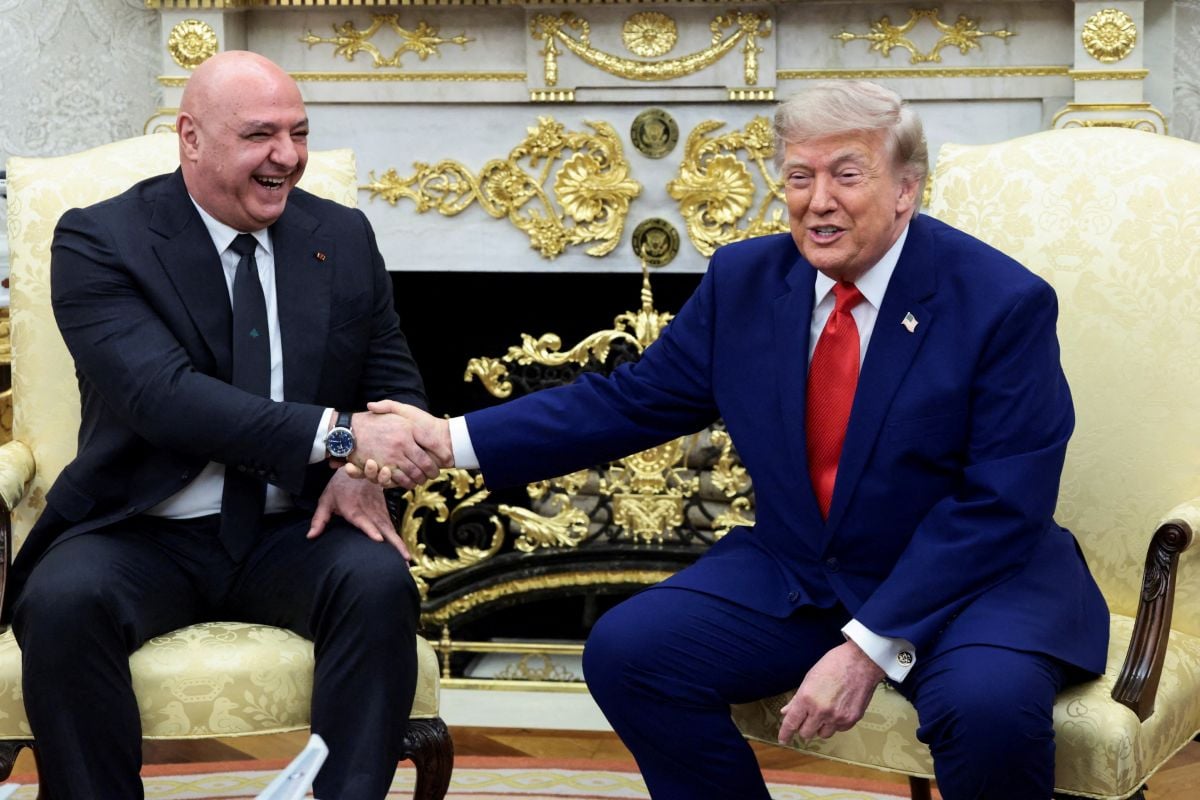
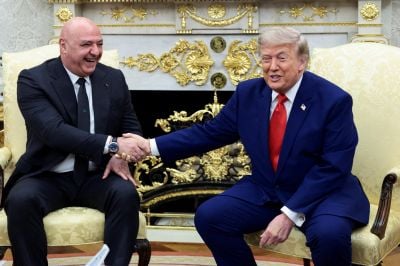
U.S. President Donald Trump shakes hands with Lebanese President Joseph Aoun during their meeting in the Oval Office of the White House in Washington,the U.S., on July 21, 2026. (Credit: Evelyn Hockstein/Reuters)






U.S. President Donald Trump welcomed his Lebanese counterpart Joseph Aoun at the White House on Tuesday. Arriving at 11 a.m. (6 p.m. Beirut time), Aoun was greeted by Trump on the steps of the presidential residence. Before their closed-door meeting, the two leaders spoke to the press and answered questions from journalists, an opportunity Trump took to assert his support for Lebanon.
The meeting came as the Lebanese Army has begun a test deployment in several pilot areas of southern Lebanon, in sectors where the Israeli army had so far only occupied surrounding areas. This first meeting between the two presidents also comes as Washington is putting strong pressure on Beirut to secure the disarmament of Hezbollah, a condition set by Israel for its withdrawal from southern Lebanon. After Aoun declared, "It is an honor to meet a great president like you," the U.S. president replied: "You see, he knows how to flatter me." This joke, made at the onset of the meeting, set the tone for the rest of it.
In front of journalists, Trump emphasized that "relations with Lebanon are very good," as are those with Aoun, asserting that "the Lebanese people are very talented."
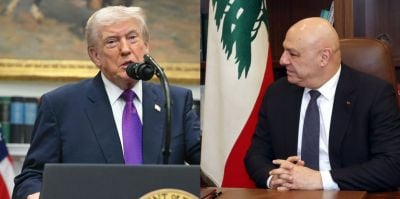
Trump mused that Lebanon had been mistreated for a long time and deserved greater respect. "Again, it's been a very badly treated place and country, and we're going to have it properly treated with the respect that it deserves," he said. "It's an honor to have the president and your representatives here, and we are going to solve a lot of problems. We have already solved some for Lebanon," he added.
Arriving in Washington over the weekend, Aoun had already met on Sunday with Secretary of State Marco Rubio. The latter had stated that "as long as the Hezbollah problem persists, Lebanon will never know true peace." He praised "the courage of the Lebanese government" and "its determined efforts to restore sovereignty, disarm Hezbollah, and dismantle its terrorist infrastructure." Echoing his secretary of state, Donald Trump also mentioned "the Hezbollah problem." "But we have done some things that I think the world will take note of," he said.
When asked about Parliament Speaker Nabih Berri’s rejection of the framework agreement with Israel, President Aoun pointed out that the Speaker is "a statesman." “He supports what we are doing, and he supports ending the state of hostility once and for all,” he added, whilst noting, however, that the framework agreement did not require parliamentary approval. Trump added that, "It's a process, but we are making real headway. When Berri sees the progress made, I’m sure he’ll be on board. Everyone wants to see this resolved."
Sharaa 'would be very effective' against Hezbollah
Asked about the timetable for Israel's withdrawal from Lebanese territories, Trump indicated that Israeli forces were already in the process of redeploying. "They're in the process of redeploying to other sections, and again, they get along very well. That was a great agreement they signed with Lebanon, and they're redeploying," he said.
He also said that the United States has "very concrete plans" to support the Lebanese Army, a topic that was to be discussed with Joseph Aoun.
For his part, the Lebanese president insisted on the central role of the Lebanese Army. When asked whether the "Lebanese Army currently has the funding, equipment, and manpower necessary to implement the framework agreement" or whether he is asking President Trump today for "additional U.S. assistance," Aoun replied: "Definitely with the support of Mr. Trump... I need two things from you, political support and support for [the Lebanese Army]... the most trusted institution in the country and it has the most powerful weapon which is the trust of the public. Like any armed forces in the world, the Lebanese Armed Forces [LAF] is the backbone of security and stability... without the LAF everything will collapse."
When asked by a journalist about a possible intervention by the Syrian army in Lebanon against Hezbollah, President Donald Trump replied: "Well, it's a concept. We get along very well with the president of Syria. He's done a very good job. I wouldn't be surprised if this gentleman [Aoun]'s gonna do a job just like that.... he's been fighting Hezbollah for a long time. I think it'd be very effective.”
Trump also said that he would speak to Hezbollah if Aoun asked him to. "I would speak to Hezbollah. I speak to everybody. I'll speak to people that a lot of people think I shouldn't be speaking to, and things work out," said Trump. "I would say this: if the president wanted me to speak to Hezbollah, you know he's lived with Hezbollah for a long time, and if the president wanted me to speak to Hezbollah, I would.”
The visit by Aoun is the first by a Lebanese president to Washington since 2009. A former commander-in-chief of the army, he was elected in January 2025 with Western backing, marking a turning point in Lebanese politics. Since coming to power, he has pledged to disarm Hezbollah.
Israel has killed more than 4,300 people since the war on Lebanon re-escalated on March 2, with the Israeli army launching a ground offensive and occupying significant parts of southern Lebanon.
The scaled of attacks decreased significantly following the signing of the U.S.-Iran memorandum of understanding on June 17, when Tehran demanded that Israeli hostilities in Lebanon cease as part of the agreement.
Meanwhile, Lebanon and Israel are continuing their direct talks that began in April in an attempt to separate the Lebanon file from the broader regional war, which has re-escalated in recent weeks.

 8 p.m. recap: Israel again threatens Beirut’s south suburbs; 2 ships hit near Hormuz; Riyadh football matches canceled
Lebanon should offer to let him build a Trump plaza and golf course on the beach at Ramlet El Baida
22 July 2026 02:49