



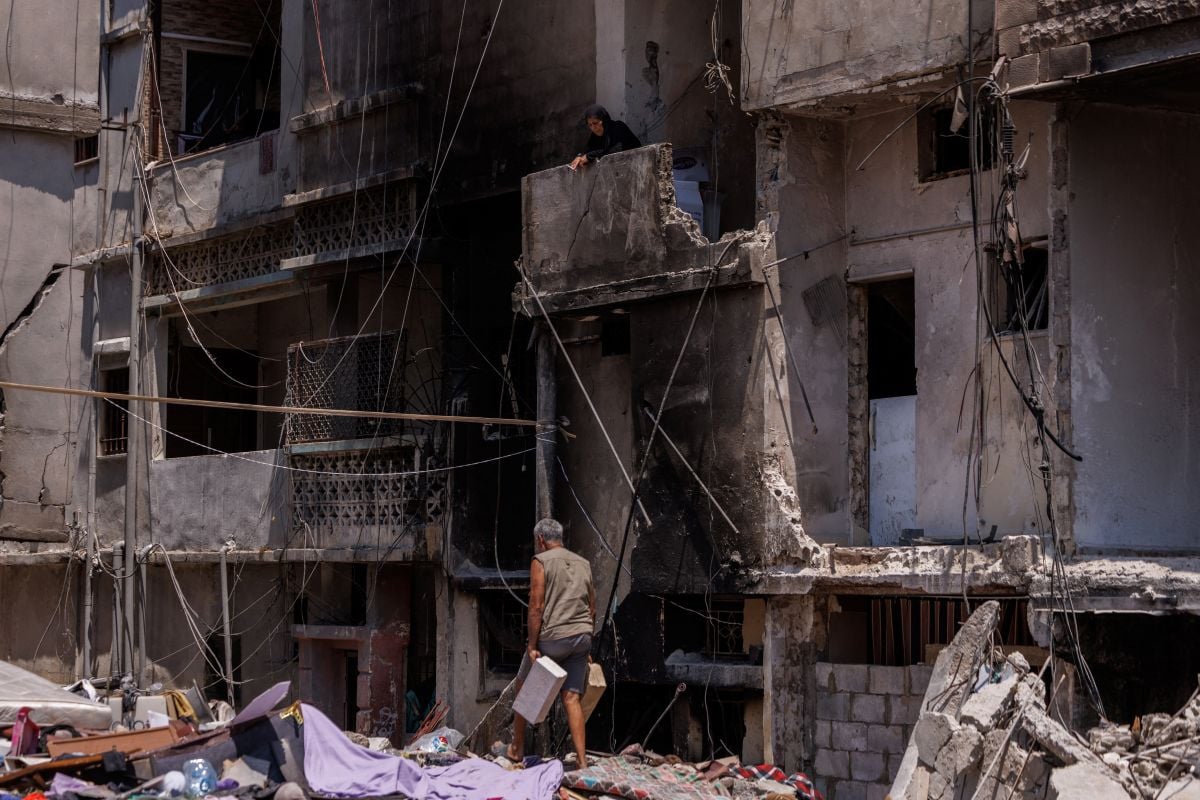
A woman smokes a cigarette as she stands on the balcony of a building damaged in an Israeli airstrike, while Hassan Hejazieh carries bricks as he walks amid the rubble, attempting to rebuild his home after returning home following displacement during the war, following the Israel-Lebanon deal, in Tyre, southern Lebanon, July 5, 2026. (Credit: Zohra Bensemra/Reuters)






BEIRUT — As a new round of talks between Lebanon and Israel began in Rome, Parliament Speaker Nabih Berri — who has made no secret of his staunch opposition to these negotiations and to the framework agreement that resulted from them on June 26 — once again criticized this "trapped" text.
If implemented and if the withdrawal is carried out gradually starting from "pilot zones," where the Lebanese army would deploy to disarm Hezbollah alongside the Israeli withdrawal, this withdrawal "will take two years," he lamented Tuesday.
These renewed criticisms come as the presidential palace in Baabda announced Monday night that "the Lebanese delegation has been instructed to demand the immediate start of Israeli forces' withdrawal from two pilot zones before any further discussions." The two initial zones are located in the caza of Bint Jbeil, in the central sector near the towns of Ghandourieh and Froun, and Zawtar, north of the Litani river in the caza of Nabatieh.
According to a Lebanese diplomatic source familiar with the content of the negotiations, cited by AFP, "the Lebanese Army is ready to gradually take control of the localities from which the Israeli army would withdraw." An American military delegation began discussions Saturday in Beirut with the Lebanese Army on the modalities for implementing the Israeli withdrawal from one of these "pilot zones."
Israeli withdrawal by caza
The direct negotiations that led to the framework agreement "have not produced any really positive results for Lebanon," according to the legislative chief, who nonetheless said he would be happy "if they manage to achieve a withdrawal, the return of displaced Southerners to their villages, the liberation of Lebanese prisoners in Israel, and reconstruction."
In a statement to the daily al-Joumhouria, citing the main objectives of the negotiations for the Lebanese state, he said, "ultimately, what matters to me is to eat the grapes, not to kill the vineyard keeper." While still opposing the ongoing diplomatic process and the first direct talks between Beirut and Tel Aviv in decades, Berri is careful not to further strain his relations with President Joseph Aoun and Prime Minister Nawaf Salam and strives to avoid any internal dissension.

Berri reiterated his rejection of the proposal for withdrawal via pilot zones, emphasizing his opposition to the "very principle" of this strategy and recalling that he had proposed obtaining a withdrawal based on the cazas (regional administrative divisions) in the south. He criticized the time that withdrawal based on pilot zones could take, "up to two years" by his account, and the fact that the zones under consideration "aren't even occupied." At the Zawtar level, the Israeli army has established, below the region and by the river, a crossing over the Litani and occupies Zawtar Sharqieh (the eastern part). Earlier today, it carried out a demolition at Zawtar Gharbieh, the western part, suggesting it has the means to advance even if not occupying the locality. In the central sector, the occupying forces had advanced from the east to the outskirts of Ghandourieh, but did not reach Froun, which is a few kilometers to the north.
The 'trap' of the framework agreement
"The aim" of the agreement's provisions is "to drag the army into internal clashes and provoke discord that would only serve the Israeli enemy, which seeks to lure us into this trap," denounced Berri. Regarding the meeting in Rome, the legislative chief believed that it would only be "a repetition of a laborious process, without any real progress."
The delegations began their talks around 11:30 a.m. at the U.S. embassy in the Italian capital. Army commander General Rodolp Haykal is following the proceedings from the Baabda presidential palace. "The Lebanese delegation has been instructed to demand the immediate start of Israeli forces' withdrawal from two pilot zones before any further discussion," the Lebanese presidency announced last night.
These talks are taking place as hostilities have resumed in the region between Washington and Tehran. The two countries, still at war, had reached a framework agreement for a "durable peace" after five cycles of negotiations in Washington. Like Berri, Hezbollah, armed and funded by Iran, rejects this agreement. Tehran had demanded a cease-fire in Lebanon as a condition to sign a protocol agreement with Washington on June 17. But that text seemed to fall apart after unprecedented U.S. and Iranian strikes in the Middle East since the start of a cease-fire in early April. On Monday night into Tuesday, the United States launched strikes against Iran for the third straight night ahead of the anticipated reinstatement Tuesday of the naval blockade of Iranian ports.
The framework agreement was signed after a fragile cease-fire took effect in the new war that broke out between Hezbollah and the Israeli army. Hezbollah drew Lebanon into this war on March 2 by bombing Israel to support Iran. The Israeli army, however, continues to conduct strikes in the south and destroys villages it occupies in its "buffer zone" of nearly 620 square kilometers.
Since this conflict began, Israeli strikes have killed more than 4,300 people, according to Lebanese authorities. Over the same period, the Israeli army has reported the deaths of 38 soldiers and one civilian contractor in Lebanon.