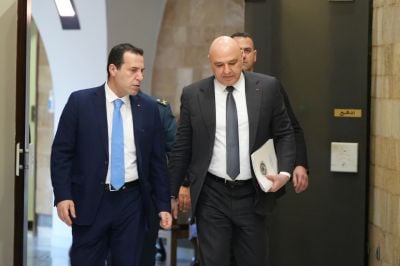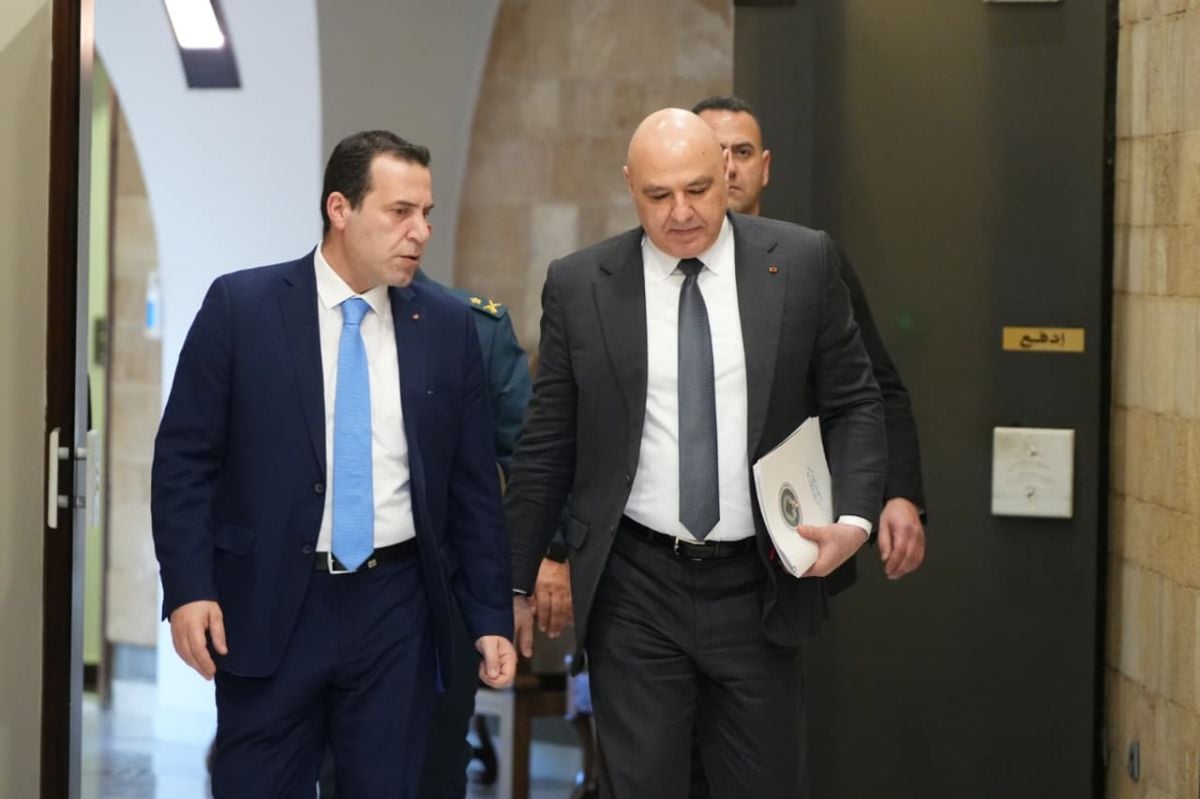
President Joseph Aoun at the exit of a Cabinet meeting at the Baabda Presidential Palace, on Feb. 16, 2026. (Credit: Mohammad Yassine/L'Orient-Le Jour)






BEIRUT — On the eve of scheduled talks between Lebanese and Israeli officials in Rome, President Joseph Aoun is continuing to place his hopes on his upcoming meeting with U.S. President Donald Trump to shift the balance of negotiations.
On Monday, Aoun said he would personally ask Trump to pressure Israel to fully withdraw its forces from Lebanon, a concession Israel has so far refused to make. Instead, Tel Aviv is demanding Hezbollah's disarmament and insists that the first "pilot zones" where the Lebanese Army is expected to deploy under the framework agreement be located in areas where Israeli forces are not present. In response, the Lebanese president said Israeli Prime Minister Benjamin Netanyahu "must understand that war will not bring him security."
Speaking before a delegation from the board of directors of the Amilieh Association, Aoun said that "the objectives on which all Lebanese agree are withdrawal [by Israel], the return of the displaced, the repatriation of prisoners and remains, as well as reconstruction," adding that "now it is necessary to try this path after the failure of the military option."
"As the president of all Lebanese, I reaffirm that I will not give up the South nor the rights of Lebanon. That is why we insist on Israel’s withdrawal from all Lebanese territory and on Israel signing a commitment confirming it has no designs on Lebanon," he said.
Aoun is scheduled to travel to Washington at the end of July to meet Trump, marking their first in-person meeting after multiple phone conversations.
"I will ask American President Donald Trump to exert the necessary pressure on Israel so it implements what was agreed to in the 'framework formula' as well as the Lebanese demands, while taking advantage of the current willingness of the American administration to achieve peace in the region and to strengthen Lebanon's position in this context," he said.
Aoun reiterated that "the army and the state are the only ones capable of protecting the Lebanese," as opposed to political parties and sectarianism, "as we have seen from 1975 until today," he stressed. He added, "The disappeared Imam Moussa Sadr was the first to oppose the South being used for causes that are not Lebanese," stressing that "the inhabitants of the South are exhausted and deserve to live in security and stability, rather than seeing their property and lands regularly destroyed and their sons martyred. Why should Lebanon and the South always pay the price?"
Following these remarks, Aoun met with Prime Minister Nawaf Salam. According to a statement piblished by the Lebanese presidency on X, the two discussed the president's upcoming meeting with Trump. Salam also briefed Aoun on "the substance of the talks" he held during his visit to Turkey on Friday.
More broadly, the two leaders discussed the upcoming round of talks with Tel Aviv in Rome, particularly the instructions given to the Lebanese delegation, including the "need to demand the immediate withdrawal of Israeli forces from the two pilot zones [already identified] before any further discussions." They also reviewed the situation in south Lebanon "in light of the continued Israeli attacks."
Parliamentary petition calls for UNIFIL mandate to be maintained
Meanwhile, as the Israeli government continues to insist that the hundreds of thousands of displaced residents of south Lebanon will not be allowed to return to their homes, 86 lawmakers from across the political spectrum — more than two-thirds of Parliament — signed a letter Monday to members of the U.N. Security Council calling for the renewal and strengthening of the mandate of the United Nations Interim Force in Lebanon (UNIFIL), which is due to expire at the end of the year.
Presented by MP Melhem Khalaf, the letter recalls that the force was established in 1978 under U.N. Security Council Resolutions 425 and 426 with three objectives: securing Israel's withdrawal, restoring peace and reestablishing the authority of the Lebanese state. These goals, the letter argues, have still not been fully achieved despite the later expansion of UNIFIL's mandate under Resolution 1701 (2006).
The signatories argue that the "continued aggression" justifies maintaining, and even expanding, UNIFIL's mandate rather than ending its mission.
"We do not claim that UNIFIL's presence has brought about complete peace or prevented every act of aggression or violation," the letter states. "But shortcomings in implementing the mission are not addressed by abolishing it; existing dangers are not countered by withdrawing international protection; and responsibility does not disappear simply because it has endured for a long time."
While a last-minute renewal of UNIFIL's mandate remains possible, Western powers are also working behind the scenes to establish a new multinational force in south Lebanon. Against this backdrop, Lebanese Army commander Rodolph Haykal met on Monday with the ambassadors of Australia, Canada, Belgium, and the Netherlands.