


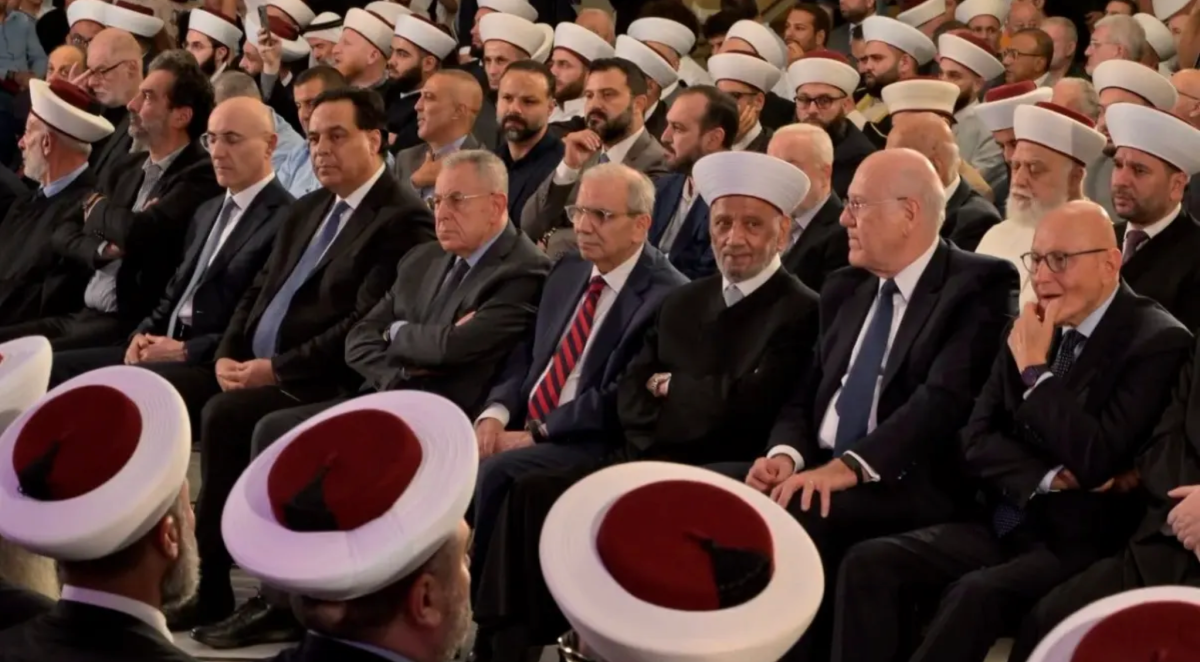
Lebanon's Grand Mufti Sheikh Abdellatif Derian with the current and previous Lebanese Prime Ministers. (Photo: NNA)






BEIRUT — Lebanon's Grand Mufti Sheikh Abdellatif Derian on Monday called for "the courage of hope and the courage of peace," saying that "peace is often more difficult than war" in a speech delivered to mark the commemoration of the birth of the Prophet Mohammad at the Mohammad al-Amine Mosque in Beirut.
"We must have the courage of hope and the courage of peace. Those among you with experience know that peace is often more difficult than war," the mufti said. "The decision to accept a truce to end aggression and massive destruction is a courageous decision," he asserted, saying that "the decision to make war may not currently be suitable for a free and dignified life nor for a promising future." "In the midst of great suffering, the Lebanese authorities' efforts to end Israeli aggression and massive destruction is a courageous and wise effort," he added, noting that wars have "destroyed what cannot be recovered nor forgotten."
The mufti praised the efforts of Lebanese authorities to lead the country out of "the state of paralysis that has governed the country and its people for years and years." "We have before us and among us a new era, one in which the president and his government have decided to make a change," he said. In this context, Derian called for unity, stating that "cooperation and coordination among the three presidencies guarantees the unity of Lebanon and the unity of its people." "None of us wishes for or accepts an atmosphere of national division," he stressed, as debates over "the prestige of the state and its prerogatives in times of peace as in times of war" directly concern, in his opinion, "Lebanon's existence and its future."
Upon his arrival at the ceremony, Prime Minister Nawaf Salam also stressed the values of peace and unity. "Through the life of the Prophet Mohammad, we recall justice, mercy and tolerance, rejection of division and sectarianism, as well as the primacy of peace and bringing people together for good," he said. He expressed hope that the coming days would bring Lebanon "security and stability," that "our compatriots may return to their land and homes," and that all Lebanese can gather "under the roof of one state, strong and just, which preserves the dignity of its people and protects them."
Israel has killed more than 4,300 people in Lebanon since it re-escalated its war on Lebanon on March 2. At the end of June, a few days after a nominal "cease-fire" took effect, Lebanon and Israel reached a U.S.-brokered framework agreement calling for the disarmament of Hezbollah, the gradual withdrawal of Israeli forces from southern Lebanon, and the deployment of the Lebanese Army in the region.
Hezbollah opposes these negotiations between Israel and Lebanon, the eighth round of which is scheduled to take place in Rome in early September. Since June, Israel has nonetheless continued its strikes on Lebanon, violating the "cease-fire" in place as it typically does.

 7 p.m. recap: 1 person killed near border with Lebanon; 200 kilos of explosives carried by mules; Riyadh shuts its airspace