


Iranian women in front of a jeweler's shop in the Grand Bazaar of Tehran, Aug.24, 2026. (Credit: AFP)






Iran on Monday dismissed the U.S. threat of an “economic D-Day” aimed at suffocating the country, calling it an “admission of defeat” by Washington, which is set to detail the campaign later in the day, nearly six months after the start of the Middle East war.
U.S. Treasury Secretary Scott Bessent announced in an op-ed published in the Financial Times on Monday an “economic D-Day” — a reference to the 1944 Allied landings in France — aimed at cutting Iran’s remaining “lifelines.” He also claimed on X that the United States had “dismantled Iran’s military capabilities, destroyed nearly 100% of its military factories, and ended its nuclear program.”
“Your rhetoric doesn’t hold up,” retorted Kazem Gharibabadi, Iran’s deputy foreign minister, questioning why, if Washington had achieved those goals, it would need to launch “the biggest financial invasion in history” and mobilize “all U.S. institutions and powers.”
“Is this a victory or an admission of defeat by the United States?” he asked mockingly.
Bessent is expected to detail the measures contemplated by the United States later Monday, as diplomatic efforts to resolve the regional conflict — sparked on Feb. 28 by an Israeli-American offensive against Tehran — remain stalled.

Washington has warned that “any country maintaining ties with Tehran will be pushing its own economy into oblivion.” Iran, in turn, has threatened reprisals against any country joining the U.S. sanctions, which it describes as “economic terrorism.”
China, Iran’s strategic economic partner, has said that U.S. “sanctions and pressure” will not resolve the conflict. The United Arab Emirates, meanwhile, announced Tuesday that it would suspend “all trade exchanges and financial transactions” with Iran “until further notice.”
'Really very difficult situation'
At the heart of the conflict is the strategic Strait of Hormuz, through which a fifth of the world’s hydrocarbons once passed. Tehran has kept the waterway almost continuously closed for six months, pushing oil prices higher and increasing pressure on U.S. President Donald Trump ahead of the November midterm elections.
Iran has ruled out a return to the prewar status quo in the strait and has been negotiating the terms of passage with Oman, the other country bordering the waterway. Omani Foreign Minister Badr al-Busaidi is expected in Tehran on Tuesday.
Pakistan’s powerful army chief, Field Marshal Asim Munir, whose country is mediating in the conflict, is also due to hold talks with Iranian officials in Tehran on Monday.
Despite Tehran’s show of defiance, Iranian President Masoud Pezeshkian has acknowledged that the country is facing “many economic hardships” after decades of U.S. and international sanctions.
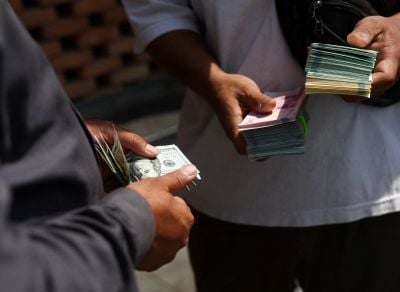
According to two free-market tracking websites cited by Reuters, the Iranian rial has plunged to a record low, falling below 2 million rials to the dollar.
“Iran should make compromises now,” Sarah Hassanbeigi, a pharmacist interviewed by AFP in Tehran, said. “The situation is really very difficult. I don’t think people can bear this much longer.”
As of July 22, inflation had reached 66% year-on-year, compared with 46% in February, while the national currency continues to plummet. Last week, a dollar traded for 1.88 million rials, compared with 1.65 million immediately before the conflict.
According to maritime tracking firm Kpler, the U.S. blockade already imposed on Iranian ports has caused Iran’s oil exports to fall from 2 million barrels per day before the war to just 400,000 barrels per day by mid-August, their lowest level since the start of the conflict.
“We must increase our power ... The greater this power, the lower the risk of war and attack,” said Bagheri, 65, in the Iranian capital, declining to give his surname.
Oil tanker on fire
Meanwhile, Yemen’s Houthi rebels, allies of Tehran, have increased pressure on the oil market by stepping up attacks on vessels in the Red Sea and on Saudi oil facilities, in the world’s largest crude-exporting country.
On Monday, a tanker caught fire off the Saudi port of Yanbu after being hit by a “projectile,” according to the British maritime agency UKMTO. Security firm Vanguard Tech reported that the vessel had been hit by a missile and was sailing under the Saudi flag.
 Israeli army carries out demolition at Jabal Amel School in Houla as strikes continue