



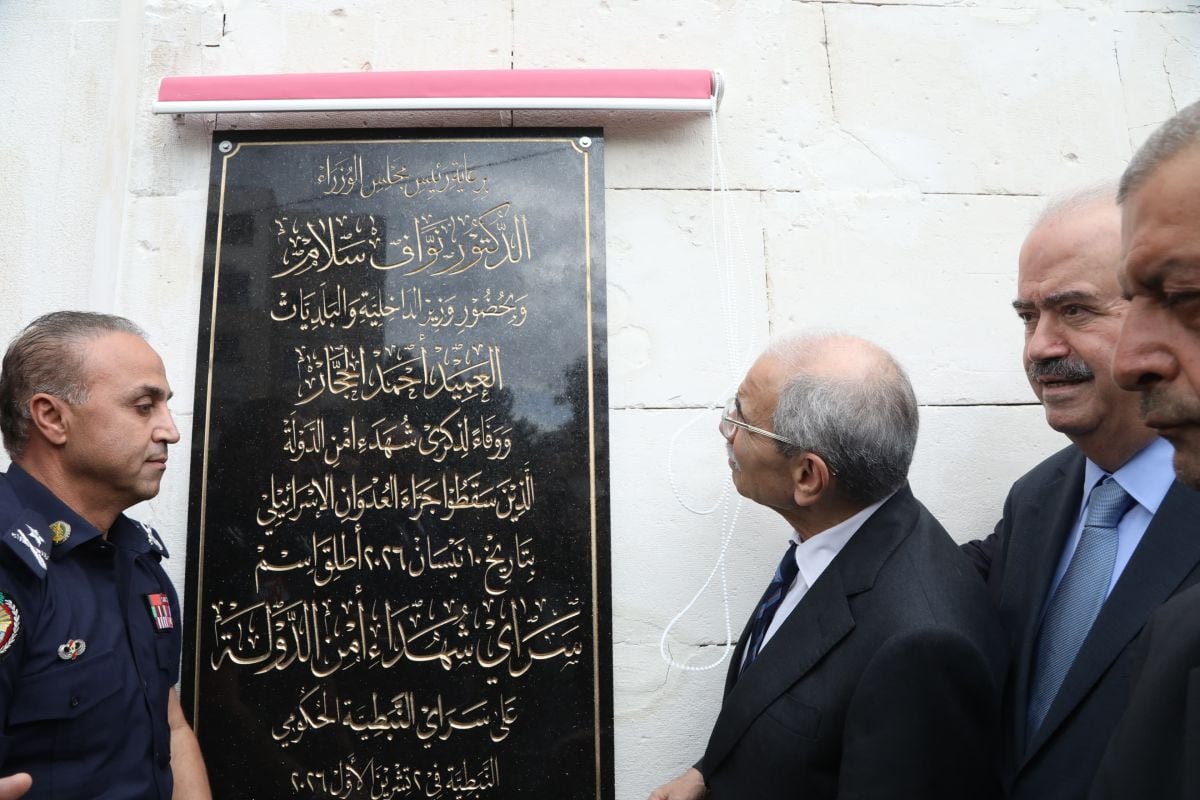
Prime Minister Nawaf Salam stands outside the Nabatieh Serail in southern Lebanon during a visit to the city, Oct. 2, 2026. (Credit: @grandserial/X)






Top story
Lebanese Prime Minister Nawaf Salam toured the Nabatieh region of southern Lebanon on Friday, just a few kilometers from the occupied "buffer zone," in an area still subjected to daily Israeli strikes and destruction. On his third visit to Nabatieh since taking office in February 2025, Salam announced several projects to rehabilitate infrastructure destroyed by Israeli bombs during the war, while acknowledging that the state cannot shoulder the enormous reconstruction effort, estimated at nearly $27 billion, alone.
"I am here today to reaffirm the return of state institutions to normal operations, and that security in the South is the essential condition for the return of residents," Salam said before laying the foundation stone for a new Civil Defense headquarters to replace the one destroyed by an Israeli airstrike in May 2026, visiting gendarmerie units in Kfar al-Joz and meeting the city’s imam.
Meanwhile, residents of neighboring Nabatieh Fawqa took advantage of the relative calm to inspect their village, which remains under Israeli fire control.
Why it matters
After two weeks of back-to-back diplomatic meetings in the United States on the sidelines of the United Nations General Assembly, aimed at mobilizing international support for strengthening the army and rebuilding the country, Salam visited southern Lebanon on Friday with Finance Minister Yassin Jaber and Interior Minister Ahmad Hajjar.
He also spoke with residents who approached him in the streets of Nabatieh. Saying he did not want to "sell illusions," he assured them that he had raised their "needs and concerns" with Lebanon's international partners during his stay in New York and Washington.
The tour also reflects the authorities’ desire to demonstrate their commitment to southern Lebanon, observers noted, as they face the task of disarming Hezbollah and fears of renewed Israeli escalation persist.
Since Israel seized and demolished Hezbollah infrastructure beneath Ali Taher hill, which overlooks the Nabatieh region, authorities have taken several steps to strengthen the state’s presence in the city, including security and military deployments and plans to reopen the local courthouse.
What to watch
Tensions continue to simmer in the Middle East. A tanker came under fire Friday morning while crossing the Strait of Hormuz, the British maritime security agency UKMTO reported, after a month of calm in the Gulf. The United States has not struck Iran since Sept. 1.
Meanwhile, Washington is preparing to significantly expand its military presence around Iran. Following the deployment of a third aircraft carrier, the USS Theodore Roosevelt, to the Middle East, the U.S. military has begun sending up to 10,000 additional troops, including several Marine units aboard the USS Makin Island Amphibious Ready Group, according to The Wall Street Journal.
This would bring the number of U.S. troops in the region to nearly 60,000, the newspaper reported. The troops and vessels are expected to arrive by late November, aligning with President Donald Trump’s threats to resume airstrikes after the U.S. midterm elections.
According to Pentagon sources cited by the Journal, the massive buildup is intended to give Trump a wider range of options "on the table" in dealing with Iran, regardless of the outcome of talks with Tehran.
Elsewhere in the news
- Southern Lebanon was the focus of President Joseph Aoun’s meeting with a delegation from Deir Mimas, a Christian village that remains inhabited despite being in the zone occupied by Israel. Aoun praised residents' "attachment" to their land, calling it "an act of faith in Lebanon and a noble national message." "The continued presence of residents in border villages is the first line of defense for sovereignty," he stressed, adding that the state "will protect you and will not give up a single inch of your territory."
- Saudi Arabia accused the Houthis of attacking the holy city of Medina following Saudi strikes on Yemen’s capital, Sanaa. The drone attack near the mosque containing the Prophet Muhammad’s tomb sparked outrage across the Muslim world and the region. Lebanon’s Foreign Ministry "condemned the Houthi militia’s drone attack on a power station in Medina."
- Israeli airline El Al announced the cancellation of flights scheduled for Friday to repatriate Israelis stranded in Dubai. The move followed Emirati carrier Flydubai’s suspension of flights after one of its planes was diverted en route to Tel Aviv.
- Sami Abu Shehadeh, the leader of an Israeli Arab party, was forced to withdraw his candidacy for Israel’s parliamentary elections, scheduled for Oct. 27, following pressure from Israel’s Supreme Court.


 Exchange of strikes between Saudi Arabia, Houthis; Sanaa, Medina targeted