An Israeli soldier works on a tank on the Israeli side of the Israel-Lebanon border, after Israel and Lebanon signed a framework agreement following U.S.-mediated talks, on June 28, 2026. (Credit: Avi Ohayon/Reuters)






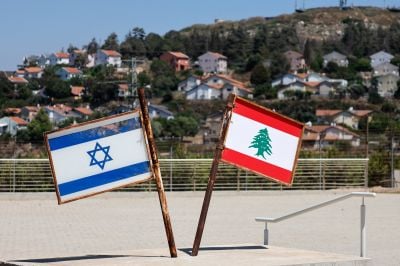
SOUTH LEBANON — A precarious calm prevailed in southern Lebanon on Sunday on the security front, but tensions remained high, two days after the signing of the framework agreement between Israel and Lebanon under U.S. auspices, a text that has strengthened the opposition of the Hezbollah-Amal duo to the direct talks that led to its signing.
The Israeli army announced the death of one of its soldiers, "killed in combat in southern Lebanon" on Sunday, near Deir Siryan (Marjayoun), during a confrontation with "a Hezbollah fighter," according to Israeli media. Another soldier was lightly wounded in the same incident, the army said.
This brings Israel's military losses to 38 soldiers and one civilian contractor since the re-escalation of Israel's war on Lebanon on March 2. In that same time frame, Israel has killed 4,247 people in Lebanon and injured 12,195 others, according to the Health Ministry.
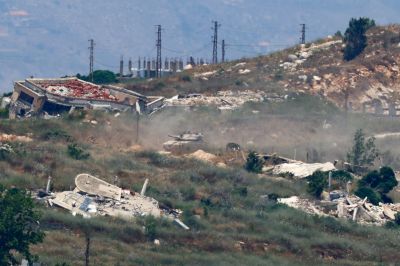
The Israeli army provided no further details on the circumstances of this confrontation. According to our correspondent in southern Lebanon, a loud explosion shook the area between Deir Siryan and Taybeh (Marjayoun) during the night from Saturday to Sunday. It was initially mistaken for an airstrike, before it turned out to be the demolition of a gas station.
Israeli war planes and drones also flew over several regions of the country, including the Western Bekaa, our local correspondent reported.
Israel carried out explosions and demolition operations notably in Khiam (Marjayoun), where homes were seen in flames, and Haddatha (Bint Jbeil).
Meanwhile, Israel fired at the outskirts of Shebaa (Hasbaya), with two white phosphorus shells. At dawn, Israeli forces also built up an earth embankment near a nature reserve located southeast of the town.
During the day, an Israeli drone fired two stun grenades into the yard of a house on the outskirts of Braasheet (Bint Jbeil), while a family was inspecting their home in the area.
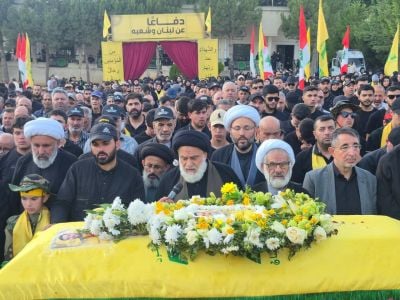
For its part, Hezbollah made no statement regarding possible clashes with the Israeli army. On Sunday, the group held funerals for 68 of its fighters killed by Israel during the war and buried in several towns in the Bint Jbeil and Sour districts.
A funeral ceremony was also held in Tamnin al-Fawqa, in Hermel, attended by Hezbollah MP Hussein Hajj Hassan. "The agreement you have signed does not bind us," Hajj Hassan declared in a speech.
‘Lebanon first’
The fragility of the situation on the ground is coupled with the categorical opposition officially expressed by the Amal-Hezbollah duo to the Israeli-Lebanese framework agreement, which has raised serious concerns.
The two parties in particular reject the "pilot zone" plan, areas from which the Israeli army would agree to withdraw permanently if it deems that the Lebanese Army has effectively deployed there in Hezbollah’s stead.
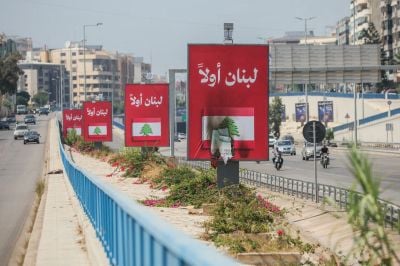
Political tensions have been further heightened by recent protests by Hezbollah supporters wishing to demonstrate their rejection of the agreement, as well as by the episode of pro-Iranian posters displayed on the airport road, which over the weekend were replaced by new posters bearing the slogan: "Lebanon first."
In response to the situation, President Joseph Aoun used a phone call with U.S. President Donald Trump on Saturday night into Sunday to ask him to "apply pressure" for the withdrawal of Israel from southern Lebanon.
Ghalibaf calls Berri
Iranian Foreign Minister Abbas Araghchi stated that all parties to the protocol signed with the United States should honor their commitments, including the clauses relating to Lebanon.
"Unfortunately, the Zionist entity [Israel] continues its airstrikes on Lebanon," Araghchi lamented during a joint press conference with his Iraqi counterpart, adding that the memorandum of understanding [MoU] signed between the United States and Iran had also been accepted by Israel.
He emphasized that Washington "should take responsibility and force" Israel to stop its attacks in Lebanon in order to end the war in the country, and called on the U.S. to pressure Israel to withdraw from areas it occupies in Lebanon.
The president of the Iranian Parliament and chief negotiator with the United States, Mohammad Bagher Ghalibaf, meanwhile, spoke with his Lebanese counterpart and leader of Amal, Nabih Berri. The two officials discussed "Israel’s violation of the first point of the memorandum of understanding signed between the Islamic Republic of Iran and the United States" on June 17, which calls for an end to the war on all fronts, according to a statement from the Lebanese Parliament.
In Israel, army chief of staff Eyal Zamir called "the agreement signed with the Lebanese government historic and important," adding that "the real test now is its implementation," according to comments relayed on X by the Israeli army.
He added that "fighters from the 36th Division and our Commando unit control the Beaufort Castle ridge sector and have all the necessary means and tools to defeat the enemy."
An Israeli official, cited by Israel’s Channel 12, asserted that the Israeli army would not withdraw from other areas until the Lebanese Army had managed to drive out Hezbollah. The previous day, Israeli Defense Minister Israel Katz had stated that the Israeli army had received orders to prepare for a “prolonged stay” in Lebanon, while Prime Minister Benjamin Netanyahu had welcomed the agreement with Lebanon, which he said was "a blow to Iran and Hezbollah."