






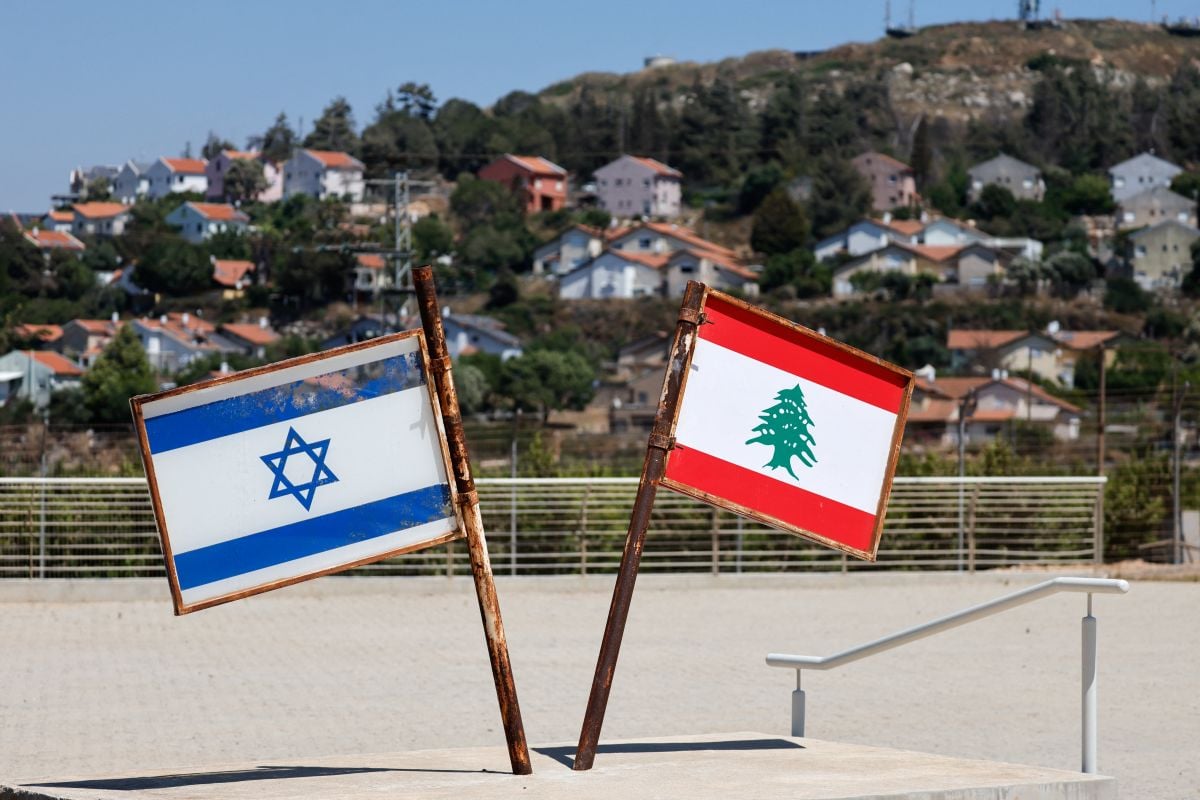
Representations of the Israeli and Lebanese flags on a memorial in the border town of Metula, in northern Israel, on June 27, 2026. (Credit: Amir Cohen/Reuters)






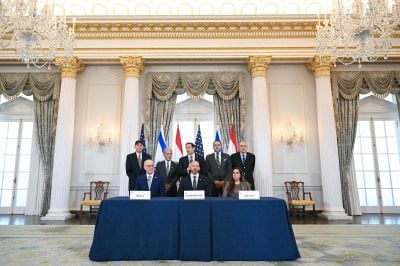
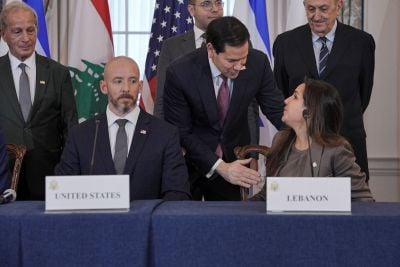
BEIRUT — The framework agreement concluded Friday between Lebanon and Israel at the end of the fifth round of negotiations in Washington has sparked sharply divided reactions across Lebanon's political spectrum, with officials rejecting, criticizing or hailing it.
The agreement comes amid Israel's continued occupation of parts of southern Lebanon and ongoing violations of the ceasefire, including targeted drone strikes that have killed several people since the latest truce took effect on June 21.
The announcement, which coincided with the 10th day of Ashoura, prompted small, unorganized protests, primarily by Hezbollah and Amal supporters, outside Lebanon's Grand Serail in Beirut.
Amid the backlash, Prime Minister Nawaf Salam, who backed the agreement, and Parliament Speaker and Amal Movement leader Nabih Berri, who opposed it, stressed their rejection of "any form of discord" and any "attempt at national division" in a joint statement issued after a phone call.
Meanwhile, Mahmoud Qomati, deputy head of Hezbollah's political bureau, said the agreement did not "warrant" street protests, even as the party categorically rejected it.
Amal-Hezbollah alliance rejects agreement
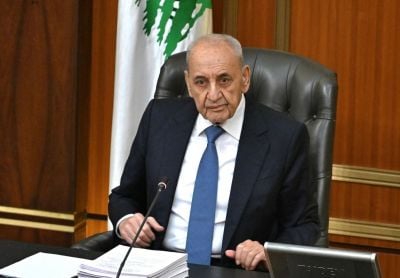
Parliament Speaker and Amal Movement leader Nabih Berri released multiple statements criticizing the agreement. In his comments to Saudi media outlet Asharq Al-Awsat, Berri said "I examined the contents of the framework agreement, I read it, and I saw discord in it." The outlet also reported that the parliament speaker had not been informed in advance of the agreement’s contents.
Later on Saturday, Amal issued an official statement rejecting the document. "The movement considers this agreement to be unbalanced and, in most of its provisions, to entrench realities favorable to the enemy at the expense of Lebanon's national interest. It carries political and sovereign risks and cannot be accepted, as it does not provide the basis for a fair agreement that safeguards Lebanon's rights," the statement read.
Amal went on to reiterate that it "rejects any direct negotiations with the Israeli enemy." He also told L'Orient-Le Jour that the agreement was "contradictory and impossible to apply."
Hezbollah Secretary-General Naim Qassem likewise condemned the agreement, describing it as "humiliating," "shameful," and "an abandonment of sovereignty" in Israel's favor.
He added that the condition making any Israeli withdrawal from Lebanon contingent on Hezbollah's complete disarmament throughout Lebanese territory is "extremely dangerous" "This demand crosses every red line and turns Lebanon into a plaything in the hands of the Israeli enemy," Qassem said. "This agreement is null and void, and it is the provisions of the Iranian-American protocol agreement that should be applied," he added, referring to the June 17 agreement signed by Washington and Tehran to end the regional war, including in Lebanon.
Hezbollah MP Hussein Hajj Hassan likewise insisted the party does "not recognize" the agreement and that it "will not be implemented" as long as "the Resistance and its weapons remain."
"This is not an agreement but a capitulation and the complete surrender of the Lebanese authorities to the United States and the Zionist enemy," he said in an interview with Russian Sputnik Radio. "The obligations contained in the agreement are binding on Lebanon, while no commitments are imposed on Israel."
He further accused the government of having "handed over Lebanon's land and resources to the enemy" by signing the agreement. Hajj Hassan also asserted that the government's "defeatist approach," based on "submission," had stripped it of "legitimacy and representation."
"As for our next steps, they will depend on the deliberations and consultations we conduct within the party and with our allies," he said.
A similar message was echoed Sunday by Hezbollah MP Hassan Fadlallah, who had been the first to warn Friday of the risk of "civil war" following publication of the agreement. "The agreement of humiliation and shame signed by the authorities will never see the light of day and will not be implemented," he declared. "Nothing will happen without our consent."
"Our finger will remain on the trigger, and we will continue on the path of resistance until we achieve our objectives," Fadlallah added.
Amal and Hezbollah in particular reject the notion of "pilot zones," sectors from which the Israeli army would agree to withdraw permanently if it believes the Lebanese army has been effectively deployed there instead of Hezbollah.
The vice president of the Higher Islamic Shiite Council, Sheikh Ali Khatib, also denounced the agreement as "a new submission to American pressure and dictates," arguing that the Israeli withdrawal outlined in the text remains conditional on "Israeli demands that are impossible to meet."
"It seems Lebanese officials have learned nothing from past experiences, which led to the failure of every agreement reached without Lebanese consensus," he said, drawing a parallel with the failed May 17, 1983 agreement signed between Lebanon and Israel during the civil war.
"One of the agreement's most harmful consequences will be to deepen Lebanon's internal political and popular divisions," he added.
Several critics
Sunni MP Jihad Samad, close to Hezbollah, likewise argued that "the framework agreement effectively legalizes Israel's occupation of Lebanon," accusing the government of "knowingly and deliberately attempting to undermine the Iranian-American agreement concerning Lebanon."
Meanwhile, the People's Movement, a small group allied with Hezbollah, called on the public to "mobilize consciously and courageously to thwart this agreement and overthrow the puppet authority that signed it."
Free Patriotic Movement (FPM) leader Gebran Bassil, for his part, voiced criticism of the agreement stopping short of outright rejecting it. "Despite its shortcomings, the framework agreement must be approached responsibly," he said. "It is beneficial if it enables us to recover all our rights, but dangerous if it becomes a source of discord. Everyone must avoid falling into this trap and refrain from rejecting any path that could liberate occupied territory, strengthen the state and establish peace." Bassil, Batroun MP, also rejected the agreement's formula of a "progressive redeployment" of Israeli troops, saying he instead wanted "guarantees of withdrawal and non-aggression."
"Where are the refugees and the resources?" he asked, referring to unresolved issues including Palestinian refugees in Lebanon as well as disputed water and offshore gas resources.
For its part, al-Jamaa al-Islamiyya, a Sunni Islamist party affiliated with the Muslim Brotherhood, stopped short of rejecting the agreement but said that "any discussion on the state's monopoly over arms must not take place under pressure from the occupation or under threat, but within the framework of a national dialogue." The party also called on the government to "demonstrate transparency by publishing the text and annexes of the agreement, particularly the security annex, the verification mechanisms and the timetable for redeployment."
Former Progressive Socialist Party leader Walid Jumblatt limited his reaction to a single sentence posted on his X account: "What is striking about this agreement — tripartite in form but unilateral in content — is the complete sidelining of the 1949 Armistice Agreement."
MP Halime Kaakour, a Sunni MP for Iqlim al-Kharroub, said it was "a grave and dangerous error," pointing in particular to Clause 13, which stipulates that both parties must "refrain from any hostile or antagonistic action in international political or legal forums."
"How can you accept such a clause?" she asked President Joseph Aoun and Prime Minister Salam.
"Does this mean abandoning efforts to prosecute the enemy for war crimes and crimes against humanity? In other words, you are entrenching impunity, denying justice to the thousands of victims of war crimes and violations of international humanitarian law, and depriving Lebanon of an important avenue for obtaining financial reparations."
"You speak of peace," she concluded. "Don't you realize there can be no peace without justice, and that a peace imposed through force and submission will not protect us from future conflicts?"
The FPM echoes the same criticism, arguing that it "deprives Lebanon of an important and powerful lever."
Kataeb and Lebanese Forces voice support
In a statement, Kataeb leader Samy Gemayel considered that Lebanon "emerges victorious" from the agreement, which, according to him, enshrines "the end of the war, the complete Israeli withdrawal from Lebanese territory, Israel's official recognition that it has no claims or ambitions toward Lebanon, the restoration of sovereignty, the extension of state authority, and the exclusive authority of legitimate institutions over weapons and decisions of war and peace."
"The Lebanese state has shown that when it negotiates on behalf of Lebanon and from its own legitimacy, it is capable of defending the interests of the Lebanese," the Metn MP said. He nevertheless stressed that the real challenge now lies in implementation. "What is required today is strong political will, commitment to the state, and a refusal to yield to intimidation, blackmail or attempts to obstruct this process."
Lebanese Forces leader Samir Geagea responded directly to criticism of the agreement from Berri, Joumblatt and Qassem.
Addressing Berri, he said that "discord began when the Taif Agreement was implemented in the security and military spheres for some but not for others," in an apparent reference to Hezbollah's arsenal.
Turning to Joumblatt, Geagea wrote: "Those invoking the Armistice Agreement today would have done better to react when it first began to be violated in 1964, instead of mourning its ruins today," referring to the establishment of Palestinian armed groups in southern Lebanon.
Responding to Hezbollah's claims that the agreement lacks legitimacy, Geagea argued that "the legitimate authority in Lebanon today consists, as in most countries around the world, of the president, the government and Parliament."
According to him, the agreement will "allow Lebanon and the Lebanese to emerge from the tragic deadlock and its consequences caused by the successive 'resistances' operating in the South.

 8 p.m. recap: Israel again threatens Beirut’s south suburbs; 2 ships hit near Hormuz; Riyadh football matches canceled