


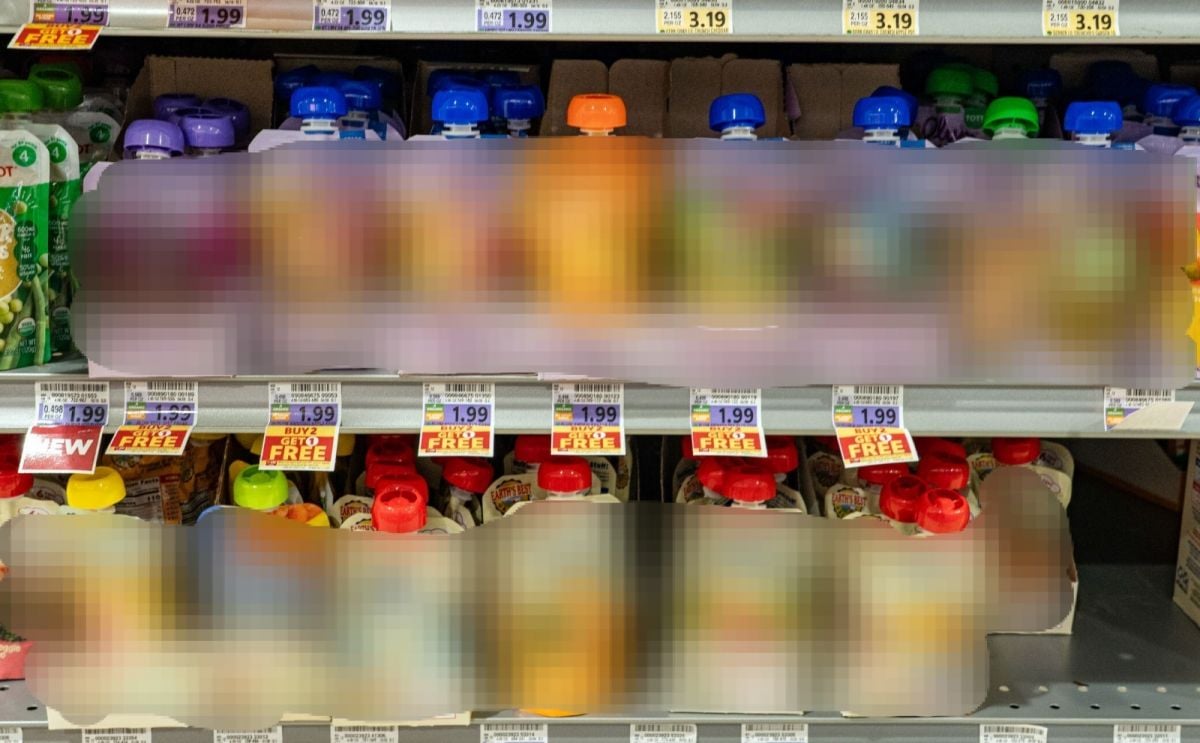
Spouted pouches on a supermarket stall. According to Greenpeace, this type of product would pose a health and environmental challenge. (Credit: Greenpeace)






The commercialization of baby food in flexible plastic pouches with spouts, especially fruit purees, is becoming widespread.
Convenient, these packages allow children to squeeze the pouch and eat its contents directly. But they may pose health risks, according to a study published June 2 by Greenpeace and conducted by the European Sintef Institute on several products from two major brands.
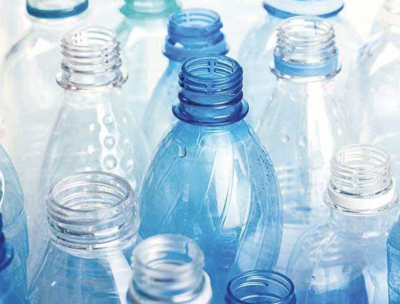
Researchers found microplastics — tiny particles resulting from the breakdown of plastics that persist in the environment and the human body — in all samples analyzed. “These packages have only been on the market for less than twenty years, and their production is increasing in the Middle East and North Africa [MENA] region,” Greenpeace points out, adding that their consequences for children’s health are “still unknown.”
Farah al-Hattab, plastics campaign lead at Greenpeace MENA, told L’Orient-Le Jour that in the MENA region alone, the baby food market was valued at nearly $7 billion in 2025, with an estimated annual growth rate of 6.4 percent through 2030, when it is expected to reach $9 billion.
Analyses focused on two products packaged in polyethylene pouches. They revealed 99 microplastic particles per gram in one and 54 in the other — that’s about 11,000 particles per pouch for the first and 5,000 for the second. Researchers say they determined these particles came directly from the packaging, while also detecting “traces of other chemicals known to be harmful to human health.”
The study also highlights the dangers of long-term exposure to these products, particularly with containers that are microwaved: after three minutes, one product released nearly 4 million particles and the other nearly 2 billion, including even smaller nanoplastics.
Health and environmental risks
Maher Abboud, a polymer specialist and researcher at Saint Joseph University, explained that plastic packaging is initially inert but can break apart when in contact with other organic materials over time or under mechanical stress, like the pressure exerted by a child.
“Plastic is made up of tangled filaments that can detach and migrate into liquids or foods,” he said. He also noted that other chemicals can become mixed in: “The plastic in packaging is often mixed with additives, for example to give them a color or to provide a certain flexibility,” he said.
“The potential effects of microplastics and endocrine disruptors on the health of young children remain a rapidly developing area of science,” said Hattab. “We already know that microplastics have been detected in the air, in foods, as well as in our organs and our blood. They pollute our bodies and damage human cells and tissues. Certain chemical substances associated with plastic have been linked to reproductive development disorders, thyroid problems, decreased fertility, male genital malformations, metabolic changes, and may be carcinogenic.”
Abboud considers Greenpeace’s report findings “plausible,” he adds a note of caution: “More in-depth research is needed.” In his view, health studies should be based on tracking large populations over several years.
“We know for sure that these compounds and additives have an impact on health, but to make scientific claims, we’d need to determine at what concentrations and over what period of time limits are exceeded that put our health at risk,” he explained.

For Greenpeace, the problem extends beyond just health issues. These pouches, made up of several layers of plastic, are “very difficult to recycle and often end up in landfills or in nature,” said Hattab. She also pointed out that “packaging accounts for about 40 percent of global plastic production, and flexible packaging — like these children’s pouches — is among the fastest growing segments.”
What can be done?
Greenpeace believes that the presence of microplastics in foods intended for babies is “a red line.” The organization is asking manufacturers to conduct further research. Hattab is urging governments to drastically reduce the use of single-use plastics, noting that plastic pollution is already affecting public health, food systems and ecosystems in the region.
Finally, the group says there is sufficient scientific evidence to justify “a drastic reduction, and a potential elimination, of anything that could expose babies to the risk of contamination by products that could be harmful to them,” the environmentalist said.
Questioned about this view, Abboud believes the precautionary principle is justified: “In case of doubt, it’s better to use another material. Glass remains the safest solution today for food contact.”

 7 p.m. recap: Houthis strike Riyadh airport again; Yemeni forces claim Bab al-Mandeb gains; Abbas postpones Palestinian polls