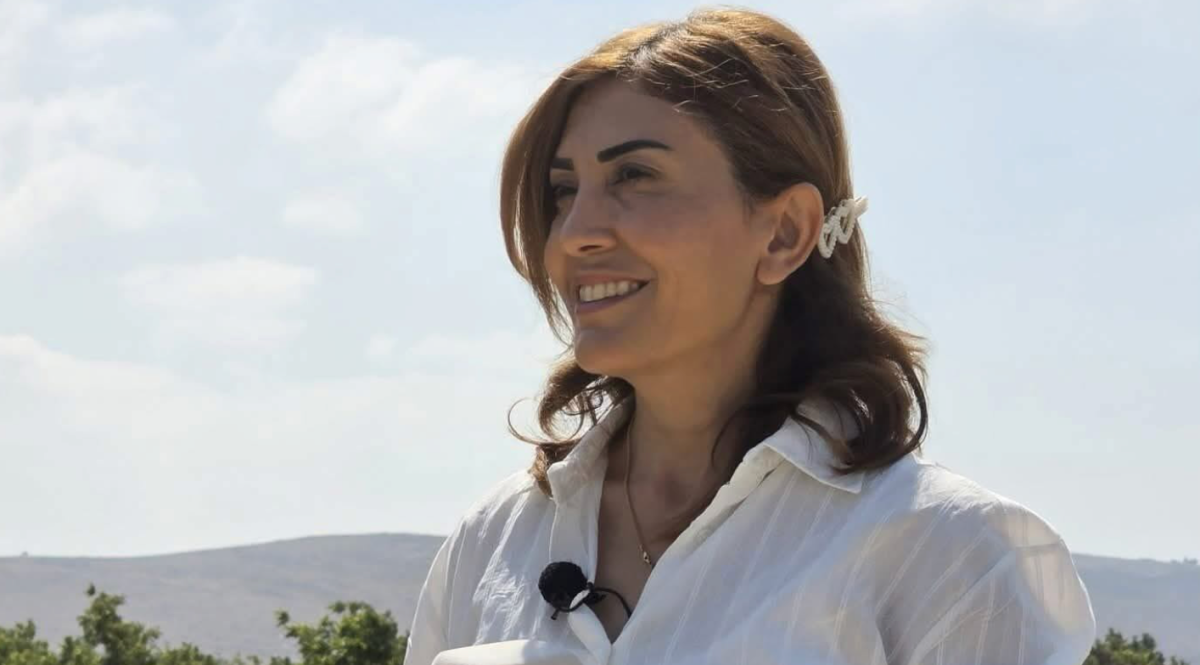
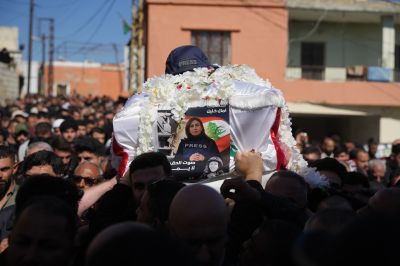
Lebanese journalist Amal Khalil was killed by a targeted Israeli strike on Tiri, southern Lebanon, on April 22, 2026. (Photo shared on social media)






Amnesty International released a statement on Thursday which concluded that the Israeli strike that killed Lebanese journalist Amal Khalil and seriously wounded camerawoman Zeinab Faraj in the southern Lebanese village of Tiri on April 22 "must be investigated as a war crime."
In parallel, Legal Agenda conducted an investigation which also indicated that Israel had deliberately killed Amal while being aware of her civilian and journalistic status. Amal had received numerous death threats pertaining to Israeli sources in the lead up to her eventual killing.
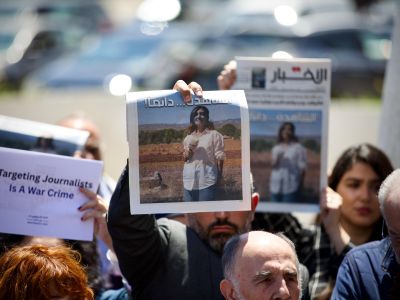
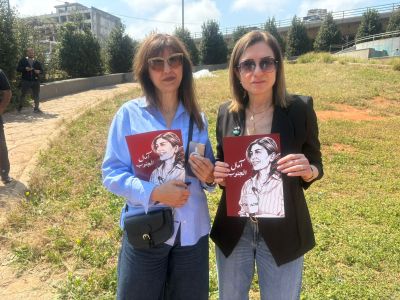
On Thursday morning, Legal Agenda held a press conference at Metropolis Cinema in Beirut to share its findings. In attendance were Zeinab, members of Amal's family, and other local journalists who have survived previous targeted Israeli attacks.
On April 22, Amal and Zeinab were traveling South to report on Israel's continued strikes and incursions into Lebanese territory. Israel's first strike at 2:25 p.m targeted a car and killed two men: the mukhtar of Bint Jbeil, Ali Bazzi, and a young man accompanying him named Mohammad al-Hourani. This prompted Amal and Zeinab to exit their vehicle, which was following that of Bazzi and Hourani, and take shelter in a nearby building. Around one hour later, Israel targeted their parked car with a second strike, wounding them in the blast. Yet another hour went by before Israel proceeded to target the house where the journalists had taken refuge with a third strike, seriously injuring both women. Amal succumbed to her wounds around three hours after this third and last strike, during which time first responders had not been given the green light to reach and rescue them.
The strikes took place during the second month of the war's re-escalation. Tiri is located in an area Israel had designated a "buffer zone," a euphemism typically used to refer to border territory it occupies, whether in Lebanon, Gaza, or Syria. In Lebanon, civilians have been barred from returning to their towns and villages that fall within this so-called "buffer zone," with anyone attempting a return at grave danger of risking their life.
'Assassination and a war crime'
Legal Agenda's investigation, conducted in partnership with the Lebanese Union of Journalists, indicates that the Israeli army "acknowledged carrying out a strike on the building where Amal and Zeinab had taken refuge."
The Beirut-based NGO also characterized her killing as an "assassination and a war crime that warrants investigation in preparation for accountability."
According to the investigation, the "intentional nature in Amal's killing is demonstrated by three main elements: the Israeli army’s targeting of the journalist, its awareness of her civilian and journalistic status, and its obstruction of efforts to rescue her."
The investigation shows, based on Zeinab’s description, that the drones hovering less than a meter above the journalists in the building feature real-time video monitoring, continuous surveillance, precise targeting, and the ability to track moving targets with speed and flexibility. These drones could allow the Israeli army to identify the journalists in the building, according to the investigation.
The Israeli army was also aware of the victims’ status as journalists through official channels used for field coordination with UNIFIL and the “Mechanism” committee. Coordination notifications for carrying out the rescue mission included informing it of the presence of two journalists at the attack site.
Obstructing rescue teams
"The Israeli army obstructed the arrival of ambulance teams to the site, despite being notified of a request to evacuate media casualties. The Israeli army delayed granting approval for nearly one hour and 45 minutes, forcing the rescue team to withdraw under threat after rescuing Zeinab from beneath the rubble of the building. The team was thus unable to save Amal," said Legal Agenda.
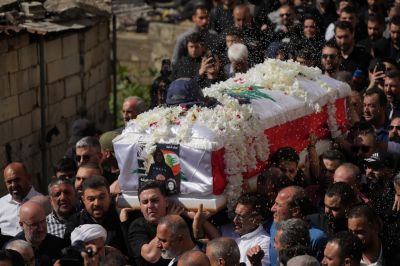
The investigation notes that Amal remained alive under the rubble of the building for approximately two and a half hours after it was targeted by the Israeli army, and for about an hour after ambulance teams were forced to withdraw from the site without being able to rescue her due to imposed Israeli obstruction.
"Ambulance teams were forced to wait again for nearly one hour and 40 minutes to obtain Israeli approval before returning to the site of the attack and recovering Amal’s body from beneath the rubble.
Amnesty International: Damning findings
"Israel's continued strikes give us reasonable grounds to believe this was a direct attack on civilians, revealing a shocking disregard for international humanitarian law," Heba Morayef, Amnesty International's regional director for the Middle East and North Africa, said in a statement.
“The fact that the two journalists were in what Israel has designated a no-return zone does not make them lawful targets. All parties to a conflict have a clear obligation to distinguish between civilians and military targets at all times and to direct their attacks only at military objectives. There can be no justification for targeting civilians who sought shelter in search of safety. This attack must be promptly, independently and impartially investigated as a war crime,” she said.
Israel has killed 4,334 people in Lebanon since March 2 according to the latest Health Ministry figures. Hezbollah strikes on Israel, meanwhile, have killed at least two Israeli civilians, while at least 39 Israeli soldiers have died in southern Lebanon, according to Israeli media, Amnesty said.
Since the war began on Oct. 8, 2023, after Hezbollah opened a support front for Gaza, Israel has killed 22 journalists and media workers in Lebanon.

 7 p.m. recap: Saudi Arabia warns Houthis as Israeli strikes hit south Lebanon