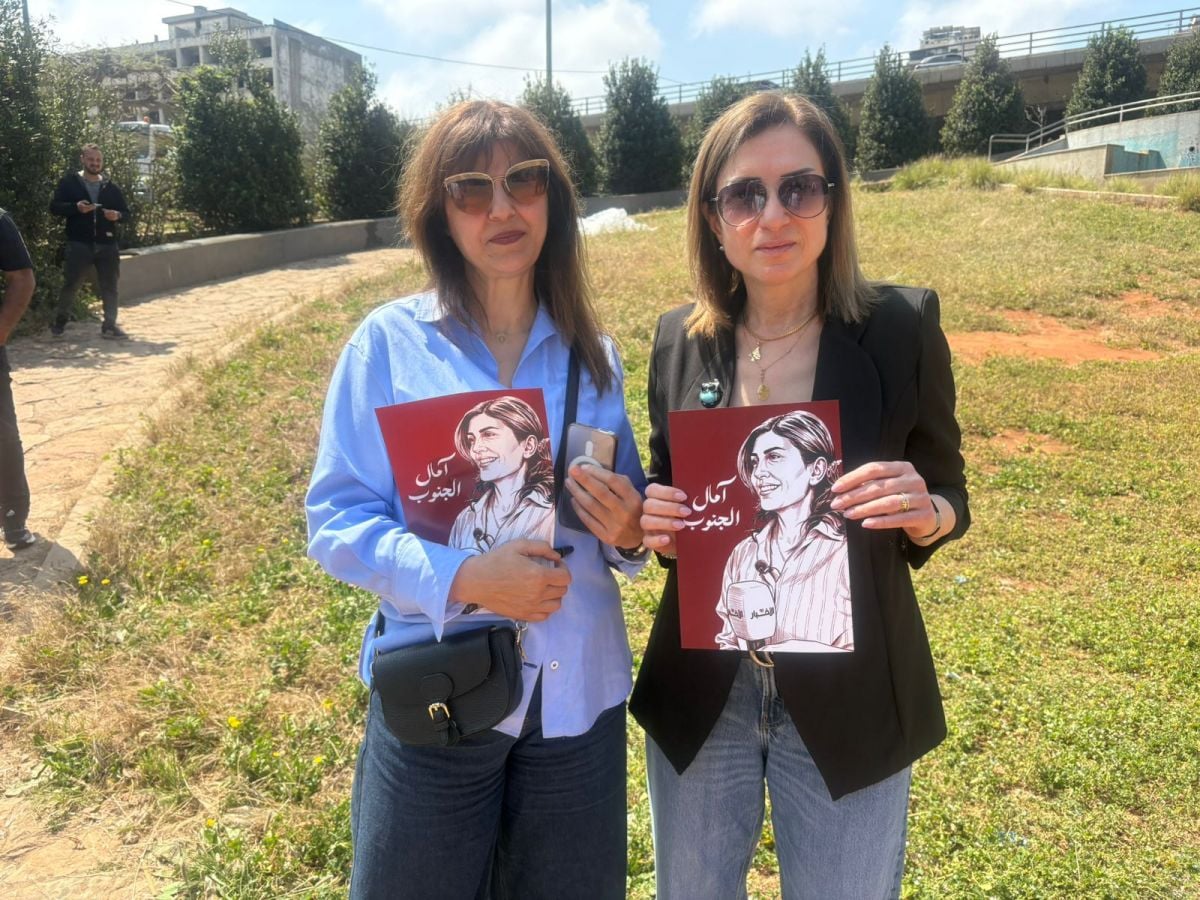
Two demonstrators hold up portraits of journalist Amal Khalil during a sit-in in front of ESCWA, on April 28, 2026. (Credit: Suzanne Baaklini/L'Orient-Le Jour)






"Her last report led to her death": With anger and bitterness, dozens of journalists gathered Tuesday in front of the Escwa headquarters in Beirut to pay tribute to Lebanese journalist Amal Khalil, killed in an Israeli airstrike in Tiri, southern Lebanon, on April 22.
According to our reporter on the ground Suzanne Baaklini, Amal Khalil’s brother and sister were present, as well as a representative from the pro-Hezbollah newspaper al-Akhbar, which she worked for. Protesters also paid tribute to other journalists killed amid the war.
The president of the Lebanese Order of Press Editors, Joseph Kosseifi, said in his speech that Israeli strikes in Lebanon have killed 27 journalists and wounded 30 others.
"We are here to express our anger and denounce crimes committed by Israel against journalists since 2023, leading to Amal Khalil’s death. Journalists are protected by international conventions that Israel does not respect, targeting them directly, which constitutes a deliberate crime. Israel had already threatened Amal Khalil in 2024. The U.N. and international journalist unions should demand that Israel stop targeting journalists ... particularly by filing a complaint with the International Criminal Court," he stressed.
Kosseifi also called on journalists to "remain united beyond political divisions." He then expressed his intention to present the union’s statement, which includes Lebanese journalists’ demands, to the United Nations and calls for Israel to be held accountable and for the U.N. to guarantee their protection.
Correspondent for al-Akhbar in southern Lebanon, Amal Khalil was killed by an Israeli strike on April 22 in the village of Tiri while continuing to cover the war in the region, despite threats against her. She had escaped an initial Israeli bombing that targeted her convoy on the way to Bint Jbeil and managed to take refuge in a nearby building.
The building, however, was then hit by another strike, killing Amal Khalil and injuring her colleague, photographer Zeinab Faraj. Rescue teams were prevented for many hours from reaching the scene to help the journalists.
The al-Akhbar representative noted that Khalil "did everything she could to deliver aid to the displaced people in Sour." Inaam Kharoubi, one of her colleagues at the daily’s editorial office, believes that "this incident shows we can no longer rely on international law because Amal was wearing a press vest."
"We were in contact with her until around 3 p.m., then heard that she had taken refuge [in a building]. We went through some very difficult hours, following developments hour by hour. We knew they wanted to kill her deliberately. Her last report led to her death," she went on.
"The least we can do is express our solidarity toward this young journalist who lost her life and who was deliberately targeted by the Israeli enemy while doing her job," journalist Kassem Kassir, present at the sit-in, told L'Orient-Le Jour.
"We support the approach of Information Minister [Paul Morcos] to file a complaint against Israel. The best outcome would be to get them convicted for war crimes, and if that’s not possible, at least to try," he added. "It’s the witness who is killed so he cannot tell the truth from the ground," said journalist Hassan Hamieh.
‘War crime’
Independent journalist Shahnaz Ghayad described the incident as "a war crime under the Geneva Conventions." "Unfortunately, international law is not being applied, but we must continue to raise awareness about what is happening to journalists," she said.
Meanwhile, a group of Spanish journalists expressed in a statement their "solidarity and support, as well as indignation over the killing of journalists in Lebanon by the Israeli army."
"Our group, Periodisme contra el Genocidi, was formed in Barcelona last summer, following the killing of six colleagues during an Israeli attack in Gaza, and we are dismayed to see these crimes not only continuing but spreading to the region. We continue to speak out to end these crimes. We ask our institutions and the European Union to stop being complicit and to use all means at their disposal to end this brutality," the statement read.

 7 p.m. recap: Saudi Arabia warns Houthis as Israeli strikes hit south Lebanon