





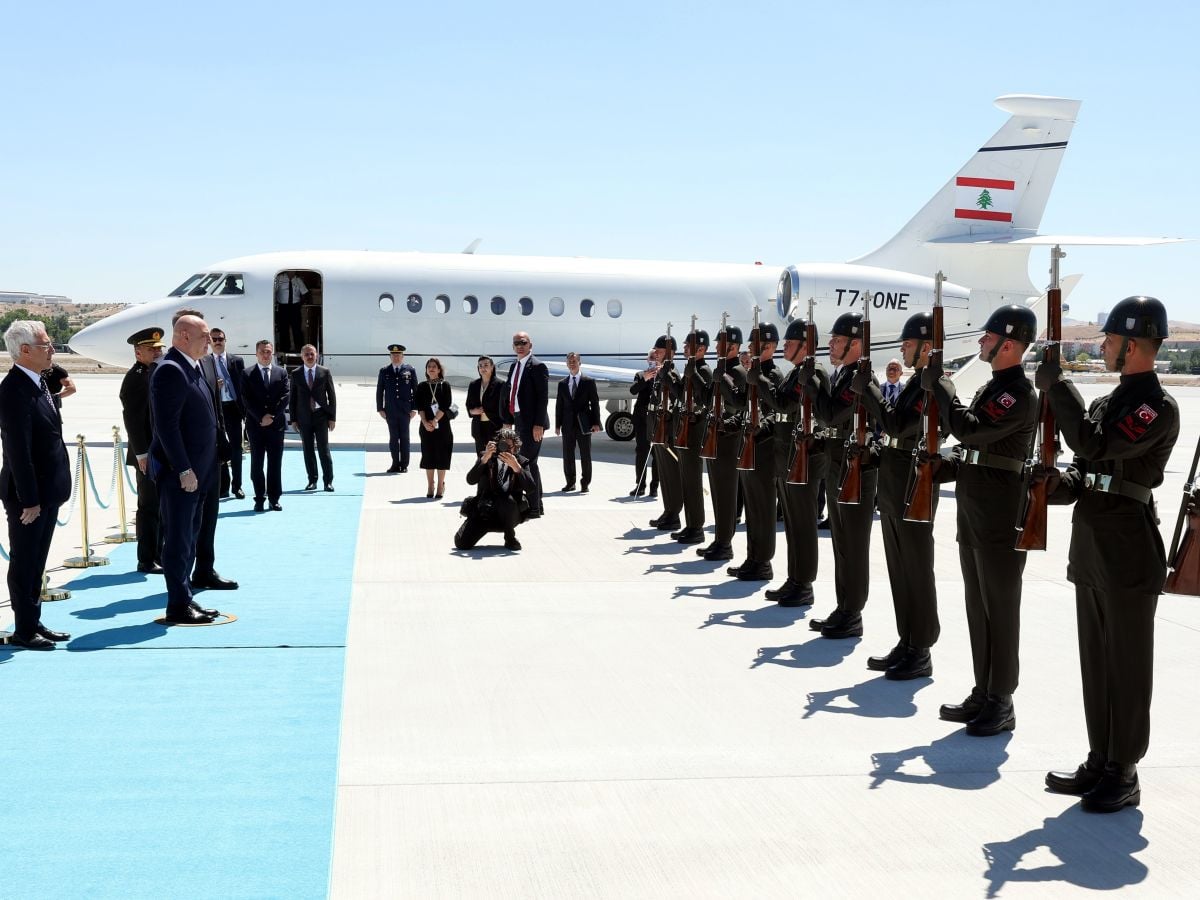
President Joseph Aoun upon his arrival at Ankara airport on July 30, 2026. (Photo published on the X account of the Lebanese Presidency)






President Joseph Aoun arrived in Ankara on Thursday at 2:30 p.m. local time for an official state visit during which he met with President Recep Tayyip Erdoğan to discuss economic and security cooperation between Lebanon and Turkey, amongst other things.
He was welcomed by the Turkish Minister for Energy and Natural Resources, Alparslan Bayraktar, the Deputy Governor of Ankara, Cem Afşin Akbay, the acting commander of the Ankara garrison, Brigadier General Ayhan Kalender, the deputy mayor of Ankara, Faruk Köylüoğlu, and the Lebanese Ambassador to Turkey, Mounir Anouti.
The first stop of the visit took Aoun to the mausoleum of Mustafa Kemal Atatürk, founder of the Republic of Turkey, where he laid a wreath and observed a minute of silence. He then left a message in the mausoleum’s guest book, in which he stated that "President Atatürk’s experience, marked by his determination and loyalty to his ideals despite all difficulties, remains an inspiration for all people aspiring to build a true state," adding that "the Lebanese people, friends of the Turkish people, see in this experience a model for strengthening a state of law and institutions, a state based on justice and equality."
Aoun later reaffirmed Lebanon’s commitment to its sovereignty, whilst his Turkish counterpart, Recep Tayyip Erdogan, said that the country would be among the first to benefit from a return to regional stability. He also gave assurances that “Turkey’s support for the Lebanese Armed Forces in the security sphere will continue uninterrupted” and that his country was “fully prepared to contribute to the reconstruction and rehabilitation of southern Lebanon."
“We have reviewed regional developments, particularly in light of the ongoing Israeli occupation of southern Lebanon, and we reaffirm our strong and unwavering support for Lebanon’s sovereignty, for its brotherly people with whom we share strong ties, and for its territorial integrity,” said Erdogan, speaking to the press alongside Aoun.
Reflecting on the heavy toll paid by Lebanon since the start of Israel's war, the Turkish president offered his “sincere condolences to the brotherly Lebanese people” and wished “a speedy recovery to the wounded.” He pointed out that Turkey had been, “from day one ... among the countries that had reacted most strongly” to Israel's attacks, stating that Ankara had “consistently highlighted the war crimes and crimes against humanity committed by Israel."
Welcoming the diplomatic initiatives aimed at putting an end to “this aggression and occupation,” Erdogan also gave an assurance that his country was “fully prepared to provide all possible support and assistance for the reconstruction and rehabilitation of southern Lebanon, which has been severely affected by the Israeli attacks.”
Aoun: Lebanon 'will not relinquish its national dignity'
Even though Israel currently occupies more than 600 km² of Lebanese territory in the South and continues to carry out near-daily home demolition operations and strikes, Aoun nevertheless asserted that Lebanon “will not relinquish its national dignity” and “will not submit to a tyrannical force."
Aoun also rejected “any unilateral interference” in Lebanon’s internal or sovereign affairs, emphasizing that the country was “more determined than ever to restore the state’s sovereignty, to rebuild, and to forge a secure and stable future for all Lebanese.” He reaffirmed the priorities of his term of office: “Israeli withdrawal from the whole of Lebanese territory, the return of displaced persons to their villages, reconstruction, economic recovery, and the exclusive sovereignty of our legitimate forces over the armed forces.”
Regarding the United Nations Interim Force in Lebanon (UNIFIL), whose mandate is due to officially end in late 2026, Recep Tayyip Erdogan said that this deadline “will mark a significant development.” He gave an assurance that Turkey wished to “participate in all initiatives” aimed at supporting security in the region and guaranteeing Lebanon’s sovereignty following the withdrawal of the U.N. force, adding that “Turkey’s support for the Lebanese Armed Forces in the security sphere will continue uninterrupted.” Several contributing countries, including France and Italy, are already planning for the post-UNIFIL phase.
'A new phase' in Lebanese-Turkish relations
The two leaders also emphasized the development of bilateral relations. Erdogan said he had discussed with his counterpart “the nature of the assistance Turkey could provide” to Lebanon, as well as ways to strengthen cooperation in various fields. For his part, Aoun remarked that his visit was taking place “at a pivotal moment, as our region is reshaping the contours of its future.”
Noting that he was only the third Lebanese president to make an official visit to Turkey in 70 years, he stressed that bilateral relations “deserve to be more sustained and more ambitious.” He commended his Turkish counterpart for having “a clear vision and a sincere desire to take relations between our two countries to a new level of cooperation,” adding that this visit would mark “the beginning of a new phase in Lebanese-Turkish relations, based on partnership, trust, and joint action befitting the history of our two countries and the aspirations of our two peoples.”
The president affirmed joint “responsibility to ensure that the Lebanese-Turkish partnership plays a part in building this future, rather than being merely a bystander,” noting that he had found in his Turkish counterpart “a statesman who has a deep understanding of the region and realizes that Lebanon’s stability is not merely a Lebanese affair, but an essential element of the stability of the entire region.”
Turkey’s leader, for his part, remarked that “Lebanon is among the first countries to benefit from the climate of stability, peace, and cooperation in the region,” adding that the “brother country” had “long been the hardest hit by serving as a battleground for rivalries and conflicts between certain regional powers.”
The Lebanese leader also expressed his gratitude to Turkey for its support for Lebanon “during its most difficult times,” citing in particular the aid provided following the explosion at the Beirut Port in 2020, then again during the war, and “whenever Lebanon has needed a friendly nation.” He also praised Ankara’s “ongoing support” for the Lebanese Army, as well as its “active participation” in UNIFIL, “a commitment that we appreciate and hope will continue.”
Aoun said he was “delighted to be making this visit,” which he described as “a milestone that reflects the strength of relations between our two countries, as well as our shared commitment to strengthening cooperation in the interests of our two peoples and the stability of our region.” Referring to the recent war in Lebanon, Aoun said he was driven by “a deep sense of responsibility” as he came “from a country that is suffering, but which, at the same time, continues to fight, to stand firm, to hope and to dream.” Recalling “the heavy toll” paid by Lebanon, he affirmed that “what the war failed to destroy was the will of the Lebanese people.” He concluded by stating that “there should be no provocation against a neighbor, a friend or a brother, and there should be no unilateral interference in our internal or sovereign affairs. “This is what relations between Turkey and Lebanon have been like since the creation of their modern states,” he said.
Erdogan calls for a strengthening of relations between Beirut and Damascus
Whilst Lebanon and Syria have turned a new page in their relations following the fall of Bashar al-Assad’s regime in December 2024, Erdogan considered that “the continuation and development of dialogue” between the two countries would be “beneficial and fruitful." He also said he was “fully prepared to provide all necessary assistance to strengthen relations between these two states, which have gone through a difficult period.” Erdogan further assured that his country was following “closely” the recent diplomatic initiatives undertaken by Aoun. He indicated that Turkey was assessing “the nature of the aid and contributions” it could provide to support these efforts, whilst examining the prospects for developing bilateral relations in various fields. “We will continue to support the strengthening of Lebanon’s institutional capacities and will continue to provide humanitarian and technical aid,” he added. Finally, he thanked Aoun for his visit.
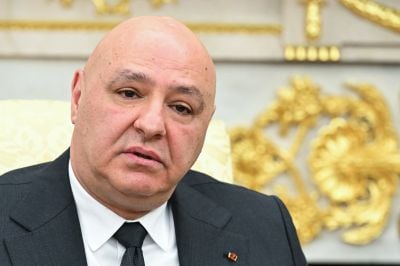
Meanwhile, Druze leader and former head of the Progressive Socialist Party (PSP), Walid Joumblatt, gave an interview to Turkey Today from Rue Clemenceau in Beirut, in which he emphasized the importance of Turkey’s role in the region. He believed that Israel “will use all its political tools to create problems for Turkey” and called on Turkish leaders to exercise great caution in the face of regional developments. Joumblatt also stated that Lebanon needed Turkey as a friendly nation and a regional power capable of helping to strengthen political and security stability, as well as fostering economic cooperation and opening up new prospects in relations between the two countries.
