





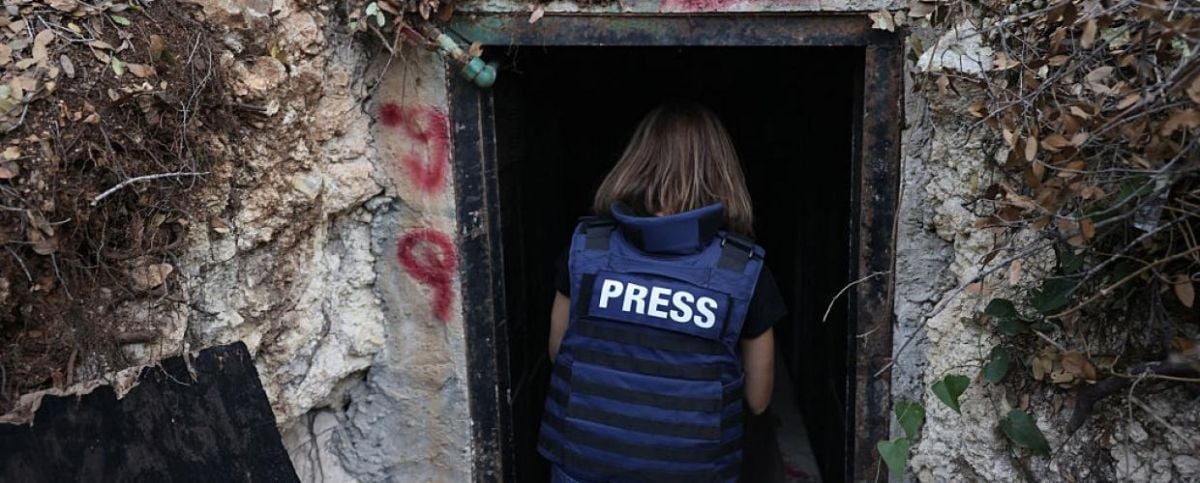
A journalist wearing a vest with the word "press" written on it, during a tour organized by the Lebanese Army in a Hezbollah tunnel discovered in southern Lebanon, in November 2025. (Credit: Anwar Amro/AFP)






BEIRUT — The proposed Media Law, which was approved by joint parliamentary committees this month and initially scheduled for Parliament's July 16 session, has sparked controversy among journalists and free speech advocates. At the heart of the debate is paragraph (b) of Article 104, which provides for prison sentences of up to three years — with the possibility of harsher penalties or forced labor in some cases — for "disinformation and the dissemination of false or harmful information." Critics argue that the provision is open to broad interpretation and could undermine press freedom, a source close to the journalists' union told L'Orient-Le Jour.
Although Parliament did not examine the bill after the July 16 session was adjourned for lack of quorum due to the general amnesty law, calls are growing to reconsider the amendment to Article 104. The provision was introduced by the Parliament's Administration and Justice Committee before being incorporated into the draft by the joint parliamentary committees.
“We need a modern law, but this text is confusing,” the union source said, describing the article as “a step backward.” The source noted that Lebanon amended its existing media law in 1994 to eliminate prison sentences for journalists, replacing them with fines.
Governed by a 60-year-old law (in 1962), Lebanon's media sector has been waiting for 16 years for Parliament to adopt legislation drafted in 2010 by MP Ghassan Moukheiber in collaboration with Maharat, an NGO that advocates for freedom of expression. However, the bill — developed with the participation of other NGOs, media professionals and lawmakers — has undergone numerous amendments in parliamentary committees and subcommittees over the years.
In a statement, the Lebanese journalists’ union said it “rejects the bill, as it lacks a national vision for media and does not protect media professionals.” “More alarmingly, some articles allow for the imprisonment of journalists and media professionals. The union fears this is the main goal: to stifle the profession and restrict freedoms,” the statement added.
The press editors also called for “the withdrawal of the bill in its current form and its referral to the Media and Communications Committee for further review.” “The syndicate is ready to present a comprehensive vision for a truly national media landscape, with concrete proposals, via a complete bill that embodies this approach and should serve as the foundation for future legislation,” the statement also said.
Maharat, meanwhile, defended the original bill, saying it is far removed from the version now under consideration and condemning the changes made to Article 104.
“The essence of the law is entirely different. It transfers publication liability from criminal to civil court, abolishing pre-trial detention and prison sentences for statements falling under freedom of expression, except for hate speech, which is subject to very limited conditions,” the NGO said in a statement.
“However, the amendment to Article 104 is very concerning because it adds a clause to the provisions on incitement to hatred related to the dissemination of false or misleading news. This wording reopens the door to criminal prosecution, contradicting the spirit of reform based on limiting liability to the civil sphere, except in cases of serious and direct incitement to discrimination, hostility, or violence. It is therefore necessary to distinguish between the core of the law — which abolishes criminal penalties — and the new amendment to Article 104, which should be deleted or reworded,” the NGO asserted.
When contacted, Information Minister Paul Morcos, one of the proponents of the new law, was unavailable for comment.

 7 p.m. recap: Iran warns Egypt, Israeli soldiers vote in south Lebanon, Haret Hreik responds to Kataeb