







Plastic bottles are repeatedly used and exposed to elements that contain unsuspected dangers. (Credit: AFP)






A recent study, published on Jan. 8 in the Proceedings of the National Academy of Sciences (PNAS), shocked the world by revealing that water in plastic bottles contains 10 to 100 times more tiny plastic particles than previously thought.
Researchers examined three brands and found an average of 240,000 plastic fragments per liter, ranging from microplastics to nanoplastics.
L’Orient-Le Jour sought insights from Maher Abboud, Professor of Chemistry at the Université Saint-Joseph (USJ), a specialist in polymer materials (plastic components), and presently serving as the Dean of the Faculty of Science.
His analysis focuses on interpreting these results within the context of Lebanon.
How can this discovery be interpreted? Why do you think there is such a huge difference with previous research?
Traditional methods for measuring plastic particles in water were limited to detecting microplastics, which are on the scale of a millionth of a meter. The significant hurdle was to devise techniques capable of identifying particles at a scale of one billionth of a meter, or nanometers.
Thanks to the innovative technique developed by these researchers, relying on laser measurements, it is now possible to detect particles in water that are just a few nanometers in size. This breakthrough explains the revelation of 10 to 100 times more microscopic plastic particles in water.
What type of plastic are water bottles commonly made of? Why and under what conditions do plastic fragments seep into the water? Do you think the water bottles used in Lebanese homes are subject to the same conditions?
The polymers [plastic compounds] of which bottles of water or other liquids, such as oil, are generally made of the PET or PETE type, i.e., polyethylene terephthalate.
This polymer is manufactured by industry, and is the most suitable mechanically, physically and biologically for water containers, given that water does not initially interact with this material.
Except that polymers in general, and this one in particular, degrade naturally over time, because they are made up of a set of filaments that are tangled macromolecules, forming a very long chain that folds on itself to form a ball.
These chains break down when the plastic is exposed to sunlight, oxygen, etc. The materials are then fragmented, which can be accelerated by contact with another element [water, oil, etc.].
The fragments that break off then pass into the liquid contained in the bottle, giving rise to micro polymers, or even nanopolymers.
The problem is that they have a long lifespan, taking a long time to disappear completely.
The bottles we have in our homes, if they are made of PET or another product, are also affected by degradation. However, the rate of degradation varies according to the type of polymer used. Repeated use of these materials is not recommended [these bottles have an expiry date].
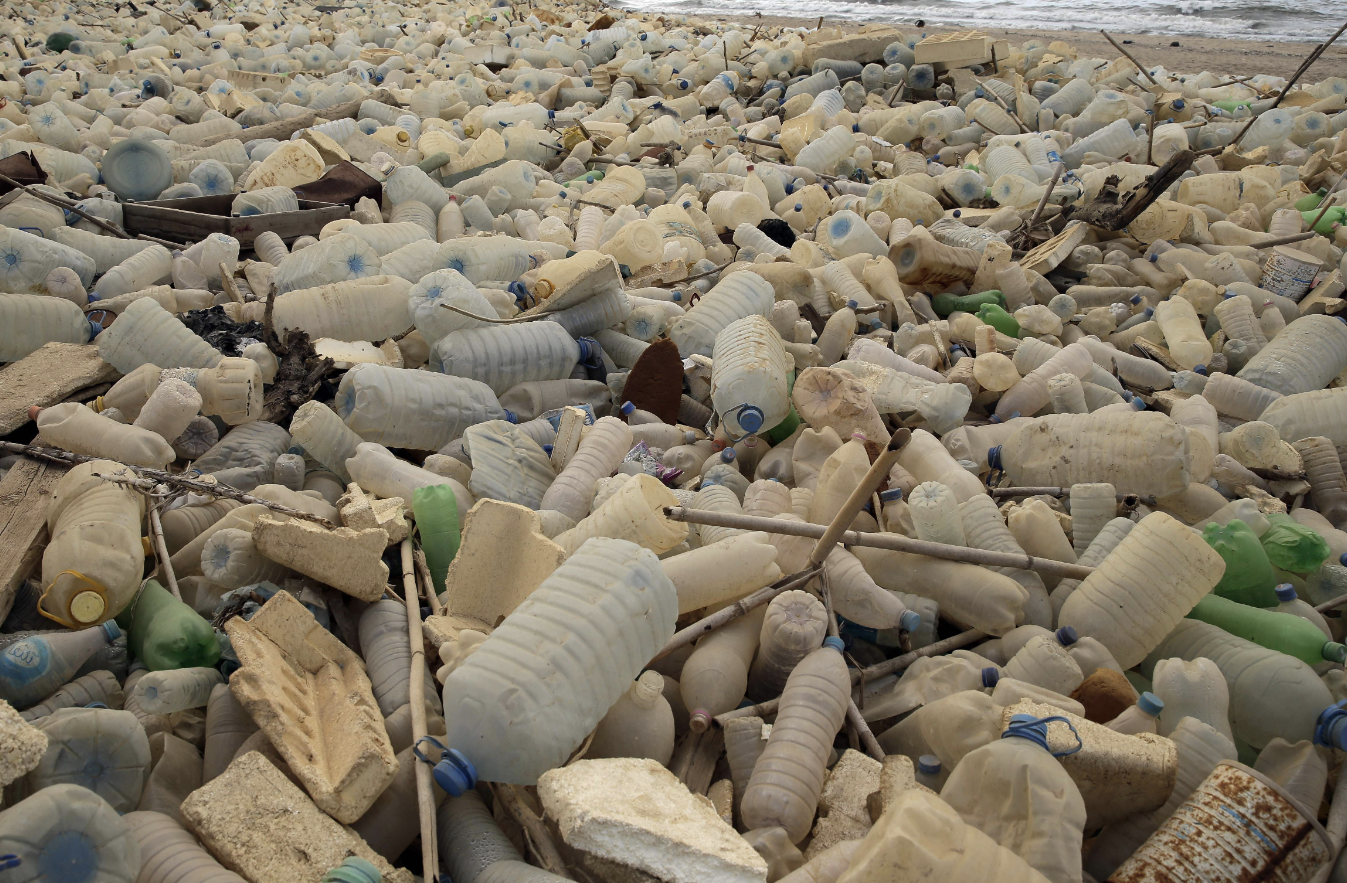
Plastic waste litters at Costa Brava beach. (Credit: Joseph Eid/Photo archive)
Ninety percent of the particles found in bottled water by the researchers of the study published in PNAS are nano-plastic. How dangerous are they?
Nanoparticles make up the majority of the materials found by the researchers in the water.
They are a thousand times smaller than microplastics, as if we were comparing a hot-air balloon with a grain of sugar, hence their infinitesimal size, which proves the degree of fragmentation of these plastics in water.
The danger of these nanoparticles is linked to their size because they are more easily deposited on human organs and could come into contact with our cells.
What do we know about the health repercussions of ingesting these microscopic plastics?
There are not yet enough studies to assess the effect of these microparticles and nanoparticles on the human body, but their repercussions can only be negative since these materials are not designed to be found inside the body.
Several epidemiological studies carried out worldwide in the past on certain categories, such as pregnant women or people who are more exposed than others to this type of product, have noted consequences for reproductive health and fertility, for both sexes.
In particular, there could be effects on congenital malformations.
Once ingested, these nanoparticles do not leave the body easily, given their very small size.
It should be noted, however, that the danger comes not only from ingestion, but also from breathing in these plastic nanoparticles, which, just as they can be deposited on water, can also remain suspended in the air and penetrate the pulmonary alveoli through inhalation.
Beizhan Yan, co-author of the study, told AFP that if people are worried, they can consider alternatives such as drinking tap water. Given that this alternative is not available in Lebanon, what recommendations would you make to the Lebanese?
We can follow a trend that is becoming increasingly popular around the world, which is to switch to glass bottles, a material that does not age or fragment like plastic and is therefore harmless because it is relatively stable.
This is one of the solutions we could propose to Lebanon. It should also be remembered that we have lost some of our ancestral habits, such as drinking from a glass jug.
This article was originally published in L'Orient-Le Jour. Translated by Sahar Ghoussoub.
