






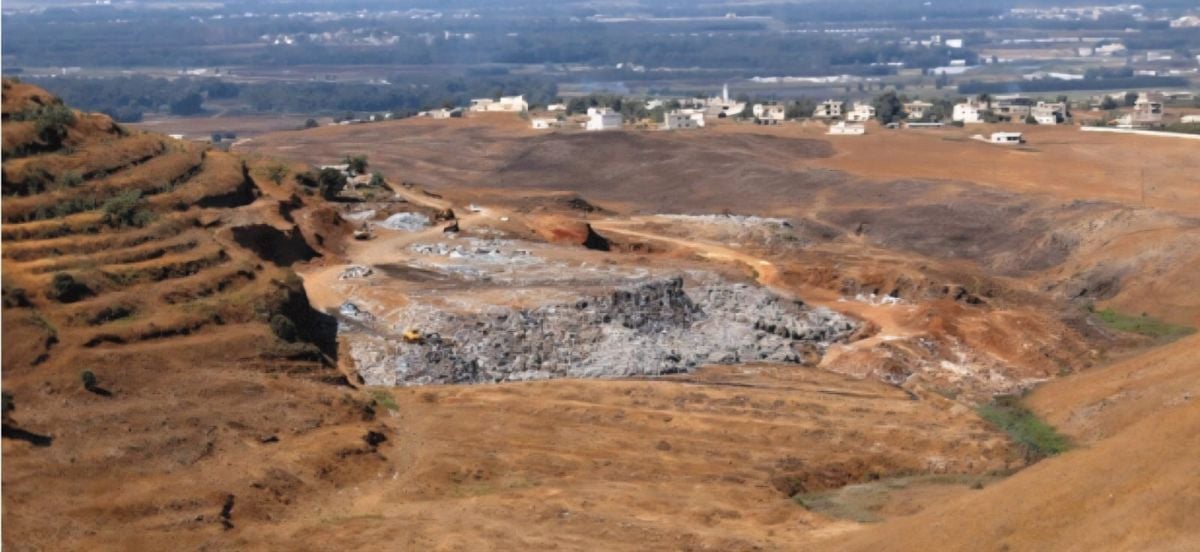
Overview of the Srar landfill in Akkar, the northernmost part of Lebanon. (Credit: Photo provided by Michel Hallak/ OLJ)






NORTH LEBANON — Residents of Akkar in northern Lebanon have expressed alarm over the possibility that the Srar landfill, the region's main waste disposal site, could soon receive waste from Tripoli, according to our correspondent Michel Hallak.
In a statement, the "civil society of Akkar" denounced "information circulating regarding agreements, meetings, and contacts conducted without the knowledge of the public" concerning the proposal. It called for "the whole truth be revealed to the people of Akkar" and demanded "that all the details of this affair be made public, with full transparency."
Tripoli, Lebanon's second-largest city after Beirut, has long struggled with waste management. Despite repeated attempts to establish waste treatment facilities, the city continues to rely on an uncontrolled coastal landfill that has exceeded its capacity for years and has been repeatedly expanded.
Waste management in Akkar is similarly rudimentary. The region depends on the privately operated Srar landfill, which lacks adequate environmental and public health safeguards. The facility is paid according to the tonnage of waste it receives.
The civil society statement warned that the landfill already causes severe pollution while receiving waste from across Akkar as well as other regions, raising concerns about the impact of adding waste from a city the size of Tripoli. It also urged local politicians, religious leaders and municipalities to oppose the plan.
"Akkar is not for sale and is nobody's garbage dump," the statement said.
Tripoli's union of municipalities (al-Fayhaa) responded without categorically denying that the option was under discussion. In a statement shared with our correspondent, it described the activists' claims as "fragmented" and "inaccurate," arguing that they had been "taken out of their environmental and technical context."
The union acknowledged that Tripoli's landfill is "almost at capacity" and said it is evaluating several alternatives "through a scientific and environmental approach based on sorting, treatment and waste volume reduction."
It added that "the Srar landfill is one of the possible temporary options," explaining that any waste transported there would first be sorted, treated and compressed into bales in Tripoli.
"The Srar landfill will not be a long-term destination for Tripoli's waste and will only be certified as an option after agreement from all concerned parties, particularly the Ministry of Environment and local authorities," the statement said.
Lebanon has struggled with chronic waste management problems for decades, particularly outside Beirut and Mount Lebanon, where repeated failures to implement sustainable waste management plans have left many regions relying on makeshift landfills.

 8 p.m. recap: Israel again threatens Beirut’s south suburbs; 2 ships hit near Hormuz; Riyadh football matches canceled