







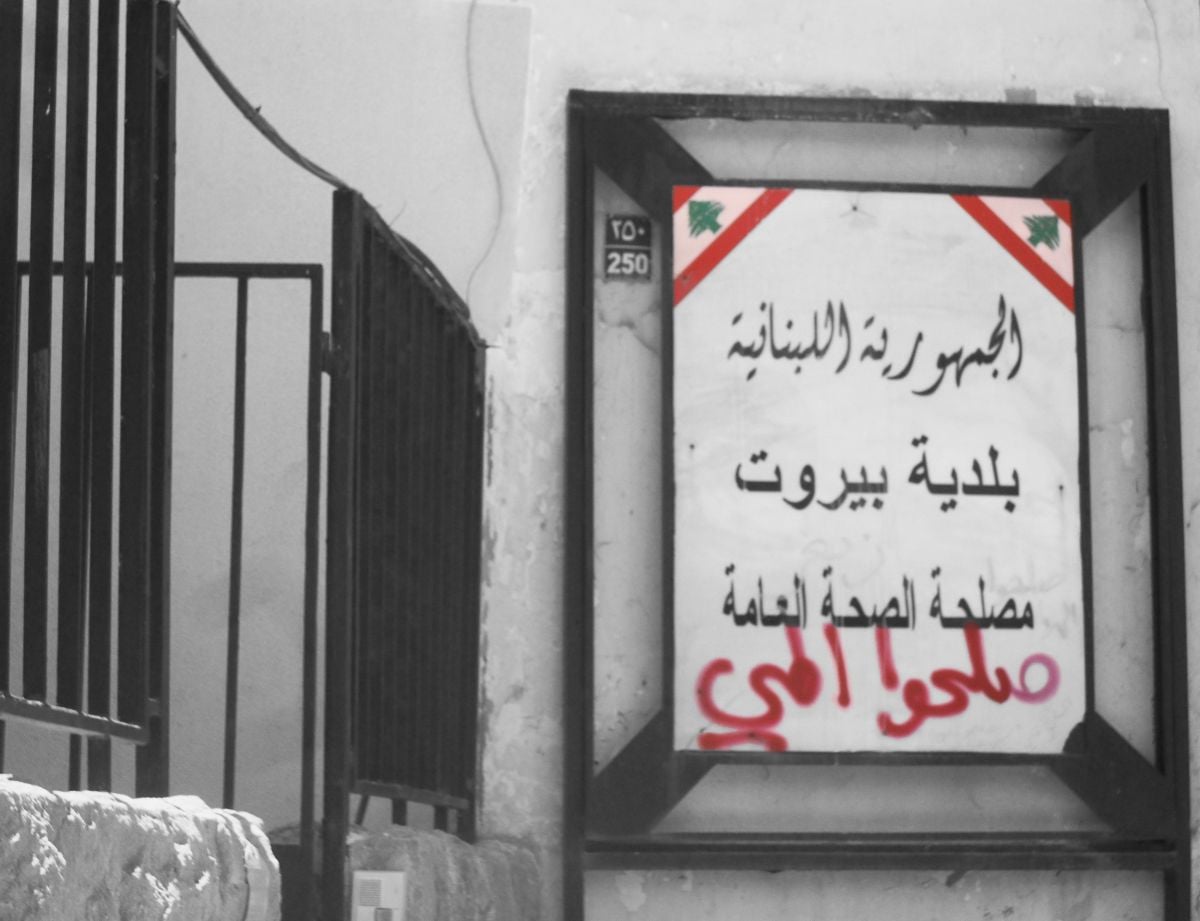
Graffiti reading “fix the water” appears on the sign at the entrance to the Public Health Department-Beirut Municipality. (Credit: Yara Malke/Edited by Celine Bejjani)






Summertime is nigh in Lebanon. I’ve been sweltering all over this week, clinging to my folding fan for dear life. The pangs of heat are only a taste of what’s coming. With the country ablaze, water shortages are sure to exacerbate the spiraling living conditions imposed by Israel’s indefinite onslaught on the country, nominal cease-fires notwithstanding.
The unique cobweb of socioeconomic and political disparities between people in Beirut means no one experiences seasonal changes — especially erratic or dysfunctional ones — the same way. Rain, cold, heat, water, and scarcity are all relative, and the gap between residents' day-to-day realities widens during war.
My friends and I escaped our broiling apartments and went out for chilled drinks a few days ago. Our conversation turned to the looming water refills we would face in the summer.
We shared our individual water truck (horror) stories. Dry giggles and knowing nods. A woman sat at the table across from ours pressed her iced lemonade to her flushed cheek as she whistled. I huffed and blurted out.
When the water tap begins coughing up the water, that’s when you know. Enter the water truckers. Our heroes. And scammers. Like an abusive relationship. Two things are certain about the final boss: his name is Abu Flen, and, despite his heartfelt promises, the truck will be late.
The woman with the lemonade chimed in.
Yes. The cost, the frequency, all so draining. But what wears me down is the waiting. It consumes my day.
The mention of the waiting game between The Call and the truck’s arrival, a parallel universe where time stands still, struck a chord. A woman looked up from her phone and added.
I always have to clear my day for it. It’s a state of emergency every time I have to refill the tank. Once, I called him and asked if he could send the guys. He said, ‘Of course, madame. Just 30 minutes and they will be at your door. Tikram 3aynik.’
Six hours later. I called more than a few times, just pleading for an answer. And all he would say was, ‘Madame, he’s on the way. I’ll check.’ He ultimately blamed the truck driver for forgetting about me during his rounds, and I had to wait until the next day for a refill.
The clientele-ist bonds — and the interactions that constitute them — between Lebanese residents and unregulated water providers reveal a shifty, situational power dynamic, one of many that spread like ivy across Lebanon’s patchy social infrastructure. A symptom of an ever-absent state.
In this house, no matter how unpredictable the informal Abu Flen institution is, I always use my indoor voice. My government won’t do the job. The water trucker will, eventually.
We both understand the code that dictates our relationship. He provides me with a basic need (at an arbitrary price, nonetheless) that no other body or institution will, and boy, does he know it.
Every time I call sheepishly for an ETA, he placates me with the cavalier confidence of an oligarch. What gets me most is the way he ends each of my increasingly desperate calls with mixed signals to boot.
I’ve often heard an expression about the Lebanese ritual of spin, both a survival tactic and a sales trick played on unsuspecting resident-clients, uncanny when applied to the context of water truckers.
El Lebneneh byekhdik 3al baher, w biraj3ik 3atshaneh [The Lebanese can take you to the sea, and bring you back thirsty].
To be fair to him, though, Hell will freeze over before I drink whatever’s in that tank.