





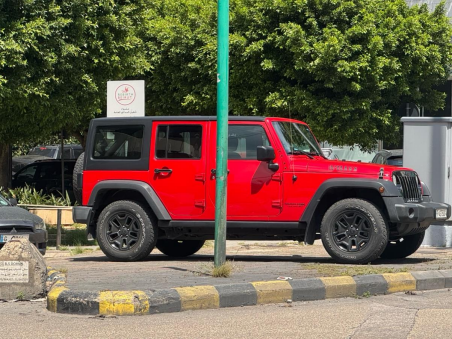
No parking, no problem. (Credit: Rana Hanna)






It has been raining a lot lately in Lebanon.
The sky has been extraordinarily generous, delivering in weeks what our country needs to survive. And yet, when the rain subsides, the water trucks will still come. They always come. Enormous, noisy, forcing themselves through streets too narrow for them, blocking passageways and entrances. The water tanker and its cousin the fuel truck: rolling monuments to everything we chose not to rebuild. Evidence of our continual decline.
This is Lebanon's most revealing image, and we have learned to ignore it. The sky gives us water and we have nowhere to put it. We have rivers, sun, wind, yet we run our homes off generators and our kitchens on plastic jugs. We are a country that no longer knows how to make use of its own abundance.
Not because we are incapable, but because somewhere along the past fifty years, we made a decision — or rather, a series of small decisions that accumulated into one: it was faster to work around the problem than to solve it. Enter the shortcut. Then we made that decision again, and again, until the workaround became the system, and the system became invisible.
In the aftermath of the plague in 15th-century Milan, Leonardo da Vinci imagined the ideal city — built on order, where infrastructure, cleanliness and design shaped not only efficiency but behavior. He believed that the visual environment significantly impacts public health and the overall quality of life. It was, as da Vinci saw it, a moral obligation as well as a necessary one. Citizens, he believed, would care for a city that cared for them.
In Lebanon, the opposite happened. The state failed, repeatedly, to provide its most basic functions. So we adapted. We built around its absence. And in doing so, we reinforced it.
When the state stopped delivering electricity, we bought generators. In many cases we became private providers, selling power to our neighbors, stringing cables across buildings. We built private institutions around the ruins of the public system because cleaning it up would have taken too long. When the roads became lawless, we parked wherever we liked — on pavements, on corners, across entrances — because if no one enforces order, why should we abide by it? At every step, we quietly relieved the state of its duties, of the pressure that might have forced it to function.
In education, results outweigh process. Grades matter more than learning. We make phone calls to smooth admissions. We hire people to write essays and sit entrance exams. Students are pushed through systems that are gradually hollowed out, and we are left wondering why the professionals they become are not quite what we needed. The behavior itself is not uniquely Lebanese. Its impunity is.
Perhaps most dangerously, we built security not as an equal right but as a service delivered by community, sect, or strongman. We traded a state that protects all for structures that protect their own. What may have once felt like survival became the architecture of the next generation — now too embedded to easily dismantle.
And then we voted for our person, perhaps more out of fear than conviction. The sectarian vote is the shortcut that makes all other shortcuts permanent. It keeps the electricity off, the water in trucks, the pavements obstructed, the exams bought. It is the choice that keeps choosing itself, election after election, while the rain keeps falling into the sea. Maybe it’s not such a bad thing that the latest elections were postponed.
I once wrote a story that is coming back to haunt me.
A person is involved in a traffic accident in which they kill their baby nephew. Unable to face reality, they flee into the woods with the child. In a remote cabin, they begin to care for him — bathing him, changing him, feeding him, lulling him to sleep, holding him through the night.
And then something begins to happen. The baby stirs, breathes, and eventually opens his eyes. After days in the cabin, he is fully alive, and the person is so overwhelmed with joy that they begin to dance, turning and turning in the morning light, holding him close.
A week later, the police find the cabin. Inside, two dead bodies.
We are that person.
We believe that we have been tending to our country — protecting it, sustaining it, each in our own way, convinced that our care is keeping it alive. But we have confused the tenderness of our attachment with the work of resurrection. We have confused short-term gains with long-lasting success. We have mistaken the hum of the generator for a heartbeat. In trying to keep a broken system going, we have only prolonged its decay.
The shortcut has become a short circuit. We cannot shortcut our way out of death but we can short circuit our way to it. We cannot truck our way to clean water or wire our way around a state that was never built. Perhaps it is time to admit it has failed, and step out of the woods before it takes us down with it.
In a recent article for al-Arabiya, author and historian Makram Rabah argues that Lebanon now faces a choice: to remain a battlefield for others, or to become a state willing to exist.
That choice asks something the shortcut never did: a commitment to the collective over individual interest, and a willingness to play the long game.
The rain will come again. Next time, I pray, we will have somewhere to put it.
Rana Hanna is the author of Birds in the Rain, a novel. She holds a Joint Honors degree in Politics and History from the University of Nottingham and an M.Phil. in Modern Middle Eastern Studies from St. Antony’s College, Oxford.

 7 p.m. recap: Iran warns Egypt, Israeli soldiers vote in south Lebanon, Haret Hreik responds to Kataeb