







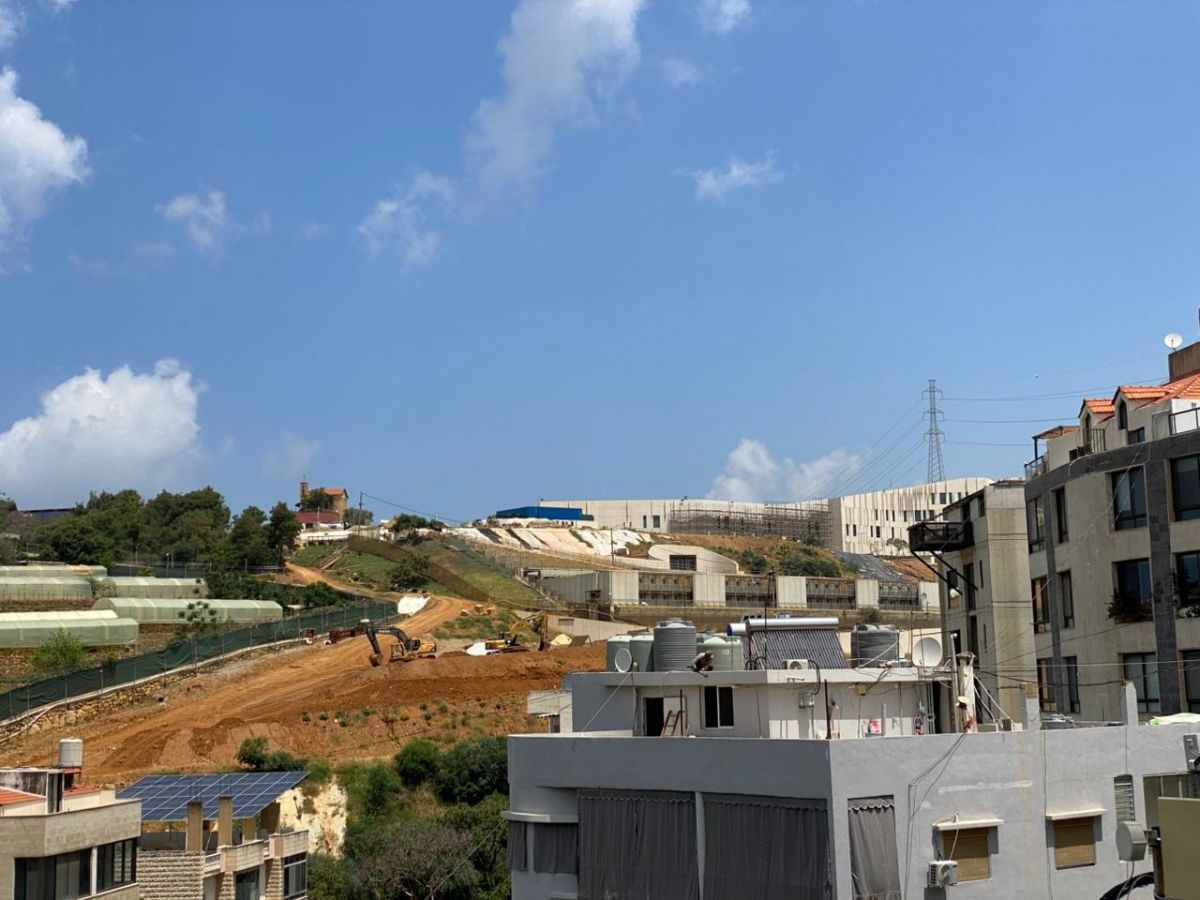
The view from my childhood bedroom. (Credit: Marguerita Sejaan)






In the early days of the war, the U.S. embassy in Lebanon, whose huge hills and outlines can be seen from my childhood bedroom’s window, sounded alarms as part of a military drill.
The first time she heard them, my mom showered (because she didn’t know when she’d “get to shower next”), got dressed, and ran down to the street. “I thought I’d rather die in the street than be buried alive by the rubble,” she later told me.
Somehow, at the same time, my sister ran into her by the gate, with two friends she had invited over. In a panic, my mom screams, “How are you bringing friends over when they’re about to strike?”
She gives them both a good look. “Enta ok, you’re displaced from Dahyeh, I get it,” she tells one of the two. “But you?” she says to the other, “You live in Zouk! Go back home!”
Everyone later laughed at her quirkiness, and as the war went on, the embassy’s military drills became part of its weekly routine.
But there remained a certain irony behind a Naccashe resident telling a Zouk resident to go home, where it’s “safer.”
At that moment, her first instinct was to delineate a boundary between the two areas: one a danger zone, but still safer than Beirut’s southern suburbs, and the other as the safest of all. Yellow, red, and green, like a hospital’s triage during disaster modes.
But hers is a Lebanese instinct, born and nurtured across khtout al-tames [military frontlines during the Civil War] and Israeli evacuation orders. We’re all living through a war. Some more than others. And some less so, as we constantly remind ourselves and those around us who “worry too much.” We remain within the imaginary lines, as if an area’s border is tantamount to an impenetrable bubble.
Around the same time, some girl-friends divulged to the group chat that they had texted their exes “to make sure they were safe.”
“But they’re all in green zones,” we replied (in so many words), and dictated that only exes in yellow or red zones could be texted.
Later, from my yellow zone, my green friends would tell me to make sure I wasn’t alone. “What would anyone be able to do against a strike? Stop it with their bodies?” I’d reply, sarcastic, proud, and terrified. I delineated my own bubble, my own khat al-tames.
But delineation was never personal. It’s always been Lebanese. There’s always been a categorization. Those who are displaced, targeted, those who can see and hear from a distance, and those in the green.
Wars are only waged on them, not us. Or on us, not them. Somehow, no matter who we are or where we’re from, we’re misunderstood, or we can’t even begin to understand. We thank God for what we have and for what we don’t.
“Haram al-nas,” the green have been saying, looking from their bubble. “I’m only upset for the people.” Another land’s people, away from ours. As if a land was ever anything but its people.
Meanwhile, nightclubs in Lebanon remained open. Lebanese diaspora told anyone who would listen that they couldn’t sleep a wink because of the war. Israeli strikes and threats displaced over a million people nationwide. Most of them still went to school, university, and work. I lost track of who is at war and who isn’t. Green, yellow, and red all turned gray.

 8 p.m. recap: Israel again threatens Beirut’s south suburbs; 2 ships hit near Hormuz; Riyadh football matches canceled