





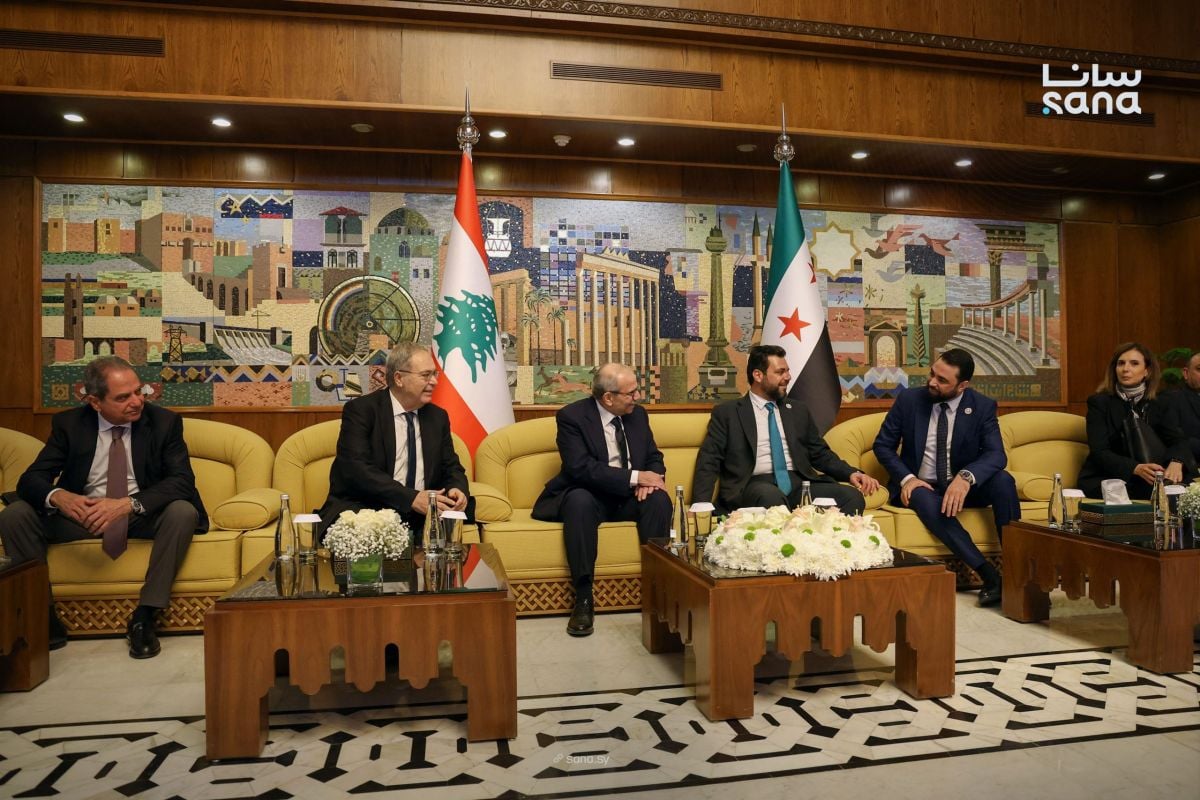
Prime Minister Nawaf Salam, accompanied by Lebanese ministers, during an official visit to Damascus, on May 9, 2026. (Photo: Sana)






BEIRUT — Prime Minister Nawaf Salam arrived in Damascus on Saturday morning at the head of a ministerial delegation as part of an official visit aimed at "strengthening cooperation in several sectors" with the Syrian authorities.
Salam said Friday that this visit aimed to "strengthen bilateral relations in the fields of economy, transport, and energy," while also tighten relations "with Syrian leaders to resolve outstanding issues between Lebanon and Syria in a spirit that serves the interests of both nations."
The Lebanese delegation included Deputy Prime Minister Tarek Mitri, Minister of Economy and Trade Amer Bisat, Minister of Public Works and Transport Fayez Rasamny, Minister of Energy and Water Joe Saddi, as well as the prime minister’s adviser, Ambassador Claude Hajal. Each minister was scheduled to hold a series of separate meetings with their Syrian counterpart before a broader meeting with Syrian President Ahmad al-Sharaa at the People’s Palace.

From the fate of missing persons to border security, via the transit of goods and the judicial cooperation agreement, the scope of the discussions held in Damascus between Salam and Sharaa was wide-ranging. On leaving the Syrian capital after a day of talks with the authorities, Salam stated that “significant progress” had been made and that this would soon bear fruit. The regional situation and its impact on the two countries, both of which have territories occupied by Israel, were also the subject of consultations.
Speaking at Damascus airport before his return to Beirut, Salam stated that Lebanese-Syrian relations are based on “trust and mutual respect for the sovereignty” of both countries, following decades of relations with the former Assad regime marked by Syrian control over Lebanese politics. Since the fall of Bashar al-Assad, the authorities of the two neighboring countries have been striving to work on numerous issues.
Outstanding issues and new initiatives
“Significant progress” was made during the day on these “shared issues, particularly those that remain outstanding”, said Nawaf Salam, who hopes to see “concrete results in the near future”. In addition to these issues, which were raised over a year ago, discussions were also held on “new initiatives”.
Salam and Sharaa, along with several ministers present, examined in particular the follow-up to the judicial agreement on the transfer of Syrian detainees to Lebanon, the return of refugees and the “fate of missing persons and victims of enforced disappearance in both countries.”
Regarding the two countries’ shared border, known for its porous nature and not fully demarcated, both sides “stressed the need to strengthen control of this demarcation and to combat smuggling in all its forms,” according to the Prime Minister. At the same time, they discussed issues relating to land transport, whilst a provisional mechanism is in place for the transit of goods, as well as the possibility of a “rail link.” On the trade front, it was decided to "develop preferential trade and encourage investment." To this end, a "Lebanese-Syrian Business Council" is to be set up shortly and hold its first meeting "in the coming weeks" in Damascus, Salam stated.
Regional 'challenges' and security cooperation
The discussions also focused on improving the electricity networks between the two countries to “facilitate the supply of electricity to Lebanon from and via Syria, as well as on the conclusion of a natural gas transit agreement,” he continued.
Salam and Sharaa also discussed the “major challenges facing Lebanon and Syria in the context of rapid regional developments on several fronts,” said the Prime Minister, who added that consultations on this matter would continue. A statement from the Syrian presidency, meanwhile, reported discussions on “strengthening security coordination” in the face of these “challenges.”

The visit by the high-level Lebanese delegation to Damascus took place at a time when Damascus regularly accuses Hezbollah of being involved in plots for attacks on Syrian territory — claims that the group denies — and while Israel continues to occupy Syrian and Lebanese territories and expresses intentions to expand its occupation further.
Among the issues to be discussed is also expected to be the matter of Lebanese missing in Syria, which has come back to the forefront since the fall of the Bashar al-Assad regime in December 2024, with Beirut seeking clarification on hundreds of cases. Salam is also expected to address the case of forcibly disappeared Lebanese journalist Samir Kassab. Information Minister Paul Morcos had said Thursday that in coordination with his Syrian counterpart, he had transmitted the file of the Sky News Arabia cameraman so that it may be examined during Salam’s visit. Kassab disappeared on Oc. 15, 2013, along with two colleagues, and his fate remains unresolved to this day.

 7 p.m. recap: Iran warns Egypt, Israeli soldiers vote in south Lebanon, Haret Hreik responds to Kataeb