






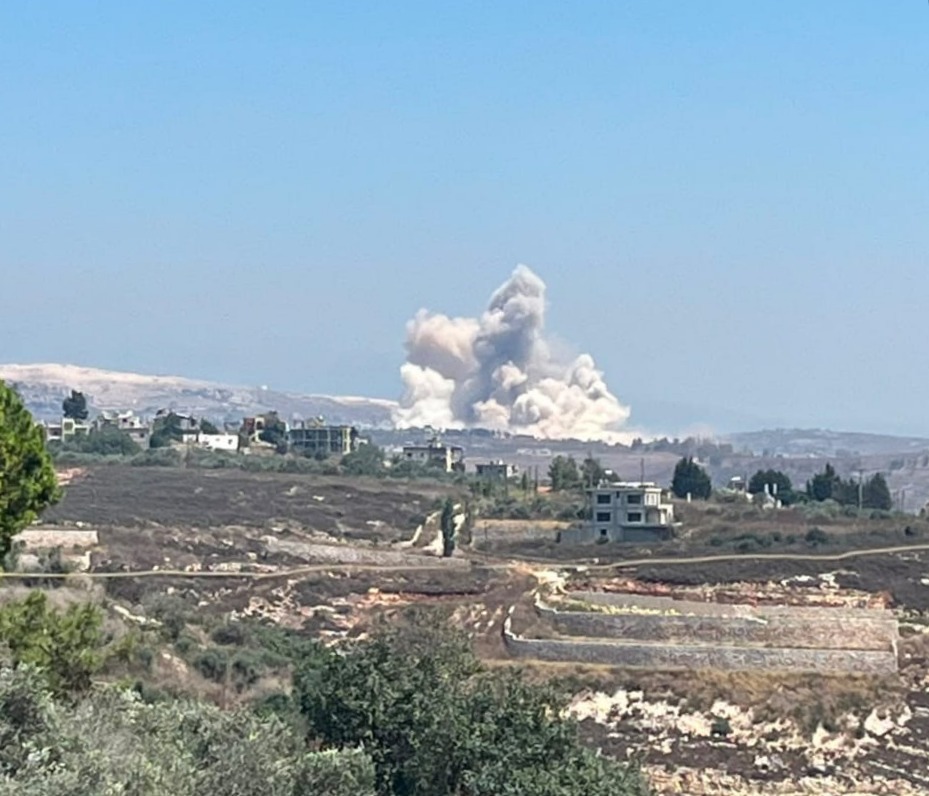
A major explosion was observed on Aug. 20, 2026, around 2 p.m. in the village of Zawtar Sharqieh, Nabatieh. (Credit: Muntasser Abdallah/L'Orient-Le Jour)






BEIRUT — The scale of the ongoing destruction in southern Lebanon prompted Prime Minister Nawaf Salam to reiterate Thursday that supporting border villages is a "national priority."
Amid dozens of villages demolished and razed by Israel in the occupied border strip, a few Christian and Sunni communities still shelter thousands of people. Cut off from the rest of the country, they live in particularly difficult conditions.
While receiving the mayors of two of these villages, Rmeish and Dibil, Hanna Amil and Akl Naddaf, at the Grand Serail, where they discussed the living conditions of their residents, Salam stated that "government support for the resistance of the southern border villages is a national priority," as is maintaining "a continuous and secure link to these villages to ensure their basic needs are met."
Since the resumption of the war between Hezbollah and Israel on March 2, these border towns have been completely isolated and rely primarily on foreign aid for their survival.
This aid is delivered sporadically due to the Israeli occupation, which prevents any unauthorized movement within the de facto "buffer zone" it has established in the South. The prime minister praised "the resilience of these residents who remain in their villages" and affirmed that "the state will continue to stand by them." The two elected officials outlined to him the means of maintaining acceptable living conditions, emphasizing the need "to maintain the presence of state institutions in this border region."
Interior Minister Ahmad Hajjar also took action, meeting with municipal delegations from southern Lebanon who came to share their difficulties. He assured them that "the towns and villages of the South will be rebuilt thanks to the will and determination of their inhabitants, as well as the efforts of their municipalities." "Lebanon will rise stronger than ever," he insisted.
UNIFIL 'fulfilling its mandate'
The United Nations Interim Force in Lebanon (UNIFIL), whose mandate ends at the end of the year, stated that "civilians are bearing the brunt of the conflict," including disruptions to daily life, uncertainty and the risk of displacement. It emphasized the role of peacekeepers in "reducing tensions, preventing misunderstandings, and maintaining communication channels" in order to prevent "further escalation."
Drawn from some 50 countries, the U.N. peacekeepers "continue to fully carry out their mandate and maintain a visible presence" throughout southern Lebanon, notably through patrols, monitoring and coordination operations, and support for humanitarian partners. UNIFIL also called on all parties to renew their commitment to Resolution 1701, refrain from any violations and avoid "provocative" actions.
Hezbollah, for its part, once again attacked the framework agreement concluded in June between Israel and Lebanon to establish "pilot zones" where the Lebanese Army would be tasked with disarming the movement.
The parliamentary bloc "Loyalty to the Resistance" condemned the attacks and destruction, accusing Israel of "hiding behind the framework agreement" to "continue its crimes" and the Lebanese authorities of persisting in "an attitude of surrender, capitulation, and concessions," which it said was encouraging Israel to continue "its massacres" and commit "crimes of genocide."
It called on the authorities to "declare the framework agreement dead and withdraw from the negotiations and their shameful sessions."
Continued Israeli attacks
Meanwhile, in southern Lebanon, Israeli attacks have continued on several localities since dawn Thursday, according to our correspondent. Troop movements were notably observed in Haddatha (Bint Jbeil), which was the site of a large explosion around 7 a.m.: Several houses were dynamited. Around 2 p.m., another large explosion was heard in Zawtar Sharqieh, in the Nabatieh district.
At midday, machine gun fire targeted Talloussa (Marjayoun), while artillery fire was reported between this village and Markaba, also in the Marjayoun district. Simultaneously, artillery fire targeted the area between Houla (Marjayoun) and Shaqra (Bint Jbeil), as well as the town of Mansouri (Sour).
A large explosion, preceded by artillery fire, occurred around 9:30 a.m. in this village, which has been targeted almost daily for several days. During the night, Nabatieh was bombarded by the Israelis, with successive raids around the strategic Ali Taher hill in particular. Intriguingly, following the dropping of very heavy bombs on a hill near Ali Taher, Dabsheh, and near the village of Dohat Kfar Roummane, witnesses reported a foul odor, though they could not identify its source. Artillery fire also targeted Wadi Slouqi, near Touline (Marjayoun), while Khiam, in the same region, was rocked by a massive explosion.
Later in the day, an Israeli army drone dropped a stun grenade on Mansouri, while a Merkava tank fired several shells at the outskirts of Braasheet (Bint Jbeil). The Israeli army also carried out an explosion in Tiri (Bint Jbeil), set fire to houses in Talloussa and conducted artillery fire on Mansouri, reports our correspondent in southern Lebanon.
Israeli military vehicles were also reported on the western outskirts of Mais al-Jabal (Marjayoun), accompanied by artillery fire against several houses and bursts of machine gun fire, while a fire broke out in the area.
Reporting contributed by our correspondent in southern Lebanon, Muntasser Abdallah
