












First, there is him. He hails from southern Lebanon, but not always. He is Shiite, but not always. He hasn’t slept in a month. He’s angry at the whole world; at those who watch Israel destroy Lebanon with impunity. At the Lebanese Army, which pulled back its soldiers from south of the Litani River in the face of Israel’s advance. At the state, which wants to negotiate with the enemy and disarm Hezbollah. At other Lebanese, who give him the feeling that they do not care, neither about southern Lebanon nor about the Shiites.
He is losing everything: his village, his community, his memories and his future. So, he lashes out to the point of seeing anyone who does not think like him as a traitor or an enemy. Anyone who has not lived through the Israeli occupation firsthand, not endured the humiliations at every checkpoint, not been haunted by the Khiam prison. Anyone who has not lost a mother, a father, a sister, a brother, a son, a daughter or a friend in an Israeli strike. Anyone who has not seen their home destroyed two or three times in 20 years.

He is not a member of Hezbollah. Not even a staunch supporter. He has no ties to Iran and no allegiance to wilayat al-faqih. He can criticize the party-militia for its actions on the domestic stage or its positions on social issues. But he did not miss a speech by former Hezbollah leader Hassan Nasrallah. It was his refuge. His pride. The one who made him feel strong. The one who gave him everything. Everything has been different since he is gone. But he cannot bring himself to turn his back on the “Resistance.”
He does not fathom why the party went to war to avenge Khamenei’s death on the night of March 2 to 3. He resented it for this. Deeply. Then he forgave it, as one forgives a father who has made a mistake.
In his eyes, Israel wants to seize southern Lebanon and stir divisions among the Lebanese. It embodies evil itself, brutality and hypocrisy. It will turn Lebanon into another Gaza. He finds it incomprehensible that other Lebanese do not see it. To him, it is obvious: either they are blind or they are complicit. In his view, Hezbollah is the last barrier against Israeli imperialism and colonialism. If it loses, the enemy will permanently occupy southern Lebanon and perhaps more.
If Hezbollah lays down its arms, his Lebanon is finished.

Then there is she. She hails from Beirut, the North or Mount Lebanon, but not always. She is Sunni, Christian or Druze, but not always. She hasn’t slept in a month. She is angry at the whole world; at those who watch Hezbollah drag Lebanon into its own destruction without reacting. At the army, which was supposed to disarm the party and has done almost nothing for more than a year. At the state, seen as either complicit or passive in the face of a party that has hollowed out Lebanon from within. At those Lebanese who, in her eyes, are ready to sacrifice everything, including her life, for the survival of Hezbollah and the Iranian regime.
She was horrified by what Israel did in Gaza. She has no sympathy for the Israeli state. But she can no longer bear to fight it. Wars fought for others that have led nowhere, including for the Palestinians, and have ruined her entire life. She wants to believe that Israel is a threat to Lebanon. But she did not forget that many in southern Lebanon once welcomed Israeli soldiers with rice, relieved to be rid of the Palestine Liberation Organization (PLO) in 1982.
She says that the Israeli army occupied southern Lebanon for more than 20 years without annexing it or establishing any settlements. She also points out that since its withdrawal in 2000, Hezbollah has triggered three wars with Israel that brought nothing but devastation to Lebanon, and above all to the Shiite community. And that it is the “Resistance” itself that is now provoking the invasion it is supposed to prevent.
In her eyes, Hezbollah has silenced Lebanon’s freest voices, carried out a coup in 2008, committed atrocities in Syria, stored the ammonium nitrate at the Beirut port and repeatedly threatened other Lebanese with civil war. To her, it is far more dangerous than Israel.
If Hezbollah wins this war, her Lebanon is finished.
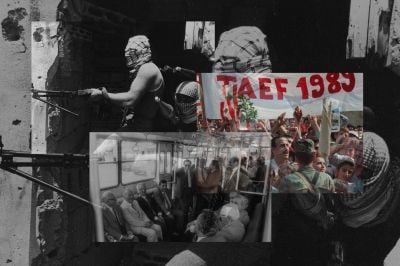
She and he are the more moderate versions of their respective camps. Among those around her, some hope Israel will finish off Hezbollah, say the Shiites are getting what they deserve and are already preparing for what comes next by taking up arms again.
Among those around him, people spit on “traitors” and threaten to deal with them once Israel is dealt with.
Between them, dialogue is impossible. Conflict, whether in words or in arms, is inevitable. How can a country be built like this? How can a nation be forged? How can it avoid tearing itself apart during and after this war, when views of its causes are so radically opposed and expectations for its outcome are just as divided?
Hatred is everywhere — within every community, every city, every neighborhood, every family and every Lebanese. This is nothing new, and we know all too well where this spiral leads.
The same causes produce the same effects. An armed militia, a divided country, a passive state, a belligerent neighbor. All the ingredients are in place for another descent into the abyss.
Civil war is on everyone’s mind. So is the idea that living together may no longer be possible. That separation may cost less than a relationship that has become increasingly forced.
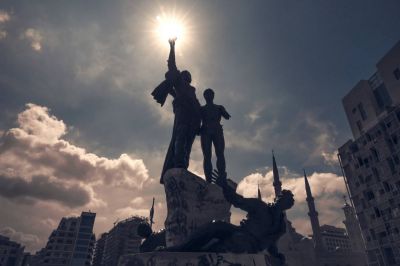
So what do we do? Do we give up on Lebanon? On this “country greater than itself” that could have been, that should have been, a world of its own? Or do we keep fighting for the idea of Lebanon to survive in a world and a time fundamentally at odds with it?
But with what tools? How can his narrative be reconciled with hers? One can try to reconcile the pain, and that is already a great deal. To speak to all Lebanese in a single voice, to the one sleeping in a tent as well as to the one who fears taking in a Shiite family and becoming the target of an Israeli strike, to the one who has suffered so much from Israel, as well as to the one who has suffered so much from Hezbollah.
This is an essential starting point, but unfortunately not enough. All suffering is legitimate, but not all the narratives built around it are.
Between 1969 and 1975, the Lebanese state did not act to disarm the PLO, which sought to liberate Palestine from Lebanese territory. The country was divided, the state too weak and the risk of civil war was on everyone’s mind.
Nothing was done, to avoid the worst. And the result was the worst of all: 15 years of civil war and a double Syrian and Israeli occupation. But what is the point of saying all this if it cannot convince anyone?
This article was originally published in French in L'Orient-Le Jour and was translated by Sahar Ghoussoub.
A reality that unfortunately leads nowhere.
02 April 2026 03:29