







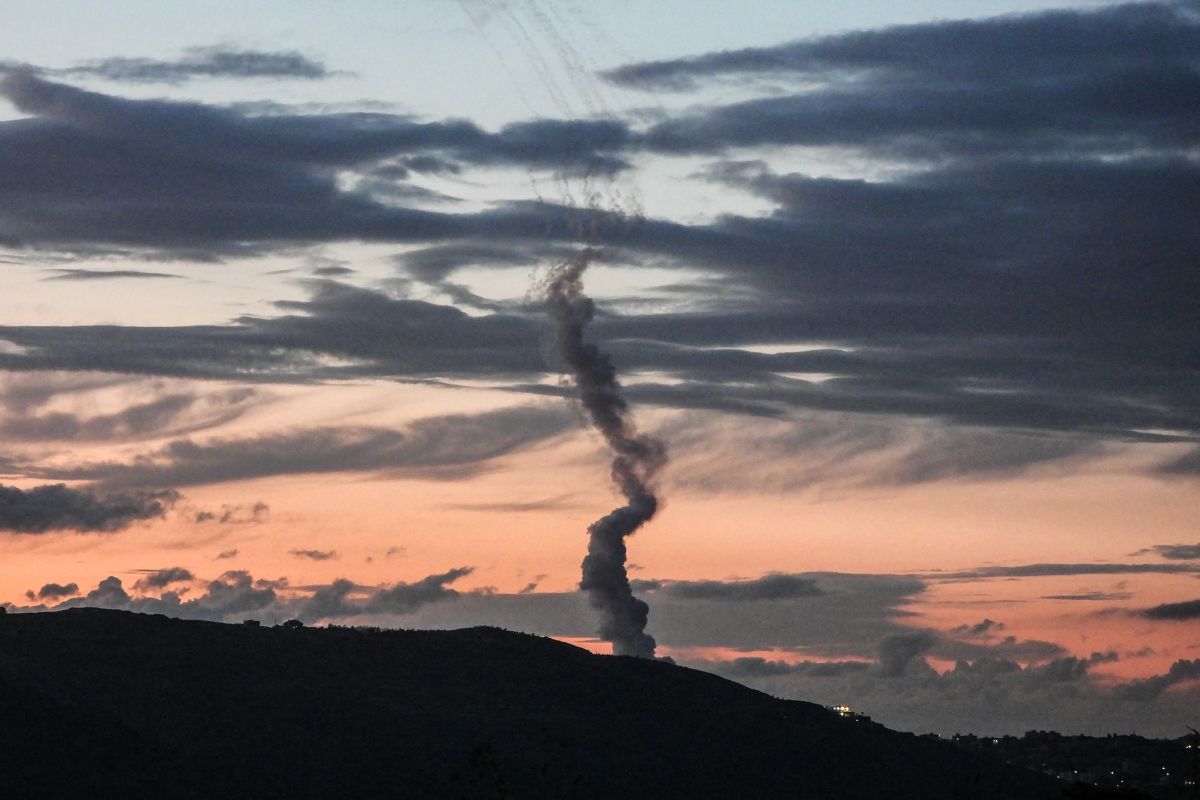
A photograph taken from the southern Lebanese area of Marjeyoun shows trails of rockets fired from Lebanon towards Israel on March 24, 2026. (Credit: AFP)






SOUTH LEBANON — Israeli Prime Minister Benjamin Netanyahu wants an "expanded" buffer zone in southern Lebanon, and experts cited in Israeli press expect that an occupation of the region south of the Litani could last "more than a few months."
Tel Aviv is openly pursuing its objectives as the Israeli Army intensifies airstrikes and ground operations in Lebanon.
On Sunday, dozens of strikes hit villages across the south — from Nabatieh to Bint Jbeil — while ground fighting between Hezbollah and Israeli troops spread across multiple fronts, including advances toward Shamaa and Ainata.
To counter this, the Shiite party claimed attacks both against these territorial gains and against positions established by the Israelis in already occupied villages such as Houla and Khiam, saying it targeted vehicles and "repelled" with surface-to-air missiles a fighter jet and a helicopter in southern skies.
In a video statement, Netanyahu said he had ordered the Israeli army "to expand the security zone" in southern Lebanon, "in order to permanently neutralize the threat of invasion and to push anti-tank missile fire away from the border."
Shortly before, sources from the Israeli newspaper Yedioth Aharonoth estimated that the Israeli army could remain in southern Lebanon "for months, if not longer."
A security official said that, due to the Lebanese government’s inability to disarm Hezbollah, the Israeli Army should remain deep inside Lebanon for “at least several months, possibly years.” Even in the event of a ceasefire, military officials cited by the newspaper said the army should not withdraw.
Bayyada captured and push toward Ainata
These comments came as Israeli advances continued in the south, especially south of Sour toward Shamaa, after the locality of Bayyada appears to have fallen into Israeli hands.
During the day, Hezbollah and the Israeli army clashed in this sector, sometimes in close-quarters battles. In Bayyada, Hezbollah claimed to have hit at least three Merkava tanks, while in Shamaa, fire from the pro-Iranian group "forced back" an Israeli force advancing toward the village.
Hezbollah said it used a "tandem charge" on a Merkava tank "which caught fire." These double charges are designed to pierce armored vehicles protected by explosive reactive armor. However, Israeli soldiers reportedly deployed near the barracks recently evacuated by the Lebanese Army in this village, according to our correspondent in the south. It is in this area that the 146th brigade of the Israeli army, an armored division under Northern Command, announced it had "expanded" with its operations the buffer zone that Israel wants to establish and 'progressed toward another objective."
According to Israeli Channel 14, this division was active in recent days around Bayyada and reportedly took the Ras Bayyada area in a few hours.
In the center of the border strip, Hezbollah claimed several attacks, especially around Ainata. This village is located just over four kilometers from the closest point on the Blue Line, on the eastern outskirts of Bint Jbeil. According to Hezbollah, attacks were launched multiple times Sunday with rockets against Israeli soldiers advancing toward this locality.
Hezbollah's surface-to-air missile fire
In the eastern sector, Hezbollah also said it targeted with drones a Hummer vehicle and a bulldozer east of Khiam prison, a locality already captured by Israel, and claimed attacks on Israeli soldiers around Qantara. Additionally, the Israeli army blew up houses in the nearby village of Deir Seryan, where fighting was also reported by the pro-Iranian party. While Israeli media reported that the army had reached the banks of the Litani River in that area, military sources told Yedioth Aharonoth that the Israeli army does not yet have a permanent position there but operates in a "mobile" manner.
Hezbollah, moreover, announced the firing of surface-to-air missiles at an Israeli plane over Nabatieh and then at a helicopter over the skies of Naqoura, and said it "shot down a drone" at Mansouri (Sour). It also claimed to have fired a series of rockets and launched multiple drone attacks on positions in northern Israel and the Golan Heights occupied by Israel.
Alongside these ground battles, Israeli airstrikes and artillery shelling continue relentlessly across all sectors of southern Lebanon, from the heights of Jezzine to the fringes of the border, including the regions of Sour, Bint Jbeil and Marjayoun. White phosphorus shelling was also reported by our correspondent, while two Islamic Health Committee paramedics (Hezbollah) were killed in the morning in a strike on the city of Bint Jbeil.
According to the Health, Ministry these incessant Israeli attacks have killed 49 people in the past 24 hours, bringing the total death toll since March 2 to 1,238. Since Saturday evening, 116 people have also been injured, for a total of 3,543 since the start of the Israeli offensive. Among the dead, 87 were women, 124 children, and 52 medical personnel or rescuers.

 8 p.m. recap: Israel again threatens Beirut’s south suburbs; 2 ships hit near Hormuz; Riyadh football matches canceled