






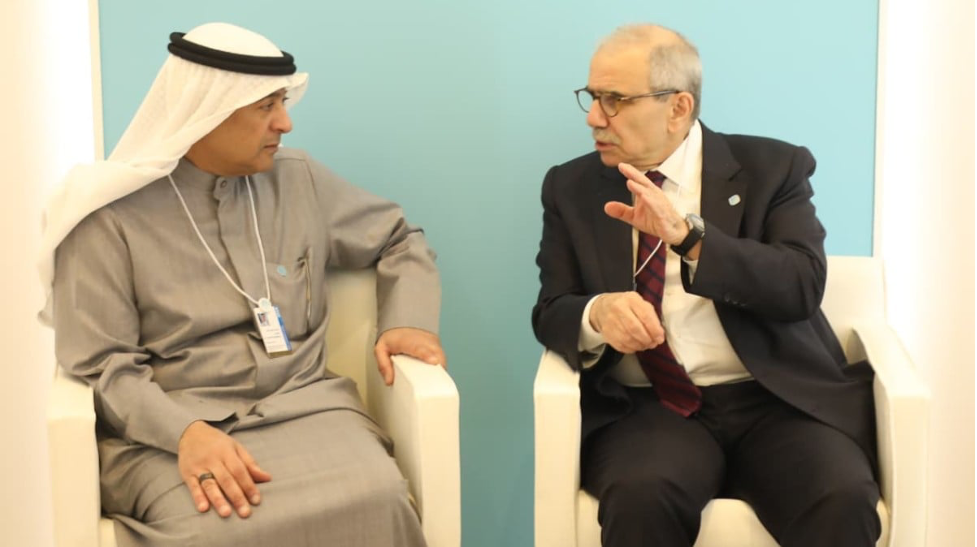
Nawaf Salam meeting with the Secretary General of the Gulf Cooperation Council, Jassem el-Budaiwi. (Credit: Grand Serail’s X account.)






From Baabda or from Dubai, the president of the Republic and the prime minister reiterated on Tuesday their desire to keep the specter of war at bay and strengthen the state’s position. Meanwhile, Hezbollah’s secretary general, Naim Qassem, returned to the fray, once again rejecting the disarmament of his militia north of the Litani and declaring that it would not accept being “humiliated” by Israel, as pressure mounts in the south.
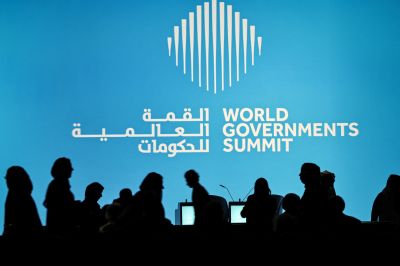
Prime Minister Nawaf Salam said at the World Government Summit in Dubai that he “will not allow” Lebanon to be “dragged into a new adventure,” against a backdrop of tensions between Iran and the United States. “Especially since the cost of engaging in a war of 'support for Gaza' has been extremely high,” Salam continued, as quoted by the state-run National News Agency (NNA). “We must protect ourselves by rallying around the state and avoiding dragging Lebanon into adventures that do not concern it,” he added.
“We have worked to reclaim the decision over peace and war, and the proof is that, for the first time since 1969 [the year of the Cairo Agreement legalizing the presence and armed actions of the Palestinians in Lebanon], the State, through the army, has imposed full operational control over the south of the country.” Nawaf Salam also called on “Arab brothers” to participate in the international conference in support of the Lebanese army set for March 5 in Paris. “We need their support,” said the prime minister.
This international conference in Paris, to be opened by French President Emmanuel Macron, is organized by the Quintet (France, Saudi Arabia, Egypt, Qatar and the United States) and aims to bolster the Lebanese army in implementing the cease-fire agreement and deploying in southern Lebanon.
The prime minister also said that “sovereignty and reform are two essential pillars to save Lebanon, and we want to return security to the Lebanese.” “[Restoring] sovereignty will enable the Lebanese state to extend its authority over all of its territory, and this reform will restore international confidence in Lebanon and its economy. All we ask of our Arab brothers and the world is to support us, not to substitute themselves for us,” he continued.
International aid to Lebanon, and, more generally, investments, according to Salam, are conditioned on Hezbollah’s disarmament and the implementation of structural reforms, following the 2019 economic and financial crisis.
In this context, he believes that “renewing the Lebanese administration allows all Arab brothers and expatriates to feel safe, which is a key factor in encouraging investment.”
Aoun: Spare Lebanon
As for the president of the Republic, he confirmed from Baabda, where he received a gathering of political figures hostile to Hezbollah, including Tripoli MP Ashraf Rifi, that he was “working with all concerned parties to prevent the country from being dragged into a new war, because the Lebanese people can no longer bear more conflict, and because international circumstances have created new realities that require a realistic and rational approach to protect Lebanon and its citizens.” This is a clear allusion to fears of Hezbollah potentially intervening alongside the Islamic Republic in case of American strikes against Tehran.
“I hope that the efforts to spare Lebanon from danger will be met with understanding and positive commitment,” the head of state added. The “rational” approach mentioned by Mr. Aoun echoes his earlier calls in January for the pro-Iranian Shiite party to act with “reason,” amid Hezbollah’s refusal to hand over its weapons north of the Litani, despite the government’s decision to that effect in August 2025.

“The return of international confidence in Lebanon is a natural consequence of the efforts we are making to rebuild the state on solid foundations, notably through the establishment of the rule of law and a monopoly on weapons” in the hands of the state, President Aoun also said. “These are two irreversible principles ... and we are working to achieve them,” he added. “There is no question of suspending the commitments I made in my inauguration speech,” on Jan. 9, 2025, he added.
For his part, deputy prime minister Tarek Mitri, interviewed Tuesday by Saudi outlet al-Hadath, said he “hopes Hezbollah will act rationally again, should a war against Tehran break out.” He added that he rejects “any involvement in a regional war or the transformation [of Lebanon] into an arena for other people’s wars,” while noting that “Hezbollah refuses to hand over its weapons north of the Litani.”
Qassem: 'You cannot ask anything more of Lebanon'
For his part, the head of Hezbollah, during a ceremony, accused “some ministers of dragging Lebanon into discord,” stating that “nothing more can be asked of Lebanon” and that pressure must now be placed on “the American and Israeli enemy to enforce the agreement” of truce signed in Nov. 2024 between Israel and Hezbollah.
“They tell us our capabilities are limited and that the Israelis can kill us. Our response is that there is no way we will accept humiliation. And between humiliation and martyrdom, we choose martyrdom,” Naim Qassem declared forcefully.
The Israeli army carried out another major wave of air strikes against towns north of the Litani River, notably Kfar Tibnit and Ain Qana in the Nabatieh district. An hour after online threats of strikes, Israeli fighter jets successively targeted two buildings in the above-mentioned towns, claiming to hit Hezbollah infrastructure.
Naim Qassem argued that these Israeli strikes targeted the “social environment” of the people of southern Lebanon and aimed to “push people to submit and abandon resistance.”