






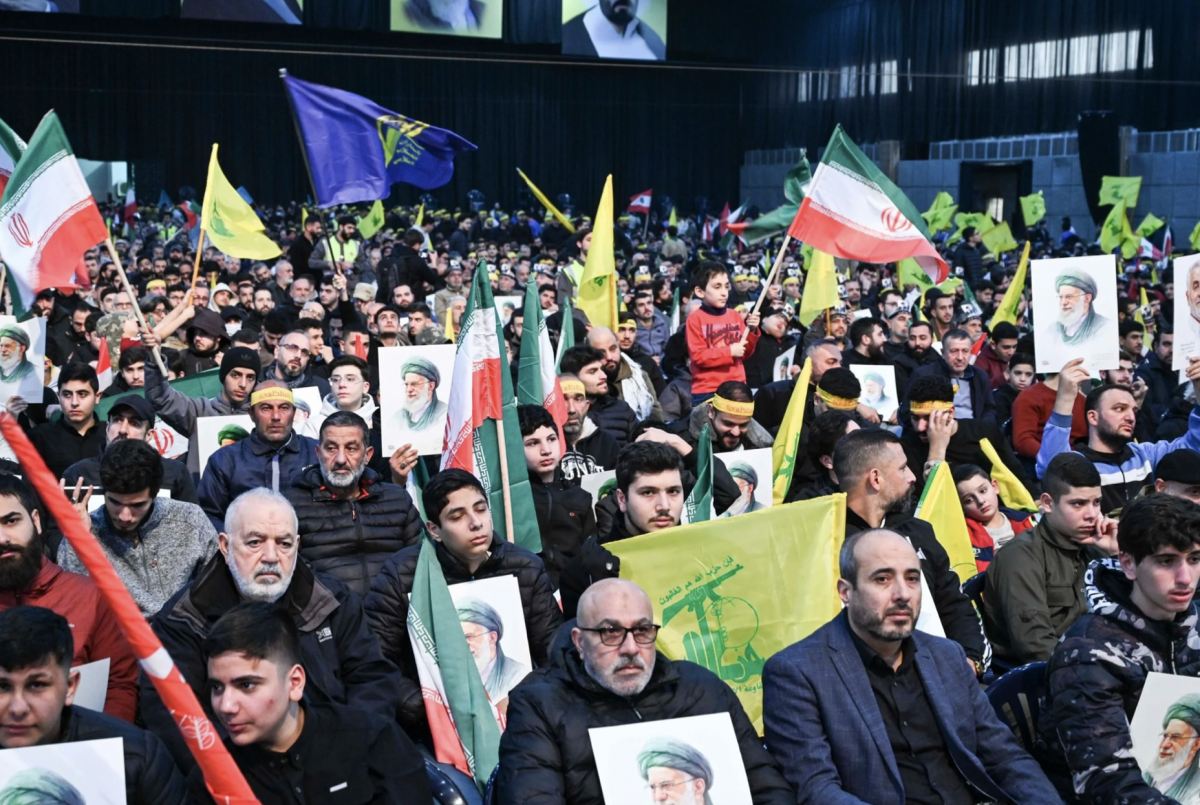
A crowd of Hezbollah supporters listening to the Secretary General of Hezbollah, Naim Qassem, on Jan. 26, 2026. (Credit: Mohammad Yassin/L'Orient-Le Jour)






BEIRUT — Hezbollah Secretary-General Naim Qassem's speech on Monday sparked criticism from across political spectrum after saying his party was "concerned by the need to face the threat" posed by the United States against Iran and was "not neutral" in any conflict involving Iran.
Various political parties, figures and a source close to the presidency condemned the remarks, delivered in a speech.
The Lebanese presidency, while declining to comment "officially," emphasized that the state maintains sole authority over decisions on war, peace, and the country’s arms monopoly. "We reiterate that the decision has been made," the source told L'Orient Today. President Joseph Aoun “will not back down on this issue,” the source added.

The president and Prime Minister Nawaf Salam's government have long opposed Iranian political influence in Lebanon and have called for Hezbollah’s disarmament. Meanwhile, the Lebanese Army is expected to present a plan in February for Hezbollah's disarmament north of the Litani River. Hezbollah, however, has refused to hand over its arsenal in this area, raising fears of potential internal unrest.
Several political parties voiced criticism
"It's Irresponsible, irresponsible, irresponsible," Walid Joumblatt, former leader of the Progressive Socialist Party (PSP) and Druze political leader, told us. Joumblatt accused Qassem of "provoking the Israelis" and warned that the remarks threatened the government’s "good progress" on the army’s plans in the South. "I don’t know why he wants to drag some of the Shiites and Lebanon into the war," Joumblatt added.
The Lebanese Forces party (LF), which has long prioritized Hezbollah disarmament, dismissed the remarks as "only sound bombs," spokesman Charles Jabbour told us. "Sheikh Qassem believes he can revive the theory of the unity of the fronts," he added referencing the 'Axis of Resistance,' under Iran's leadership, which suffered major blows following the 2023 wars in Gaza and later Lebanon. "But this time, the decision is made by the official power," Jabbour added. "I believe that the state will take the necessary measures in the face of any adventure by Naim Qassem."
LF MP Fadi Karam told local al-Jadeed TV that the speech "could drag the country into devastating wars" and that Hezbollah "does not care about Lebanon."
Hezbollah had opened a 'support front' to Hamas against Israel on Oct. 8, 2023, sparking an all-out war in Lebanon the following fall. The war concluded with a fragile cease-fire in November 2024, while the Israeli offensive in Gaza continued until October 2025.
The Free Patriotic Movement (FPM), Hezbollah’s former ally, also criticized Qassem. Speaking to L'Orient Today, Martine Najm Kteily, the party’s vice president for political affairs, called his remarks "a challenge to the state" and its decision in regards to arms monopoly. "We refuse to allow Lebanon to be dragged into a war to support a country, especially after the disastrous consequences of opening the support front in Gaza," she said. Relations between the FPM and Hezbollah have deteriorated since the 2023–2024 attrition war.
In a post on X, FPM leader Gebran Bassil described Qassem's speech as "distressing," warning it risks dragging Lebanon into further destruction rather than protecting it. He said the "unity of the fronts and the support front war have destroyed the party and Lebanon, undermining the deterrent function of arms."
Bassil also referenced the 2006 document of understanding between the FPM and Hezbollah saying: "The foundation of the document of understanding was the Lebanization of the choices of the party and its arsenal, through partnership, state-building and the defense of Lebanon. The agreement fell when these pillars collapsed."
Heated exchange in Parliament
The debate spilled into Parliament on Tuesday.
Firas Hamdan, an independent MP, condemned Hezbollah’s speech. He criticized what he called the "instrumentalization of the residents of the South and of the Lebanese as bargaining chips ... in a regional conflict to defend Iran," which he noted offered no assistance when southern Lebanon was bombed in autumn 2024.
The Parliament Speaker and Amal Movement leader, Nabih Berri, interrupted Hamdan, insisting the discussion stay on the draft 2026 budget.
Hezbollah-affiliated MPs Ali Mokdad and Ali Fayad responded sharply. Mokdad called the attacks on a "friendly and brotherly state" unacceptable. Meanwhile, Fayad reiterated, "I'm not talking about politics, but about principle ... attacking another state is an unacceptable thing."
Upon his arrival in Parliament, Labour Minister Mohammad Haidar, aligned with Hezbollah, told MTV that Qassem "expressed his opinion; for out part, as a government, we take our decisions in the Grand Serail and remain committed to respecting the ministerial declaration,” which stipulates that the state alone is responsible for defending its territory.
Meanwhile, the Islamic Republic of Iran, Hezbollah’s regional patron, welcomed Qassem’s remarks. The Iranian embassy in Lebanon described Lebanon’s position as "honorable" and underscored the "indissoluble brotherhood" between the two countries in a statement posted on X on Monday.
