







The Secretary General of Hezbollah, Naim Qassem, during an interview on Feb. 3, 2026. (Credit: Screenshot/ al-Manar)






Hezbollah Secretary General Naim Qassem accused "certain ministers of dragging Lebanon into discord" on Tuesday, asserting that "nothing more can be demanded of Lebanon" and that pressure must now be put on "the American and Israeli enemy to enforce the cease-fire agreement" reached in Nov. 2024 between Israel and Hezbollah. This message confirms the Shiite party's position, which opposes disarmament north of the Litani River, and comes as the Lebanese army's commander-in-chief, General Rodolphe Haykal, is in the United States to review the progress of the disarmament plan, the second phase of which concerns the area north of the Litani.
Speaking at a ceremony marking the 33rd anniversary of the Islamic Institution for Education and Teaching – al-Mahdi Schools, Naim Qassem emphasized: “What is needed is to exert pressure on the American and Israeli enemy to implement the agreement and end the aggression.” He also addressed a message to Lebanese officials: “Explain to them that you cannot exert pressure on your fellow citizens, because they have given so much and made sacrifices.”

The head of the Shiite party denounced "certain ministers within the government," asserting that "they are leading Lebanon into discord, plunging it into darkness, and acting as if the government were merely a pawn in the hands of the party for which they work." Tasked by Nawaf Salam's government with restoring the state monopoly on weapons, the Lebanese army recently announced the completion of disarmament south of the Litani River. Upon his return from the U.S., General Haykal will have to present his vision for the implementation of the second phase of the plan, concerning the area north of the Litani, to the Council of Ministers.
"They tell us that our capabilities are limited and that the Israeli can kill us. We reply: between submission and humiliation, it is out of the question for us to accept humiliation. And between humiliation and martyrdom, we choose martyrdom," the leader of the Shiite party emphasized again.
These statements come as Israel carried out a series of airstrikes north of the Litani River on Monday, notably hitting Kfar Tibnit and Ain Qana, where the second phase of the disarmament plan will continue. Israeli fighter jets struck buildings described as Hezbollah infrastructure. Naim Qassem asserted that these strikes targeted the "social environment" of the inhabitants of South Lebanon, with the aim of "forcing people to submit and abandon resistance." The Secretary General reiterated his party's position, which is to be part of a national defense strategy: "We are ready to discuss how to repel the aggression with all those who share this orientation, regardless of their position, because this is a national issue and the aggression affects the entire country."
Naim Qassem stated last week that his party would not be neutral in the event of a conflict between Iran and the U.S., sparking anger among his critics in Lebanon. Hezbollah opened a "support front" in Gaza in the aftermath of the Oct. 7 attacks, which escalated into a full-blown conflict with Israel in the fall of 2024, resulting in over 4,000 deaths according to Lebanese authorities. A cease-fire came into effect on Nov. 27, 2024, but Israeli strikes continue, killing more than 350 people in Lebanon since then, according to the Ministry of Health and the UN.
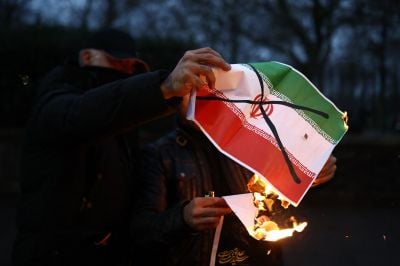
For his part, President Joseph Aoun stated from Baabda that he is "working with all relevant parties to prevent the country from being drawn into another war, because the Lebanese people can no longer endure further conflict, and because international circumstances have created new realities that demand a realistic and rational approach to protect Lebanon and its citizens." This was an implicit allusion to fears of a possible intervention by Hezbollah alongside the Islamic Republic of Iran, in the event of U.S. strikes against Tehran. "I hope that the efforts made to spare Lebanon from any danger will be met with understanding and positive engagement," the president added. Mr. Aoun's "rational" approach echoes his remarks, widely criticized by Hezbollah, in which he called on the pro-Iranian party in early January to "be reasonable" because of its refusal to disarm north of the Litani River, despite the government decision taken in this direction in Aug. 2025.
For their part, Prime Minister Nawaf Salam and Deputy Prime Minister Tarek Mitri made similar remarks on Tuesday. Speaking from Dubai, Mr. Salam stated that he would not allow Lebanon to be drawn into a new adventure. "We have worked to regain control over the decision on peace and war, and the proof of this is that for the first time since 1969 [the year the Cairo Agreement was signed, legalizing Palestinian armed action in Lebanon], the state, through the army, is imposing total operational control over the south of the country," he added.
As for Mr. Mitri, who was interviewed Tuesday by the Saudi channel al-Hadath, he expressed hope that "Hezbollah will show reason, once again, should a war break out against Tehran." He added that he rejected "any involvement in a regional war or the transformation of our country into a theater of war for others." He also reiterated that "Hezbollah refuses to surrender its weapons north of the Litani River."
International aid to Lebanon, is conditional on the disarmament of Hezbollah and the implementation of structural reforms, following the economic and financial crisis of 2019. Aid for the reconstruction of areas destroyed by the war in the fall of 2024 between Hezbollah and Israel has not yet been granted, the Shiite party refusing to surrender its arsenal throughout the Lebanese territory .
