












It was Feb. 11, 1979. Ayatollah Khomeini returned to Tehran, welcomed by millions of people in a euphoric crowd.
A few weeks later, on April 1, the Islamic Republic was established following a referendum approved by 98 percent of voters.
At the time, most observers did not grasp the significance of the event, nor what the triumph of the Islamic Revolution would mean for Iran and the entire Middle East.
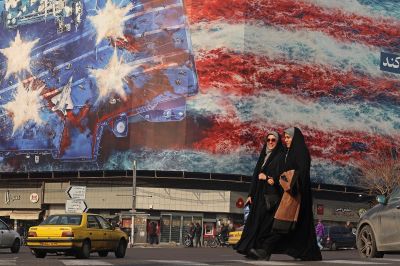
They had not realized how central the theory of Wilayat al-Faqih (the absolute authority of the jurist) at the heart of Khomeinist thought, would become — not only as the cornerstone of a theocratic dictatorship.
It would also become the basis for an expansionist project that would pave the way for both Shiite and Sunni Islamism, radicalize minds, and reshape the balance of power and alliances across the region.
In an opinion piece titled “Trusting Khomeini,” published by The New York Times on Feb. 16, 1979, Richard Falk, a professor at Princeton, wrote, “Iran may yet provide us with a desperately‐needed model of humane governance for a third‐world country.”
The Ayatollah, who would later be named Time Magazine’s “Man of the Year,” was still an “exotic” figure; Islamism was merely a tool for the political assertion of the proletarian masses, and jihadism remained a theoretical concept.
The year 1979, which was also marked by the seizure of the Grand Mosque in Mecca by 200 fundamentalists and the invasion of Afghanistan by Soviet troops, was nevertheless set to change the face of the Middle East.
In hindsight, the birth of the Islamic Republic can even be considered one of the most important events of the 20th century in the region, alongside the fall of the Ottoman Empire, the creation of Israel, and the rise and fall of Nasserism.

This chapter is turning 47 years later.
Not that the Iranian regime is about to fall, or that the United States is on the verge of military intervention. On the contrary, at the time of writing, the diplomatic option seems to be gaining ground, even though caution remains essential given the mutual distrust between the two countries and the limited room for compromise on such sensitive issues as the nuclear dossier, ballistic missiles, and support for militias.
This does not mean, however, that the end of the Islamic Republic will be witnessed soon, even if, in many respects, its days seem numbered.
Rather, the Iranian revolution is dying on all fronts, both domestically and regionally.
Once celebrated by tens of millions of people, it is now vilified in Tehran and opposed across the provinces.
Whatever the outcome of the confrontation with the United States, the Islamic Revolution will not survive Khamenei.
The regime may endure, and so may the position of supreme leader, but its fundamentals — wearing the veil, hostility toward the U.S., exportation through a missile and militia network, and the pursuit of nuclear capabilities — have collapsed.
The Islamic Republic will no longer be able to dominate — even in a contested manner — the Middle East.
If it wants to survive, it will have no choice but to either withdraw into itself or reinvent itself.
Ironically — or perhaps not — the death of Khomeinism is occurring more or less at the same time as the end of Wahhabism as a state religion in Saudi Arabia, a revolution led by Mohammed bin Salman that has gone relatively unnoticed in the Western world despite its significance.
1979 was also the year of the strict turn that would transform the kingdom and export its radical ideology — both in its Salafist form and, to a lesser extent, its jihadist form — far beyond its borders.
The competition between the Wahhabi kingdom and the Islamic Republic, between Sunni Islamism and Shiite Islamism, has profoundly shaped the Middle East over the past four decades, affecting all major issues, including the Palestinian question.
The fact that it is no longer so dominant is in itself excellent news for the region.
It is no coincidence that, at the same time, Islamism is on the decline — even if it should not be considered entirely buried — jihadism is seeing a downturn, militias are no longer held in high regard, and the vast majority of regional powers are advocating for calm and stability.
A new era is opening in the Middle East, though it does not necessarily mean more democracy, justice, or even stability.
It is marked by Israeli military dominance, by the mistrust of Arab countries toward this new “Sparta” — which now presents itself as the main factor of destabilization — by the emergence of new rifts highlighted by the standoff between Riyadh and Abu Dhabi, and by the remnants of the Iranian revolution, which will not disappear overnight.
A chaotic chapter is turning. Yet we will have to live with it for many years.
This is because in an era marked by the rise of Israeli fundamentalism, far more than military victories will be needed to erase Khomeinism and all its offshoots from the people’s minds.
This is the most essential and most difficult battle, and we are particularly well placed to understand this in Lebanon.
This article was translated from L'Orient-Le Jour by Joelle El Khoury.

 8 p.m. recap: Israel again threatens Beirut’s south suburbs; 2 ships hit near Hormuz; Riyadh football matches canceled