







Minister of Energy and Water Joe Saddi (second from the right), signing the contract for the award of the exploration and exploitation agreement in Block 8 of Lebanon’s Exclusive Economic Zone to the consortium formed by the French company TotalEnergies, the Italian company ENI, and Qatar Energy, alongside representatives of these companies, on Jan. 9, 2026. (Credit: Mohammad Yassin/L’Orient Today)






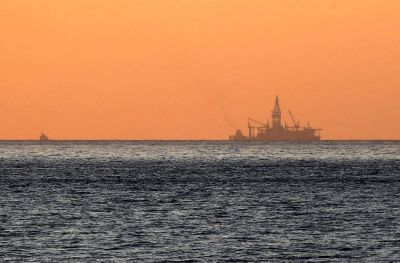
BEIRUT — A consortium formed by France's TotalEnergies, Italy's ENI and Qatar Energy signed a contract with the Lebanese government on Friday granting the companies exploration and exploitation rights for Block 8 of the Lebanese Exclusive Economic Zone (EEZ), concerning potential offshore gas reserves.
The signing of the contract came two and a half months after Cabinet ratified the agreement in October, a decision that immediately sparked controversy. Critics of the deal pointed to the less favorable terms imposed by the consortium and accepted by the government.
The deal came amid a political dispute between the Free Patriotic Movement, which had control of the Energy and Water Ministry for more than 15 years, and its Christian rival, the Lebanese Forces — now overseeing the ministry — while the same consortium had already carried out two drillings in the Lebanese EEZ, in Blocks 4 and 9, without finding commercially viable quantities.
'As soon as possible'
One of the main questions concerned the replacement of TGS, supposed to conduct a 3D seismic survey over the 1,200 square kilometers of Block 8 free of charge and within a relatively short period (recovering its costs by reselling the data and analysis to third-party oil companies), by the consortium, which now has a three-year deadline to finalize this survey.
After these three years, the consortium will have an additional two years to drill a well. This was meant to justify the change in companies, despite the longer timeline, and is a point Energy and Water Minister Joe Saddi is relying on to attract companies to the Lebanese EEZ.
"It is in Lebanon's best interest to conduct oil exploration activities in its territorial waters rather than leave our blocks idle," Saddi L’Orient Today in October. "That is why we acted in favor of an agreement that includes these two phases with the consortium."
Following the signing of this contract Friday, the minister stressed that "this step once again confirms the consortium’s commitment to continue exploration activities in Lebanon despite all challenges and reflects continuing confidence in the hydrocarbon potential of Lebanese territorial waters."
As for the launch of the seismic study — necessary to identifying the most fruitful spots for drilling — Saddi expressed hope that the consortium would prepare and implement it “as soon as possible.”
In addition to its license for Block 8, the consortium also holds rights to explore and exploit Block 9.
In 2023, the same consortium drilled a well there without finding a commercially viable amount of gas, but it had not yet submitted its official report to the Energy Ministry as required by the contract.
Now, according to Saddi, this has finally been done, albeit with considerable delay. "An official report has reached us and is at the ministry and the Energy Authority," he said during the conference.

Beyond formalizing the contract for Block 8 exploration and exploitation, the minister also seized the opportunity to announce "the preparation of the file for the launch of the fourth licensing round," as eight out of 10 Lebanese blocks (except for Blocks 8 and 9) remain unattributed.
"We are working on establishing the tender documents to attract international companies to invest in these blocks," he added, "and to boost exploration and exploitation activities in Lebanon."
Installation of an FSRU
Earlier in the day, President Joseph Aoun received a delegation of TotalEnergies representatives on the sidelines of the contract signing. He renewed "the Lebanese government’s willingness to provide all necessary support to facilitate the progress of the work," according to a statement released by the presidency.
This meeting also covered the installation of a floating storage and regasification unit (FSRU) in Lebanese territorial waters, which will likely be based in Deir Ammar, in northern Lebanon, according to Saddi, with the goal of supplying gas to power plants.
During this meeting, the TotalEnergies delegation noted that "work is underway in coordination with the Qatari side to finalize the technical aspects of the project before moving on to the second phase related to financing mechanisms."
In this context, the International Finance Corporation (IFC, affiliated with the World Bank) announced in mid-November 2025 the launch of “new investments and commitments” in Lebanon, with a budget of at least $80 million, which includes the development of an FSRU.