





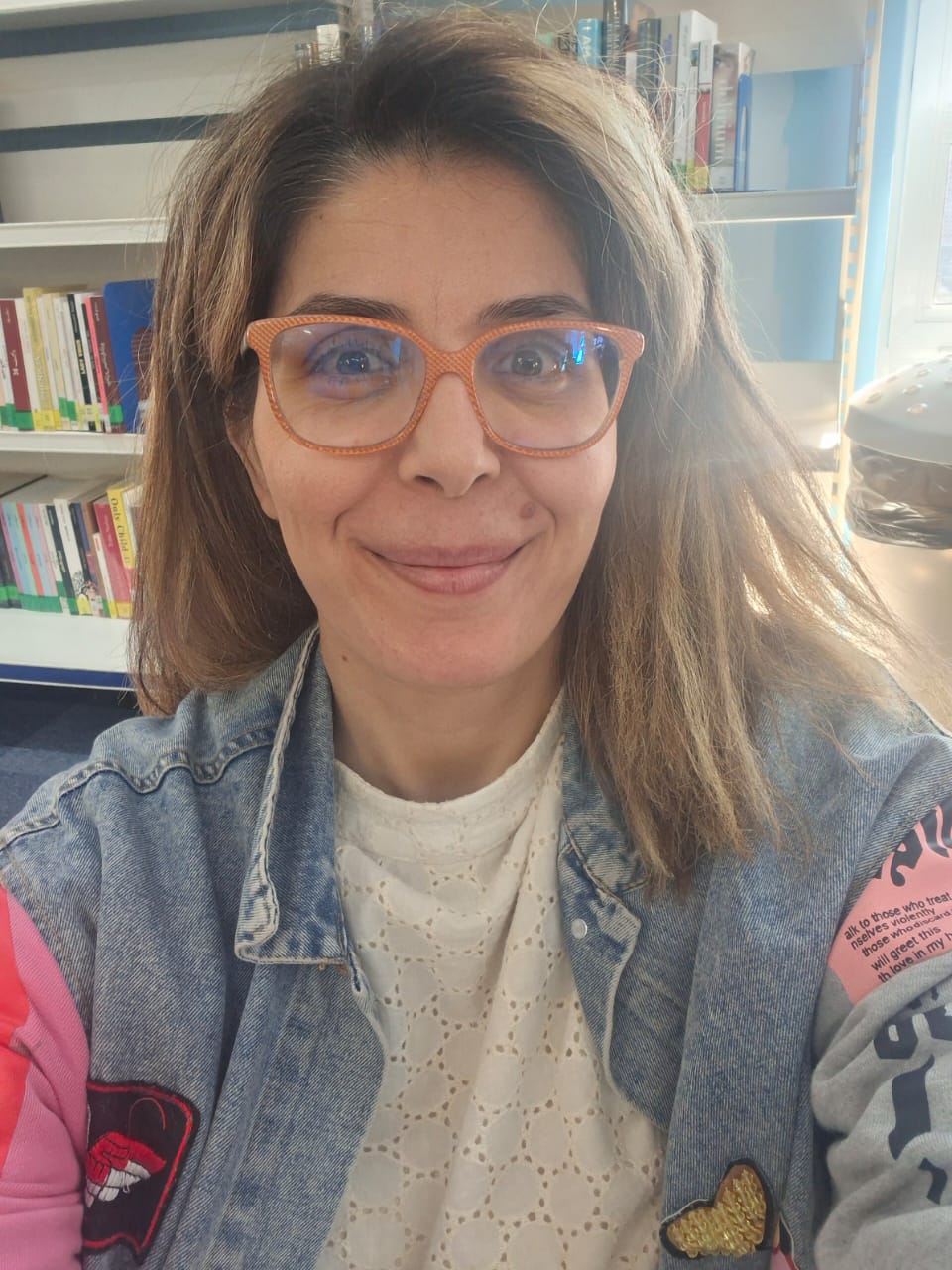
Julie Tegho created a TikTok page for students and a parallel Facebook page. (Credit: Peson photographed)






Today, education is in a significant transformation. In just a few years, traditional methods have been disrupted by the rise of social media.
TikTok, YouTube, Facebook, and many other platforms now play a central role in young people’s daily lives, shaping how they learn and access information.
The challenge is not to resist this change, but to accept and adapt to it. Rather than banning these tools, the aim is to guide young people in using them constructively and responsibly.

Better yet, we must invest in these spaces to meet students where they are and provide guidance and reassurance.
With this mindset, Julie Tegho, a lecturer in the Department of History and International Relations at Saint Joseph University (USJ), chose to take the leap.
The young woman, who holds a PhD in history from USJ and a master’s in security studies with a focus on military operations from Georgetown University, explains how she decided to launch her TikTok page, her YouTube channel, and, soon, a Facebook page.

Her goal is to use these platforms as tools for education and sharing knowledge.
'The key is to get students thinking'
From her first days at USJ six years ago, Tegho quickly realized that traditional teaching methods no longer meet students’ needs or expectations.
“In international relations, there’s still a certain notion of what a course should be: The professor speaks, the student takes notes, as was done long ago. But this doesn’t work anymore,” she says.
For her, some subjects, like history or international relations, are "living" disciplines. Their goal isn't just to transmit fixed content. "The key is to get students thinking, and to do that, they have to participate," she emphasizes.
@your_teacher_bff Vous n'avez pas le temps de refaire le monde en 10 minutes, mais vous pouvez avoir le 20. #grandoral #pourtoi ♬ original sound - Ms Julie. Histoire🗺🪖
That’s why, from the beginning, she chose to design her courses as spaces for collaborative creation. “I prepare my classes so that the student constructs the content with me, rather than passively receiving it.”
One of her most impressive initiatives is the "History Lab." The idea is straightforward but effective: During the semester at USJ, each student selects a sequence of Lebanese history topics that interests them and creates a project based on those topics.
“Instead of lecturing on the major chapters of history, I wanted to prompt them to ask questions, to realize there isn’t just one answer,” she explains.
She adds, “Students often think historians give definitive answers, when in reality, historians help you think. They don’t always agree on one interpretation.”
This educational philosophy centers students in the learning process. Traditional lecturing plays only a minor role. “In a 50-minute class, I rarely lecture for more than 10 minutes,” says Tegho.
The rest of the time is allocated for sharing, writing, reflection, and discussion. “You have to listen to students and respect each one’s pace. To avoid boredom, I ask them to write, compose, and formulate their ideas.”
Her goal is to “dispel the notion that history is just something you memorize.”
Investing in social networks
The same reasoning naturally led her to use social media. Tegho created a TikTok account for students and a Facebook page. “My podcasts are designed to help students think, get ready for exams, and prepare for university,” she explains.
She covers essential methodological topics: how to conduct research, structure thinking, and write academic papers effectively. Aware of new content consumption habits, she adapted her format to suit her audience.
“While most podcasts last 40 minutes, mine are 12 to 13 minutes, so students aren’t discouraged,” she says. These short clips aren’t simple course summaries. “They’re more like my class notes, designed as tools to help students think.”
The content closely relates to the courses she teaches, and the videos directly mirror what’s covered in class. “I always start with the audio version before the video: It’s faster to produce and reaches students more effectively,” she says.
This approach has achieved rapid success. Student feedback on social media confirms a real impact. “This approach reassures students,” Tegho observes. “Even when taking notes in class, they need something to reference later.”
On TikTok in particular, where she’s known as “your teacher bff,” the teacher reaches well beyond the classroom walls. “I have students following me from across Lebanon, and even from Paris. They write to ask questions, thank me, or share their good grades,” she says.
Some messages even come from parents. With videos reaching up to 114,300 views, her platforms have become true support spaces.
Social media as an educational tool, not a barrier to learning
For Tegho, social media isn’t a barrier to learning but a tool to be used wisely. While many parents worry about time spent on TikTok, she encourages a new perspective.
“The fact is, today’s young people search TikTok and YouTube when they have exams, sometimes before they ask their teachers,” she notes.
On these platforms, young people already find educational content and “influencers” who share basic strategies — like “how to pass your entrance exam, how to succeed on this topic.”
This reality underpins her online approach. “Since they’re already on TikTok and YouTube and use them as references, they might as well get this advice directly from me, as their teacher,” she explains.
Far from viewing social media as inherently harmful, Tegho offers a nuanced perspective on repurposing them: “They can be [harmful], if they’re consumed incorrectly. But, used well, they’re extremely helpful.”
She also notices a calming effect on students, especially during live sessions. Direct access to a teacher reassures them, helps organize their work, and boosts their confidence. “We have to stop underestimating these young people,” she adds.
In her view, learning can no longer be confined to traditional methods based only on books, documents, and journals. “We have to step outside these frameworks and go where the students already are, with the tools they already use,” she says.
The disruption caused by the Covid-19 pandemic firmly marked the end of what’s called “traditional teaching,” she says. “Since Covid, we can’t really talk about a single model based solely on face-to-face instruction and lectures,” she insists.
The widespread adoption of remote learning and the capacity to earn complete degrees from home are clear evidence. That period highlighted a reality already in progress: Students of this generation no longer consume information the way previous generations did.
While they still rely on traditional libraries and conduct classic academic research, their “great library” has now expanded to include digital resources. “The digital world offers huge resources,” she says, but also emphasizes that some boundaries should not be crossed.
This caution toward new sources isn’t new. “In our day, we were warned about Google and Wikipedia. Today, it’s the same thing; only the platforms have changed,” she notes.
Therefore, it’s not about dismissing these tools but about understanding how to use them wisely and strategically.
Tegho clarifies that this doesn’t mean every teacher must create accounts on TikTok, YouTube, or other social networks. “But what’s certain is, these platforms are extremely rich in resources,” she says.
The impact of her platform is evident in real results. One video, intentionally simple and accessible, surpassed 50,000 views within 48 hours and went viral, Tegho recalls.
The responses were quick: messages, reactions, and calls — indicating genuine need.
Another video, focused on writing university papers, generated many questions. It was helpful not only for first- and second-year students but also for third-year students and even laid a foundation for master’s or doctoral work.
This impact showcases how effective her accessible and highly relevant approach is for today's students.
This article was translated from L'Orient-Le Jour.

 7 p.m. recap: Iran warns Egypt, Israeli soldiers vote in south Lebanon, Haret Hreik responds to Kataeb