






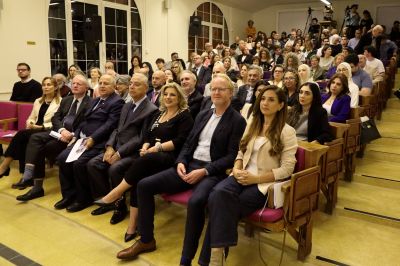
In the front row, from left to right: Professor Gina Abu Fadel Saad, the rector, Father François Boëdec (Jesuits), the former rector, Father Salim Daccashe (Jesuits), the former Lebanese ambassador to UNESCO, Khalil Karam, Carole Nehmeh, Tom Young, and his wife. (Credit: Saint Joseph University)






"Arabic is not an object of study but a place of connection, of encounter, an idea that has withstood crises, wars, exiles, and continues on its path," said Carole Nehmeh, director of the Center for Arab Research and Studies (CREA), during the celebration of CREA’s 80th anniversary on Nov. 20 at the Oriental Library of Saint Joseph University (USJ).
"Today, we are not just celebrating an anniversary; we are celebrating a breath, a fidelity that has never been extinguished," she added, recalling the vision of Father André d’Alverny (Jesuits), founder of CREA, who saw the Arabic language as a "meeting place."
The celebration took place in a warm, friendly atmosphere, as the evening's title, "CREA.80: Symphony of words and lights," suggested. It was held under the patronage of the Culture Minister, Ghassan Salameh, in the presence of Reverend rectors, Professor Salim Daccashe (Jesuits) and Professor François Boëdec (Jesuits), along with several personalities, deans, directors, and teachers.

This lively tribute to the Arabic language blended research, visual art, music, and poetry.
Canvases by British artist Tom Young, the guest of honor who shared his deep connection with Lebanon — describing it as "a country that recognizes you before you recognize it yourself"—demonstrated that "the Arabic language and culture extend far beyond the geographic area where they are used."
A musical interlude was performed by two young students, Jana Tarhini on the oud [Middle Eastern instrument similar to the lute] and Romen Ayoub on the derbakkeh [Arabic hand drum], who led the audience through key movements in Lebanese music, ending with a tribute to Ziad Rahbani.

The evening also included the allegory written by Nehmeh, "When Language Remembers Its Heart" – performed as a voiceover by Professor May Haddad, director of Certtal, Nehmeh, and Adham Dimashki – which brought to life a poetic dialogue between the Arabic language and the center.
It also made it possible to recall 80 years of the center’s history through photos from the Oriental Library's archives, an iconic institution.
"While preparing this anniversary, and thanks to the help of Professor Francis Berkmeijer (Jesuits), I had the opportunity to delve into the Jesuit archives, which are full of hidden gems," said Nehmeh.

"To move forward, you have to know your past. That was the meaning of the slogan for the 150th anniversary of USJ: 'Our roots, our future.' This event revived the desire to rebuild the CREA archives at the Faculty of Languages and Translation," she added.
This ceremony also served as an opportunity to celebrate youth by awarding DALE (Diploma of Arabic as a Foreign Language) certificates to seven laureates from Wellspring Learning Community.
The community was "the very first to place their trust in us and participate in this program, which we designed and launched based on the criteria and requirements of the Common European Framework of Reference for Languages [CEFR]. This unique certification verifies a strong command of Arabic in its modern standard form as a foreign language," said Nehmeh.
Training youth who believe in Arabic’s potential
Throughout its existence, since its creation in 1945 in Bikfaya by Father André d’Alverny (Jesuits), this religious center for Arab studies – which was initially intended exclusively for Jesuits before opening to other congregations and then the general public, eventually becoming, in Beirut, the Center for Arab Research and Studies – has always considered the Arabic language as a space for dialogue, thought, and culture.
"Unfortunately, many Lebanese students are not comfortable with Arabic, particularly on the job market. Yet today, it is a language that is in high demand. Not mastering it is an obstacle," emphasized Nehmeh.
"With the economic crisis in Lebanon and considering the challenges facing our youth, USJ, through CREA, aims to keep Arabic at the heart of university education, to inspire a love for this language, and to convince students that it is an asset for their future," she added.
"Our mission today is to train young people who believe in the potential of the Arabic language by showing it for what it is: rich, modern, and capable of evolving. At CREA, we teach modern standard Arabic not as a static language but as a living, everyday language, a language that moves forward," she said.
"Resolutely future-oriented and faithful to its heritage, CREA will continue to be a space of transmission, research, and creation for generations to come, confirming that the Arabic language remains one of the pillars of USJ’s identity," Nehmeh concluded.
This is essentially what the CREA director had the opportunity to repeat to Salameh during her Dec. 17 visit to Sanayeh. This meeting, following "CREA.80" and on the eve of World Arabic Language Day, also enabled an in-depth discussion of the center’s role in teaching modern standard Arabic and the Lebanese dialect.
The meeting culminated in a discussion of the DALE certification exam, designed and offered by the center and intended for promotion in schools; the challenges faced by the humanities disciplines; and the importance of supporting them within higher education.
This article was translated from L'Orient-Le Jour.

 Evening recap: Netanyahu announces West Bank offensive; 7 killed in Jordan church shooting; tents burned in south Lebanon
 US strike on Iran this weekend? ‘Absolutely,’ says Barrack; ‘I have no idea,’ says Trump