


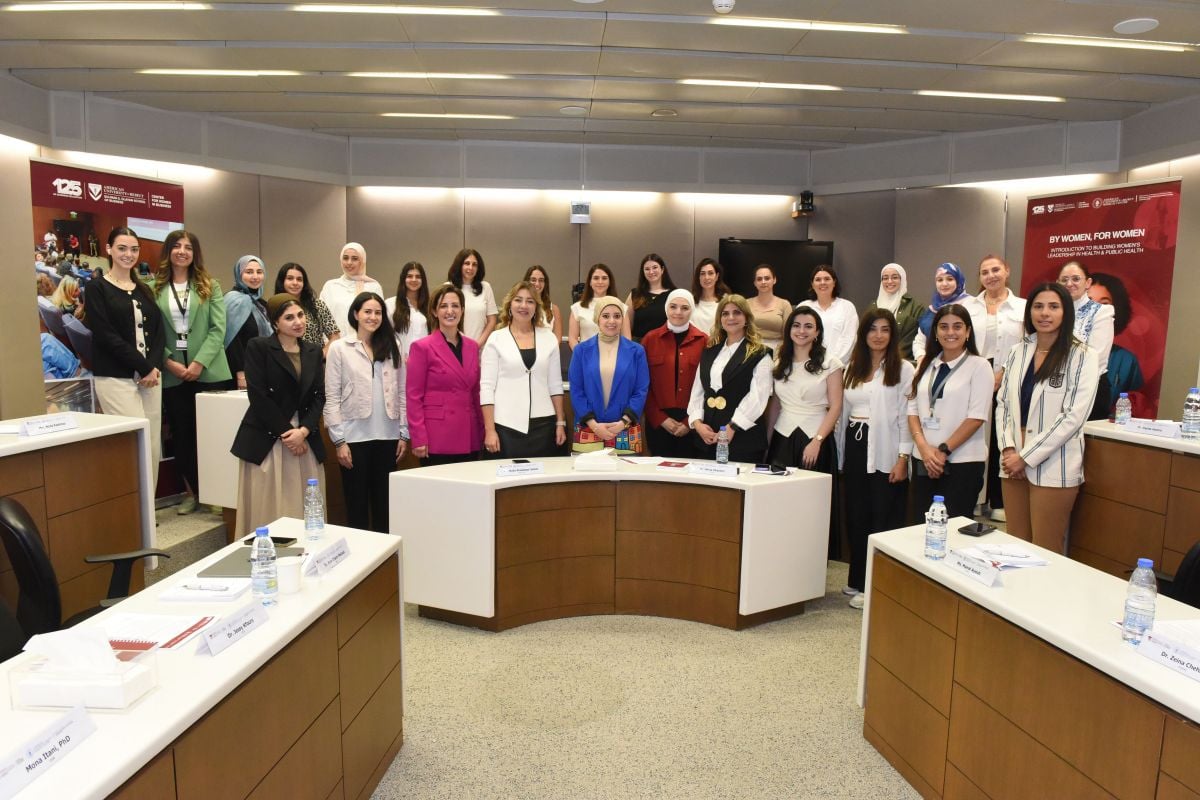
Led by teachers and experts from the American University of Beirut (AUB), the interactive sessions focused on leadership, decision-making and change management. (Credit: AUB)






Organized by the Center for Women in Business (CWiB) at the Suliman S. Olayan School of Business (OSB) and the Division of Reproductive Endocrinology and Infertility at the American University of Beirut Medical Center (AUBMC), hands-on workshops brought together over 20 women who are healthcare professionals from all regions of Lebanon for two days in November.
The group included doctors, nurses, pharmacists and representatives from the World Health Organization (WHO) and the Health Ministry.

This second cohort of the program, By Women, For Women: Introduction to Building Women's Leadership in Health and Public Health, responded to an expressed need by many women in the field and took place three months after the first cohort.
"According to research we have conducted, we found that women in the health sector do not reach leadership positions as often as men," notes Dr. Nada Khaddage-Soboh, director of the Center for Women in Business, pointing to various barriers preventing their advancement.
She shared the story of a woman doctor who remained in the same position for 30 years without ever asking for a promotion, dedicating all her time to her patients, unlike her male colleagues, who started their careers at the same time.

"Women are primarily concerned with their patients, to the point of putting the question of leadership in second place. At the same time, some may also face challenges such as family responsibilities," explained Khaddage-Soboh.
"Additionally, the predominance of a masculine mindset in organizations prevents women from accessing leadership positions," she added.
The director of the Center for Women in Business also emphasized that during the workshops, the participants realized they shared similar issues and were not "alone in what they were experiencing."

"Women in this sector, in all regions, face more or less the same challenges," she said.
Networking, beyond learning
Through hands-on case studies and experience-sharing, the health professionals developed skills in entrepreneurship, change management, conflict resolution, crisis management and more.
Among its objectives, the program aims not only to equip these professionals with essential leadership skills but also to help them recognize the biases they face, develop strategies to overcome them and maintain work-life balance, manage stress and preserve their resilience.
Beyond these goals, the organizers encouraged participants to build a support network that fosters peer learning, mentorship and collaboration.
"Today, they are a small community that shares ideas and successes, someone you can really rely on. And that was one of our goals: to be there for one another, to lift each other up and to benefit from each other's knowledge and experiences," said Khaddage-Soboh.
Led by AUB teachers and experts, the interactive sessions focused on topics including the skills needed to effectively lead teams, balancing clinical excellence with institutional priorities, building trust in decision-making, managing change, stimulating innovation and addressing institutional resistance to change.
During the workshops she led, Khaddage-Soboh addressed analytical skills and negotiation to help women defend their own rights and those of others. "Empowering women in healthcare does not stop at career advancement, but is about transforming systems from within," she stressed.
Other workshops addressed adapting to digital transformation and work-life balance to prevent burnout in demanding workplaces, adopting creative initiatives to generate lasting change and leading emergency teams during national crises.
"What stood out most in these workshops is that young health professionals felt they could rely on the support of their elders, support that previous generations did not receive in their time. They realized that some women had experienced the same hardships, but still managed to become among the best in the country or to lead mostly male teams," noted Khaddage-Soboh.
"We all wear an invisible crown, and we must believe that if we have made it this far, it is thanks to our efforts," she added.
To female health students graduating, the CWiB director assures them that a group of people is ready to support and encourage them. "They can always turn to this network when they need advice or guidance, whether through the community of healthcare professionals or directly at the Center for Women in Business."
This article was translated from L'Orient-Le Jour.


 1 p.m. recap: Salam in Nabatieh; up to 10,000 more US troops heading to Middle East