






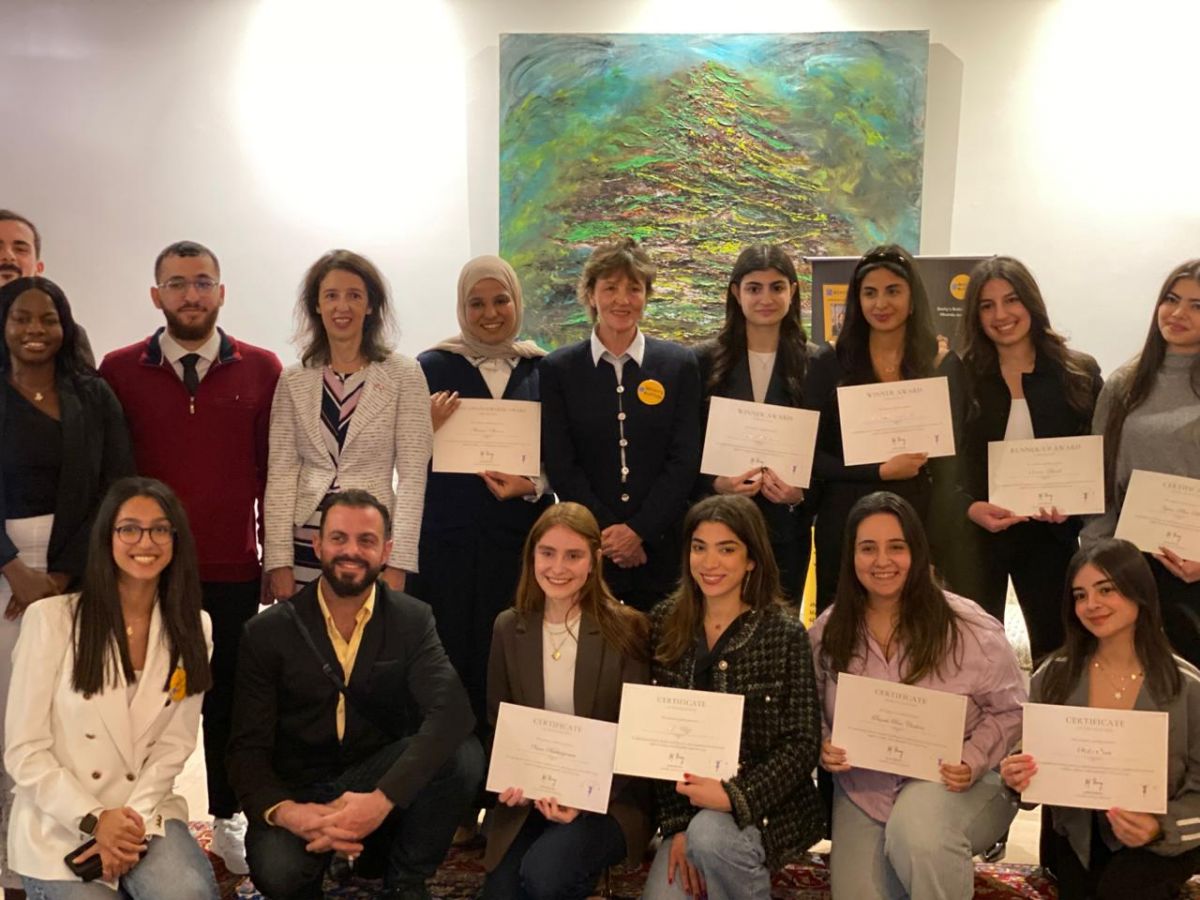
Jane Houng with the Rebecca Dykes Changemaker finalists at the UK embassy residence, on Dec. 5, 2025. (Credit: Marguerita Sejaan/L'Orient Today)






BEIRUT — On Friday, the U.K. embassy, working together with young Lebanese volunteers, awarded 10 finalists who pitched projects on how to create safer schools and universities for girls and women as part of the Rebecca Dykes Changemaker Challenge, led by the U.K.-based NGO Becky’s Button.
Ninety-eight students from 30 schools and eight universities across Lebanon applied to the inaugural Changemaker Challenge. The winning pitch came from Nour Hachem and Kim Abi Haila, both 19 years old and studying at the American University of Beirut (AUB).
Dykes was a British diplomat who was raped and killed in 2017 by an Uber driver who had picked her up from Beirut. Her mother, Jane Houng, founded Becky’s Button in 2021 and has since then been determined to work against gender-based violence (GBV) worldwide.
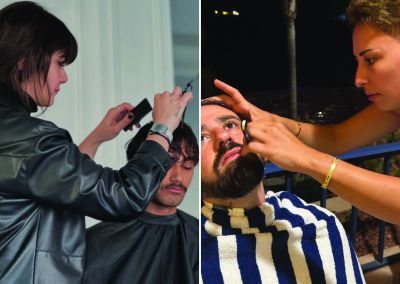
For this event, she called on Lebanese students under the age of 25 to imagine a world that’s safe for girls and young women like them.
The main work of Becky’s Button revolves around distributing a “panic button” of 125 decibels (louder than a car horn) that women can ring when feeling unsafe. “Launching this competition was something new for us,” says Houng. “We saw the opportunity to get our ideas from the ground.”
Three pitched projects have already been launched, she adds. That weekend, scouts from the World Association of Girl Guides and Girl Scouts (WAGGGS) led a GBV-awareness workshop and distributed Becky’s Button.
A few weeks ago, 16-year-old Hala Orabi led a social media campaign against intergenerational transmission of GBV and even led awareness sessions for her schoolmates in grades 7, 8 and 9.
“I just wanted to shed light on an issue that’s already present in society that we’ve all experienced,” Orabi says at the event. “Women around us are always trying to convince us girls that accepting violence from men is okay, but it never is.”
The girls attending her sessions shared stories from their own lives, while the boys were perhaps initially out of their element. “Boys were a bit resistant, but it’s normal. They’re socialized to think they’re superior and that they know everything. I was able to ignore it.”

“If at the finalists’ ages I had their awareness and passion, my generation would’ve changed the world,” says Joelle Abu Haidar, a criminal court judge and one of the competition’s judges.
The two students from the American University of Beirut (AUB) created a ‘university board,’ which would act as an online and offline platform for Lebanese university students to meet and discuss ways to make campus safer from GBV.
“In Lebanon, our past divides us so much, but we noticed that one thing we all agree on is the need to stand against GBV,” says Abi Haila, holding her certificate.
“We noticed that everyone has ideas, but no one has hope,” adds Hachem. “People just needed a push. The proof is that so far we’ve gotten positive feedback from other students.” Their project is set to launch in September 2026.
For Victoria Dunne, deputy British ambassador to Lebanon, the power in these initiatives is not only that they drive tangible change, but that they also open up the space for conversations.
While she acknowledges that it’s challenging to ask a sensitive age group this age-old question (essentially, how to protect girls?), she says what’s important is the space created in it.
“When I was a teenager, we didn’t have the vocabulary or social space to discuss these things,” she explains. “Today, women and girls get to ask themselves, ‘What is unsafe?’ How should I react in these situations?” — questions that they tend to avoid all too often.
