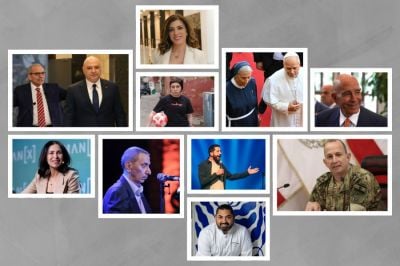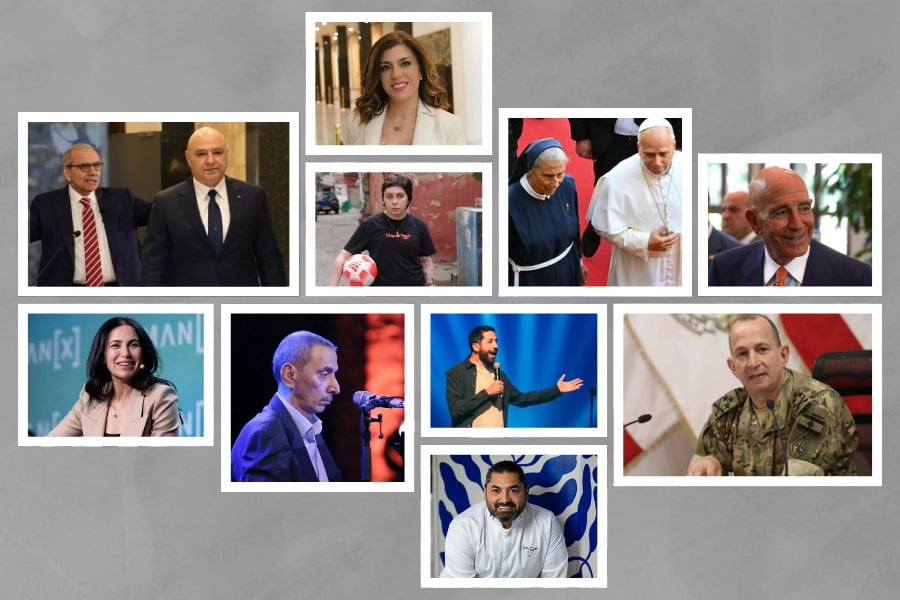
The Lebanese who made and unmade the year 2025 in Lebanon. (Credit: Montage by Céline Bejjani/L'Orient-Le Jour)






Artists, political leaders, athletes, chefs, journalists, and entrepreneurs: Many Lebanese, both at home and abroad, made their mark in 2025. Just like every year, only 10 could be selected chosen. Here is the selection from L’Orient-Le Jour.
Aoun-Salam
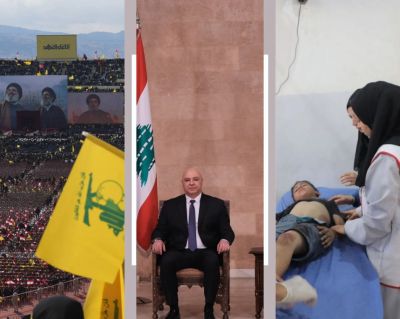
The election of Joseph Aoun as president on Jan. 9, after more than two years without one, and the formation of a government led by Nawaf Salam a month later, were seen by many Lebanese and the international community as a turning point.
Aoun, a former commander-in-chief of the Lebanese Army, arrived at the Baabda Presidential Palace backed by several foreign powers, including the United States and Saudi Arabia.
Regarded as a neutral figure, he promised in his inaugural address to ensure that the state alone controls weapons, to promote judicial independence, and to rebuild public institutions.
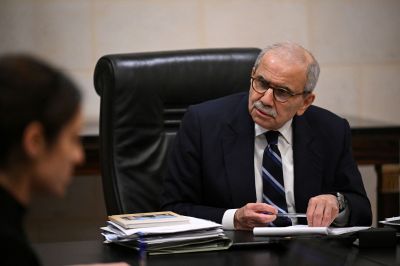
Next to him, Nawaf Salam, former U.N. ambassador and judge at the International Court of Justice, is committed to restoring the state’s sovereignty across its entire territory.
For the first time since the Taif Accords in 1989, the ministerial statement did not mention "the resistance," a term used by Hezbollah to justify its arsenal.
In August, the Cabinet adopted the army’s plan to disarm the party, following the cease-fire agreed with Israel in November 2024.
Rodolph Haykal
Appointed commander-in-chief of the army in March 2025, General Rodolph Haykal faces a huge challenge: reasserting the authority of the state over the entire territory.
In September, the forces presented a five-step plan to disarm Hezbollah, which is an effort not without obstacles: In November, Washington canceled an official visit by Haykal to protest the slow implementation of the plan.
Tensions eased, however, after the appointment (demanded by Israel) of a civilian negotiator, Simon Karam, to the cease-fire supervisory committee.
In December, France, the United States, and Saudi Arabia announced a support conference for the army in Paris in February 2026, intended to provide practical assistance in implementing the disarmament plan.
Tom Barrack
When he was appointed U.S. envoy to Lebanon and Syria, his Lebanese heritage was seen as reassuring.
But Tom Barrack, an influential businessman close to Washington power circles, soon made a string of controversial appearances.
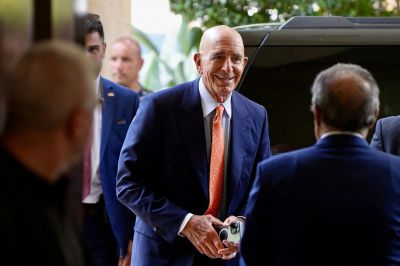
In August, he rebuked journalists at the Baabda Presidential Palace who bombarded him with questions. "You want to know what's happening, be civilized," he said, sparking a wave of outrage and forcing the presidency to issue an apology.
In September, he reduced the Middle East to "tribes and villages," then, in early December, he called to "bring together and align" Lebanon and Syria, drawing harsh criticism on the local scene.
Ziad Rahbani
Ziad Rahbani, son of Fairuz and composer Assi Rahbani, was a free and committed voice that some did not want to hear and others will never forget.
A staunch supporter of the Lebanese Communist Party, he was a fierce critic of Lebanon’s sectarian system.
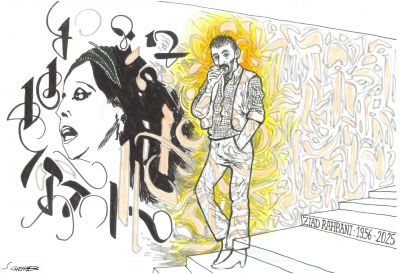
His plays, such as "Bil nisbeh la bukra shu?" and "Film amerikeh taweel," mix political satire, social critique, and engaged jazz.
Born in 1956 in Antelias (Metn), Ziad Rahbani launched his artistic career in the early 1970s with his play "Sahriyeh."
At 17, he composed his first song, "Saalouni El Nass," sung by his mother.
He would go on to write several more for her, including "Kifak enta" and "Bektub esmak."
In recent years, Ziad Rahbani had withdrawn from the artistic scene.
The artist died on July 26, leaving behind an extraordinary musical and artistic legacy.
Hoda Chedid
For more than 30 years, she accompanied the Lebanese people through moments of joy and uncertainty before passing away on Mother’s Day.
A longtime contributor to L'Orient-Le Jour and a prominent figure at LBCI, Hoda Chedid embodied rigorous journalism. Married at 22, she lost her husband, Ziad Saadeh, to cancer.
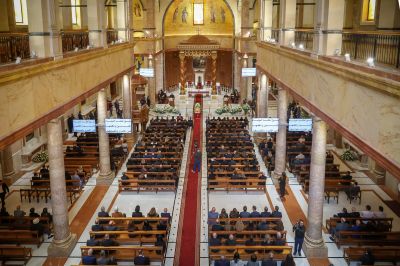
Diagnosed with cancer in 2014, she alternated between remissions and relapses over the years. “I live on morphine; there is no more cure,” she said in an interview earlier this year.
Less than three weeks before her death, Chedid was honored by President Joseph Aoun for “her achievements and perseverance in the face of illness.”
Her final farewell drew people from well beyond media circles. Colleagues, political leaders, and everyday citizens all praised her kindness, humility, and deeply unifying character.
May Habib
A 40-year-old Lebanese-Canadian, May Habib, has emerged as one of the rising figures in artificial intelligence.
Co-founder and CEO of "Writer,” an AI software company for businesses, she made the Forbes ranking of the sector’s 50 most promising startups.
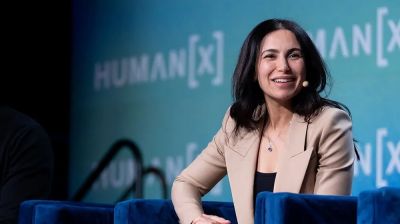
Born in Akkar (northern Lebanon), she emigrated to Canada as a child and studied finance at Harvard University.
Following a stint at Lehman Brothers and the Mubadala sovereign fund in the United Arab Emirates, she co-founded in 2015 an automated translation company, "Qordoba," which was renamed "Writer" in 2020 after developing its own LLM (large language model).
The platform subsequently evolved into "Palmyra,” which today attracts major global clients such as Uber, L’Oréal, Deloitte, and Salesforce.
Celine Haidar
Seriously injured in an Israeli strike on Chiyah, in Beirut’s southern suburbs, on Nov. 16, 2024, Celine Haidar woke from a coma on Jan. 6, 2025. Since then, the 20-year-old soccer player has been undergoing lengthy rehabilitation to regain mobility and memory.
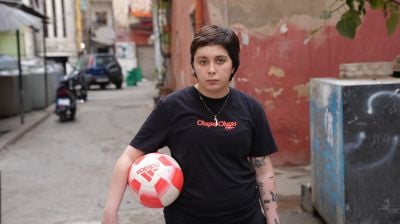
A former national team midfielder and Lebanese champion in 2024 with the Beirut Football Academy, the athlete has yet to regain all her abilities.
Supported by her club and teammates, who helped fund part of her treatment, Haidar hopes to remain connected to football, “not necessarily as a player, but as a coach, to train a new generation.”
Alan Geaam
Twenty-six years after moving to France, Alan Geaam returned to Beirut.
The only Lebanese chef to earn a Michelin star, he joined the Hotel Le Gray and is preparing to open three establishments: Padam, Qasti, and the Alan Geaam Restaurant.
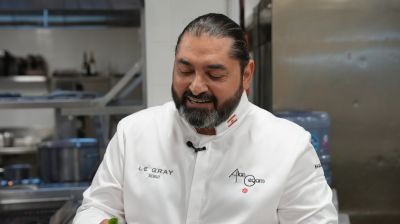
After growing up between Lebanon and Liberia, Azzam Abdallah al-Geaam took a one-way ticket to Paris in 1999 at age 24, with only modest savings.
In 2007, he became chef-owner of Auberge Nicolas Flamel before opening two bistros in 2010.
Seven years later, he launched the Alan Geaam Restaurant, offering French gastronomy with a Lebanese influence, and soon after received the prestigious Michelin star.
In 2020, he expanded the Qasti concept to Paris, followed by Marseille and Lausanne. He also opened the Ovun bistro in Riyadh.
John Achkar
After opening for Gad Elmaleh on June 30, 2024, John Achkar became, in October 2025, the first Arabic-language stand-up comedian to perform on the legendary Olympia stage in Paris.
From Beirut to Dubai, Paris, and Australia, the 34-year-old comedian has, in recent years, become a must-see in stand-up comedy.
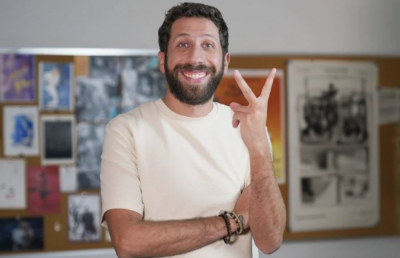
Drawing on everyday humor, he has turned his personal experience into a universal subject: divorce, exile, romantic relationships, identity, and the absurdities of daily Lebanese life.
Sister Marie Makhlouf
She broke down in tears delivering her speech before Pope Leo XIV at the Croix Psychiatric Hospital in Jal al-Dib (Metn): Sister Marie Makhlouf, mother superior of the Sisters of the Cross, struck a chord during the pontiff’s visit to Lebanon in early December.
“This hospital welcomes those forgotten by everyone. Your visit reminds them that they are loved by God. Today you tell them they are not a burden to society but a treasure for the Church,” she said in a trembling voice.
This article was translated from L'Orient-Le Jour.