





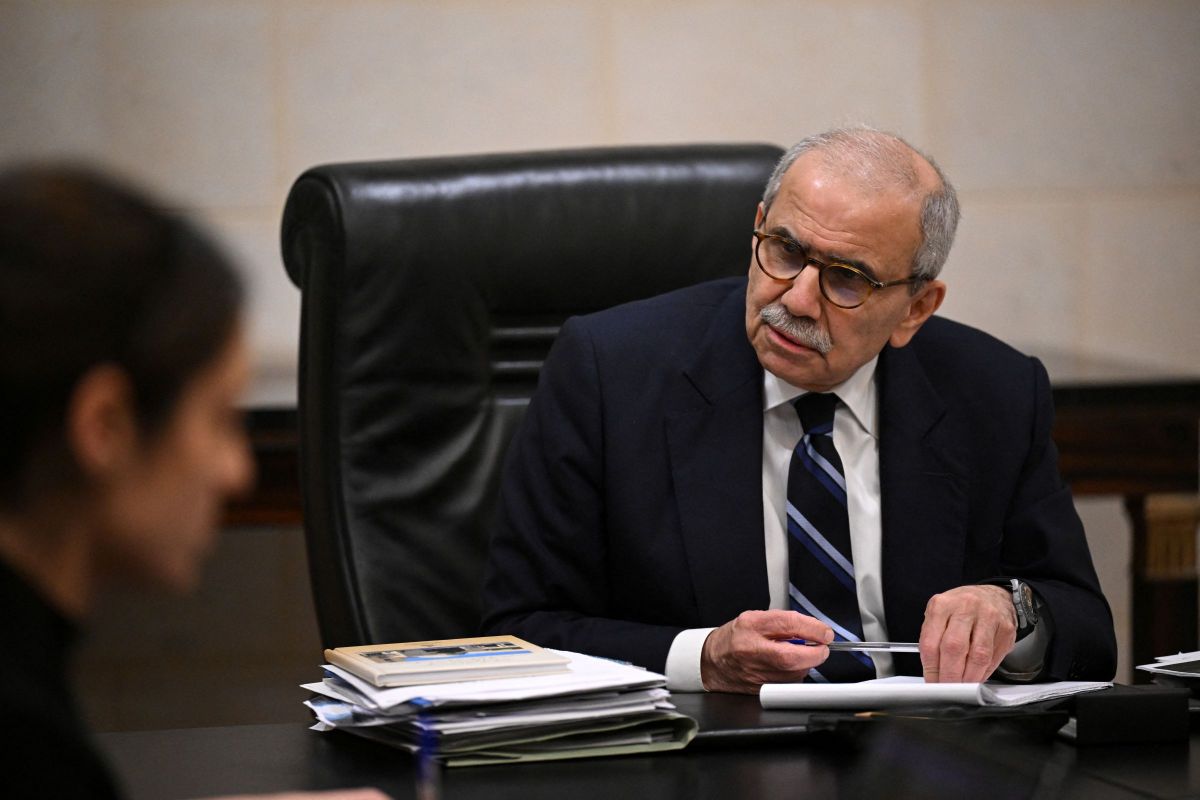
Prime Minister Nawaf Salam speaks to journalists from foreign media and news agencies at the Government Palace in Beirut on Dec. 3, 2025. (Credit: Joseph Eid/AFP)






Lebanese Prime Minister Nawaf Salam said on Sunday that he agrees with President Joseph Aoun on the issue of arms monopoly in Lebanon during the Doha Diplomatic Forum in Qatar. He also said that a draft law that could let depositors access their accounts frozen since the 2019 economic crisis is being prepared and will be presented before the end of December.
Asked about the need for Lebanon to speed up the process of disarming Hezbollah, Salam responded: "The president and I share the same vision: We both want swift implementation of reforms, especially for the establishment of a total monopoly on arms."
"We come from different backgrounds, we do not move at the same pace, but we pursue the same objective," he added.
The Lebanese government decided on Aug. 5 to commit to reclaiming the monopoly on arms and tasked the army with establishing a plan, which was approved a month later.
The army is currently operating south of the Litani River, in the border area with Israel, working to dismantle Hezbollah's infrastructure there — a move to which Hezbollah does not object, but the group rejects total disarmament in the rest of the country.
Salam has, on several occasions, taken a stricter stance concerning Hezbollah and its arsenal than Aoun, who prefers to prioritize dialogue.
The controversy over the illumination of the Pigeon Rocks in Beirut by the party notably highlighted tensions between the two men, with Salam reproaching the security forces and the army for not intervening to prevent the projection, which was organized without official authorization.
Access to blocked accounts
Speaking about the economic crisis and banking sector in Lebanon, Salam said he would present "before the end of the month a draft law regarding the sharing of losses and the possibility for depositors to access their blocked accounts."
"This bill will then need to be passed by Parliament," he added.
Asked about his intention to run for another term, the prime minister said that he "first wishes to complete this term [and that] the question will then be decided by the next Parliament."
"We have committed to holding legislative elections as scheduled. We began preparations in May," he added.
According to the Constitution, after the elections, parliamentary groups hold binding consultations with the president to appoint a prime minister.
The Doha Forum, which includes 162 countries, is presented by its organizers as "a global platform for dialogue, bringing together leaders and political officials to discuss the major challenges facing the world."
It was in this context that Salam met on Saturday with Syrian President Ahmad al-Sharaa, with whom he discussed common issues between Lebanon and Syria.
Discussions on post-UNIFIL phase
On the sidelines of his participation in the forum, Salam met with Rosemary DiCarlo, United Nations Under-Secretary-General for Political Affairs and Peacebuilding.
Discussions focused on the phase following the departure of the United Nations Interim Force in Lebanon (UNIFIL), the ongoing reforms in the country and the refugee issue.
Following a decision by the United Nations Security Council, UNIFIL, which has been deployed in southern Lebanon since 1978, will begin its withdrawal on Dec. 31, 2026, with a complete departure by the end of 2027.
Since then, the Lebanese authorities have expressed their desire to see an international force deployed in the South under U.N. auspices.
The prime minister also met with Helga Schmid, vice president of the Munich Security Conference, who extended an official invitation for him to participate in the event, scheduled for Feb. 14-16.
He also met with Prince Zeid Raad al-Hussein, President of the International Peace Institute (IPI), with whom he discussed support for institutions and strengthening governance in Lebanon.
Army's work in southern Lebanon presented in Doha
Interviewed by the public broadcaster Télé Liban, Information Minister Paul Morcos, also present in Doha, stated that "the considerable efforts undertaken by the army south of the Litani River and the various phases of this deployment were presented" during the forum. "The army is pursuing this plan despite the difficulties and obstacles."
Discussions were held with officials, particularly U.S. envoy Tom Barrack, regarding the difficulties the army is facing in its mission, even though it has not ceased its efforts, Morcos stated.
“This forum provided an opportunity to meet with several Arab and foreign officials to explain Lebanon’s official position and the efforts undertaken by the Lebanese government, notably the recent initiative by the president of the Republic to appoint Ambassador Simon Karam to head the Lebanese negotiating delegation” within the “mechanism,” the committee monitoring the cease-fire in southern Lebanon.
“This appointment, combined with the delegation’s military expertise, gives Lebanon increased momentum and influence in its negotiations,” the minister added.
Karam was appointed last Wednesday as Lebanon’s civilian representative to the “mechanism” meetings.
This choice displeases Hezbollah but was defended by Aoun, who hopes to prevent further escalation in Lebanon.

 Evening recap: Netanyahu announces West Bank offensive; 7 killed in Jordan church shooting; tents burned in south Lebanon
 US strike on Iran this weekend? ‘Absolutely,’ says Barrack; ‘I have no idea,’ says Trump