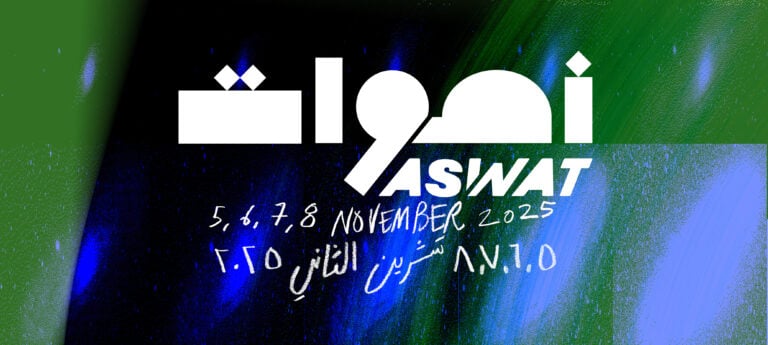
The poster for the "Aswat" festival organized by the French Institute of the Near East. (Credit: IFPO)






In Beirut, the Aswat festival, now in its third edition, is gradually establishing itself as a distinctive meeting point between the worlds of research and creation.
Its name, Aswat —" voices" in Arabic — sums up its ambition: to give a platform to varied, sensitive and embodied forms of knowledge drawn from the social sciences but expressed through cinema.
Organized by the Institut français du Proche-Orient (IFPO) and its partners, the festival brings together researchers, filmmakers, and audiences passionate about the social sciences to reflect on a central question: how can we tell reality differently? How do we think about research beyond the academic text, through visual and sonic narratives that can convey the complexity of the contemporary Arab world?
For its upcoming edition, scheduled for Nov. 6-8 in Beirut, Aswat will offer screenings, workshops, and debates around these "alternative scientific approaches to writing." It gives the curious a chance to dive into images over three days to (re)discover — from the Mashreq to the Maghreb — the key players and the political and social upheavals shaping the contemporary Arab world. Its co-founder, Taos Barbour, a research engineer at the National Center for Research (CNRS), told us about this new edition’s program.

L'Orient-le Jour: How did the Aswat festival come about?
Taos Barbour: It was created in 2022, from the desire to establish a space for meetings, training, and reflection on creative approaches to scientific writing. At IFPO (Institut français du Proche-Orient) and IRD (French National Research Institute for Sustainable Development), two research centers based in Lebanon and the region, many researchers and doctoral students in the humanities and social sciences seek to introduce new, more creative practices into their research writing.
These so-called "alternative" writings don't replace academic writing, but help enrich it, offering different and complementary perspectives and forms of expression. They allow us to revisit epistemological and ethical questions at the core of research and to view knowledge production beyond the academic sphere. However, these practices require skills that are still rarely taught in social sciences programs and are more often mastered by artists, students or professionals in the creative fields.
L'Orient-le Jour: Why Beirut?
Taos Barbour: Beirut is a hub for dynamic creation. Our initial idea was to cross perspectives on the world, from the viewpoints of social sciences and creative arts. IESAV-USJ and ALBA were natural partners from the first edition. In addition, many Lebanese researchers and artists already practice creative scientific forms of writing. Knowledge production here is not limited to the academic environment: it is also developed within associations and collectives. So we felt that the festival would naturally find an audience in this city.

L'Orient-le Jour: What is your perspective today, on the third edition?
Taos Barbour: Aswat is a beautiful, collective adventure, enriched over the years thanks to strong partnerships and a growing team, each year adding more meaning to the event. During the second edition, we opened the programming to films by students in ALBA-UOB's documentary course led by Danielle Davie, as well as those in Ghada Sayegh’s "Cinema, Archives and Memories" course at IESAV (Institute of Scenographic, Audiovisual and Cinematographic Studies). Given the success of this approach, a new generation of students from both schools are again participating this year.
This year, the ambition is twofold: to offer more workshops exploring new creative forms and to present a program that aligns with those approaches. Three workshops have been organized: a film and sound writing workshop run by Anna Roussillon, Danielle Davie and Rayya Badran; a critical and sensitive mapping workshop led by Monica Basbous in partnership with Beirut Urban Lab; and an introduction to visual and sound anthropology led by Michel Tabet, Nicolas Puig and Loubna Tarabay in collaboration with the Lebanese University. The first workshop is at Cinematheque Beirut, while the other two are held at the Royal Cinema and in the Bourj Hammoud neighborhood.
In addition to this openness to multiple forms of writing, we wanted a program that reflects our questions about knowledge production and matches the themes explored in the workshops. Anaïs Farine met this challenge brilliantly by proposing five sessions built around these issues, in addition to a presentation of IESAV students’ work on Nov. 8.

L'Orient-le Jour: Aswat is also a place to meet people. Who is your audience?
Taos Barbour: The aim is to reach as wide an audience as possible and foster exchange. The workshops are aimed in particular at cinema and/or social science students as well as knowledge producers in general: researchers, filmmakers, artists, architects, graphic designers... What matters is how people question the world.
The screenings, to be held at the Arab Image Foundation (Aresco Center, Sanayeh) on Nov. 5 and at the Royal Cinema from Nov. 6-8, are open to all, free of charge while seats last.
L'Orient-le Jour: Tell us about the programming — topics, politics, selection criteria?
Taos Barbour: This year, a major part of the programming revolves around the belief that storytelling through image and sound can subvert dominant knowledge production in two ways: by focusing on marginalized groups and by using sensory methodologies as critical tools to challenge invisibility.
Thus, feminist historiographies — both in the subjects chosen and in the alternative narratives presented — are at the core of the opening session at the Arab Image Foundation. Collective and anti-colonial writing on the environmental struggles of a Berber community in Morocco draws on Amazigh poetry in "Amussu" by Nadir Bouhmouch. Cine-cartographies, such as the subjective geographies of Palestine explored in three short films tied to Monica Basbous’s workshop, challenge the classic, dominant uses of mapping.
The selection was developed through dialogue among several IFPO researchers and Anaïs Farine, a scholar in film studies and programmer. Exchanges among anthropologists, archaeologists and cinema specialists sparked fruitful debates, which will inform festival discussions. All screenings include opportunities to meet filmmakers, researchers and activists.
The program is built around research practices: discovering, fictionalizing, mapping, feeling, participating, transmitting, digging, experimenting, collecting, listening. The idea is to remind us that research is a living practice, engaging our bodies, senses and imaginations — actions shared by researchers, filmmakers and audiences alike.
Find more information at: Ifporient.org