


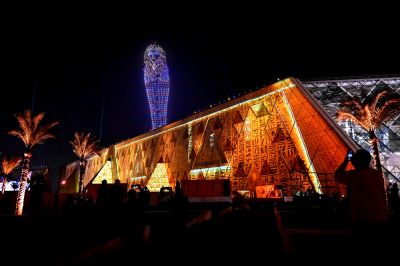
Lighting effects reproducing in the sky the sarcophagus of Tutankhamun during the inauguration ceremony of the GEM. Photo Khaled Desouki/AFP






A laser light show, a symphony orchestra, dancers in tunics inspired by ancient frescoes, scepters and golden crowns: this was the scene at the pharaonic event which marked the official inauguration Saturday night of the Grand Egyptian Museum (GEM).
The construction of this mega-project had begun two decades ago in 2005 under former President Hosni Mubarak. However, its completion was delayed. In part due to funding issues (the construction required a one-billion-dollar budget, two-thirds of which were provided by Japanese investors), but also due to political upheaval — notably the 2011 revolution that led to Mubarak’s ouster, the 2013 protests leading to the military coup ousting President Mohammad Morsi — and the economic crisis triggered by the Covid-19 pandemic.
While a partial opening took place in 2024, it was on Saturday, Nov. 1, that President Abdel Fattah al-Sissi formally and ceremoniously inaugurated “the largest museum in the world dedicated to a single civilization,” declaring before an audience of international leaders: “We are writing a new chapter in the history of the present and future, on behalf of this ancient homeland.”
A 'fourth pyramid' of half a million square meters
Originally initiated by Mubarak and Farouk Hosni, Egypt’s minister of culture from 1987 to 2011, with the assistance of former Egyptian Minister of Tourism and Antiquities Zahi Hawass, the GEM stands on the Giza plateau, listed as a UNESCO World Heritage Site for its historical and architectural significance, symbolizing the greatness of ancient Egypt and the genius of its civilization.
Designed by the Irish firm Heneghan Peng Architects, the stone-and-glass structure, set on a fifty-hectare space (half a million square meters), required monumental work. Located five kilometers from Cairo, close to the pyramids of Khufu, Khafre, and Menkaure, the building, intended as the “fourth pyramid” of the Giza plateau, incorporates triangular motifs throughout its design. Hieroglyphic figures adorn its main facade made of glass, calcite and Egyptian alabaster, stretching nearly a kilometer long.

“It is the largest museum complex in the world dedicated to a single civilization,” explained Hawass, one of the Grand Museum’s promoters who was removed from the project after the fall of Mubarak’s regime. Surrounded by gardens, the building composed of sleek lines and contemporary materials, its roof aligning with the top of the pyramids, combines modernity and respect for Egyptian traditions.
What’s more, sustainable development strategies have been implemented, such as the use of natural light and ventilation to reduce environmental impact, which earned the building 'EDGE Advanced' certification.
Star attraction: The treasure of Tutankhamun
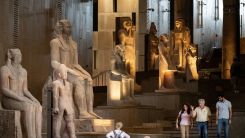
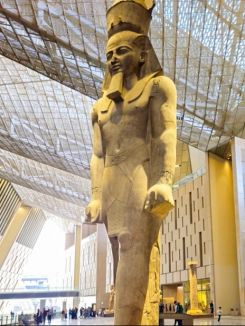
The Grand Egyptian Museum’s exhibition spaces were designed by the German scenographic architecture firm Atelier Bruckner, based in Stuttgart. From the atrium, where a colossal statue of Ramses II stands (3,200 years old, 11 meters tall and 83 tons of granite), monumental stairways lined with ancient statues connect 12 galleries across 60,000 square meters, promising to house more than 100,000 artifacts.
For now, “fifty thousand pieces are currently on permanent display, including a set of 5,389 funerary objects from the untouched tomb of the young king Tutankhamun, discovered in 1922 in Luxor's Valley of the Kings by British archaeologist Howard Carter (1874–1939),” Hawass. He adds that “most of these artifacts have never been shown to the public before.”
The collection includes the 11-kilogram solid gold funerary mask. Decorated with semi-precious stones (lapis lazuli, carnelian, turquoise, quartz, obsidian, and glass paste), it is crowned with the vulture (Nekhbet) and the cobra (Wadjet), symbols of the protective deities of Upper and Lower Egypt.
The throne is made of wood covered with gold leaf and inlaid with semi-precious stones, glass paste and silver. There are also sarcophagi, royal chariots, jewelry, weapons and divine statuettes, as well as more prosaic items such as utensils and cosmetics. When Howard Carter opened the young king’s final coffin, he found the mummy adorned with various jewels and ornaments, hands inlaid with gold holding the crook and flail, and a gold pectoral of the Ba-bird placed on the wrappings. In short, the treasures of Tutankhamun’s tomb exclusively viewable at the GEM.
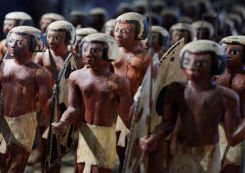
“The displayed objects in the museum’s various rooms come from the reserves of the The Egyptian Museum in Cairo (EMC), storage spaces on Egyptian archaeological sites, or from the necropolis of Saqqara, another complex of pyramids and tombs located about 22 kilometers south of the new GEM,” local guide Yasmine Abou Zikry explained to L’Orient-Le Jour. She points out that “the GEM is divided into five distinct zones, tracing through different themes in the history of ancient Egypt, from prehistory to Greek and Roman antiquity.
The collections are organized by theme and historical patterns, allowing visitors to follow the evolution of Egyptian civilization over several millennia.” Abou Zikry adds that the museum includes shops, cafés and a world-class research center "long-awaited by the Egyptology community," and houses "educational installations on archaeology that allow young people to have an enriching, fun and educational experience.”
But the highlight for Zikry is “the laboratories equipped with cutting-edge technologies to restore and preserve ancient pieces. They will serve as a center for learning and preservation of Egyptian heritage.”

Archaeology enthusiasts will be able to watch through a glass wall the conservation work done to restore a 4,500-year-old solar boat, found buried near the Khufu pyramid. “This museum, a showcase for our country’s rich and diverse history throughout the ages, is for us Egyptians a symbol of national pride,” says the guide.
Her comments echo those of Minister of Tourism Sherif Fathi in a conversation with the press: “Egypt is going to become the center of Egyptology … it is not acceptable that most international conferences are held outside the country.” He also expressed the hope that the museum’s daily visitors would grow from “the current 5,000-6,000” to “15,000." He projected an annual surplus of “five million” tourists, “most of whom will visit the museum.”
This article originally appeared in French on L'Orient-Le Jour.

 7 p.m. recap: 1 person killed near border with Lebanon; 200 kilos of explosives carried by mules; Riyadh shuts its airspace