



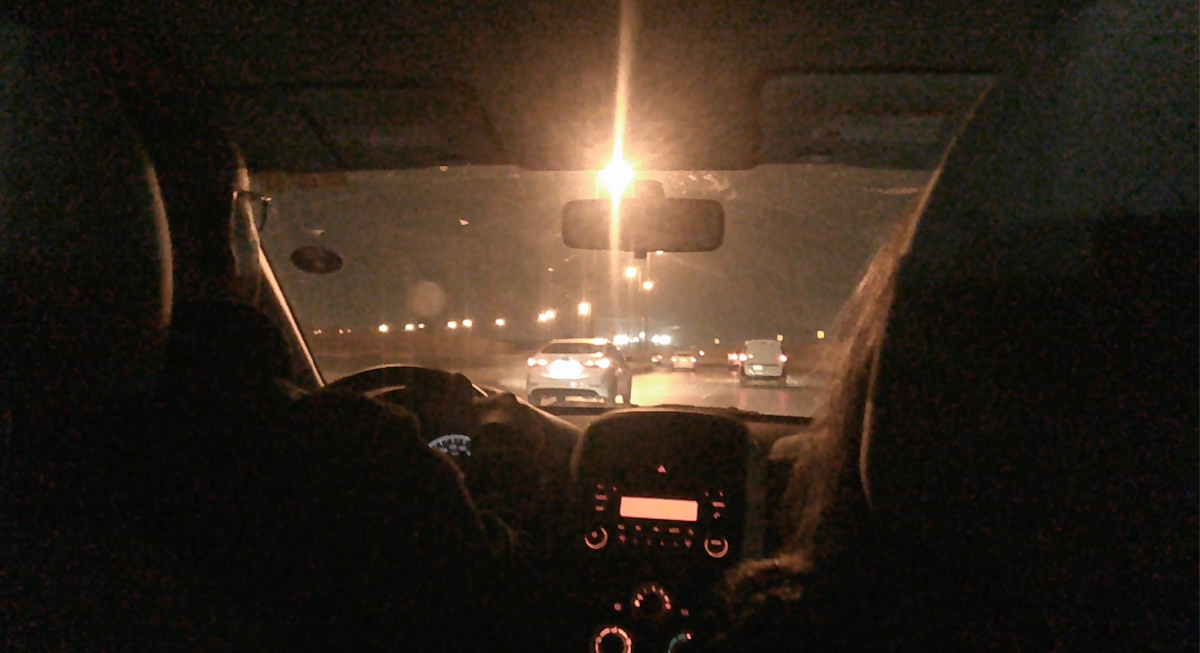
Car ride in a city with functioning streetlights. (Credit: Yara Malke/L’Orient Today)






On a visit to my parents this month, I am once again reminded that some things considered ordinary abroad have become eerily jarring to me after nearly 12 years of living in Lebanon. Having adapted to our new "normal," every time I leave the country, I am confronted with the whiplash of basic functionality and convenience.
The first is the unbearable light-ness, especially the streetlights. In a regularly functioning city, they beam from every corner like exploding stars, insisting upon themselves. I think back to the dark alleyway where my own apartment in Beirut is. It connects to a corner of the main road where people gather in a dimly lit bar like a colony of ants on a sugar cube. I've spent most of the trip bargaining with a migraine.
Then there is the return home from work or an outing to an unconditional safety, at the very least one not based on a Beirut barometer or a mass aggressor's whim. I cannot sit still, and, to everyone’s befuddlement, jump up every time I hear a door close.
The quiet also gives me the heebie-jeebies. Standard city noises are there when appropriate, yes, but there is no hum of generators or MK drones anywhere. I can hear a pin drop by the evening, and it drives my nervous system into restlessness and distrust.
I do not personally witness surprise payments every few days for a newfangled repair, an extra fee with no context, or yet another inflated, undiagnosable charge attached to a basic necessity. Public and private infrastructure is organized clearly. Not perfectly, but pretty close. Close enough that, for the most part, it is possible for regular residents of all walks of life to make plans for weeks, months, or years ahead because they can largely predict their circumstances.
Their days are routine, only ever touched by comprehensible contingencies, so they have the time and bandwidth to think about the future the way we think about making it through the day in Beirut.
These are only a few of the conventionally ordinary things that bewilder and physically unsettle my nervous system whenever I travel. I often ponder, "Kif 3ayshin nehna?"
In the old market, I meet a Lebanese woman, and we grab coffee together one morning. I tell her about my strange sensitivities. She concurs.
I know what you mean. I still feel that way whenever we go to Lebanon for holidays. The second I'm back, it feels like I have to reprogram my brain to normalcy. I sometimes get sick, and I think it's my body's way of purging the extra stress I picked up while I was there.
Look, I’m not saying it isn’t without its flaws, but, here, I wake up and do my part. I only do my part! Not everyone else's, not the state's, not my employer's, nor the million other roles I took on in Lebanon just to make it through the day. I go to school to teach, I prepare lunch for my kids and my husband, I work out in the evenings. We go out once or twice on the weekends. It's a simple, almost mundane life. But anything is better than living in Beirut. Look at the situation with the war now.
No matter what you do or where you are in Lebanon, you live some form of a thankless life. You're stuck in some kind of limbo and taken for granted. Financially. Emotionally. Security-wise. Often all at once. Hal balad, it takes from you but never gives you anything back.
I catch a slight break in her voice then. She quickly shakes off a micro-expression of sorrow and puts on a brave face.
I can't keep living in the past. I can't keep longing for a place that doesn't exist anymore. I'm starting to think it never did.
Two days later, I fly back to the place that doesn't exist. It is waiting for me with folded arms and a festering stack of crises, demanding I wear my many hats, all at once, and immediately. My body surrenders back into its element almost effortlessly. Home is where the eyes can finally rest, here in this dark, dark alley of the world. This illusory place? Unforgivingly real.

 7 p.m. recap: Netanyahu seeks mastermind behind Flydubai incident; Washington sanctions 2 French nationals; Ben Gvir's 'I want to kill you' threat