






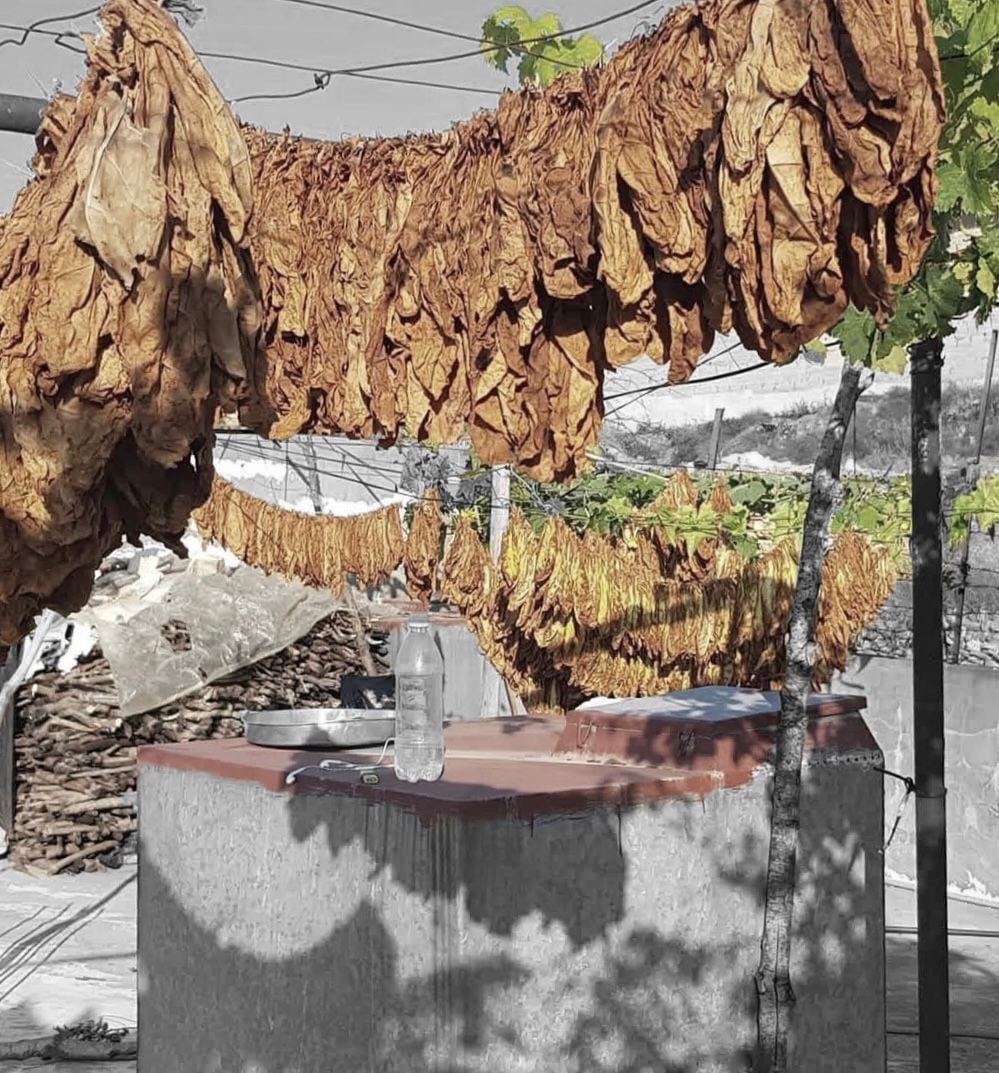
Tobacco drying outdoors in Shams’ grandparents’ rooftop in Syria. It is air-dried for 20 days in the summer, before it is cut while still soft. Some people cut it by hand, others use machines. (Credit: Shams)






Late one evening in Hamra, I ran into Shams*, someone I used to work with during one of my one-too-many stints as a waitress. He joined me for a cigarette break. We sat on a bench caked in dust and grime.
Every breath was inhaled with a side of gunk, but the weather was surprisingly pleasant. The private generators' thrum was a tireless group effort, even louder when you remember it’s there.
Shams, a Syrian citizen who migrated to Lebanon irregularly for the first time in 2014, then again in 2021, was a dear colleague. But I’ve only known his story in fragments.
He rolled Arab tobacco in wara’a sham paper. A silver chain necklace hung from his neck, threaded with rings from a friend who had passed away. He wore a sleeveless Taslan windbreaker and glanced at his Casio watch.
I’m distressed by the situation. But I’m more distressed by the fact that I’m distressed. I mean, look what other people are going through. I feel guilty for being depressed, especially after what I had gone through before I arrived in Lebanon.
Shams swirled a plastic cup of water in his hand and gazed at the cracks in the cement as he recounted the trek that brought him to Lebanon.
I remember when we met the mharrib [trafficker] after literally climbing a mountain. I was told to ask for Abu Jazra. In a split second, he began to slap us. Not normal slaps. The first person he smacked across the ear fell to the floor.
To this day, I still don't know why he did that.
We walked for five hours. Uphill, then downhill, over and over. Huge potholes. Gunshots that sounded too close for comfort. Cuts in the chicken wire for us to worm through.
By 3 a.m., I was taken to an adjoining room in a deserted house, where I was locked in for hours. Then, a vegetable truck showed up, and I was told to hide under the boxes and was dropped off in Beirut.
The noise of a car rushing over the notorious potholes at the small intersection leading to Hamra's main street interrupted his story. I looked around. Stray cats padded back and forth along the sidewalk, the only ones there who seemed to have their wits about them. Passersby seemed not to pay much attention to their surroundings.
A jumpy couple whose conversation looked like a hoot, judging by the scowls and spirited hand gestures. Panhandlers scattered across the street, though no one seemed to have any change to spare. A family pushed an empty baby stroller through an alley.
Shams took a long drag on his cigarette before continuing.
What I think about often during these times is my grandma in Syria. Every year or so, she reaches out to send me olive oil and tobacco, all grown and packaged by her.
Tata makes huge quantities every season. She loves working the land. She doesn’t sell it, just gives it out to the family.
As we got up to go our separate ways, I dropped my phone, which happens at least once a day and visibly shell-shocks me every time. Shams grinned.
Easy. Tata used to joke that whatever falls, the land will catch it.
*Name was changed to protect the person’s privacy.

 Evening recap: Netanyahu announces West Bank offensive; 7 killed in Jordan church shooting; tents burned in south Lebanon
 US strike on Iran this weekend? ‘Absolutely,’ says Barrack; ‘I have no idea,’ says Trump