




Illustration by Jaimee Lee Haddad.






Lebanon is split by bubbles, each one as thick and indestructible as steel, and we each carry them around every day, yelling through them so the others can hear, and wondering what kind of crazy person yells about their made-up, nonexistent problems. Except all of us, of course.
This installation's artists and exhibits are each wondering under which rock the other lives.

What to see

Sfeir-Semler and the Aref el Rayess Foundation are showcasing an anthology of Lebanese artist Aref el Rayess' (1928–2005) works, including those that are over 50 years old and have never seen the light of day.
In late 1975, during the first year of the Civil War, Rayess worked in exile on a powerful series of charcoal drawings. Back in Lebanon, he transformed these works into etchings for Tariq al-Silm (The Road to Peace), later censored by Lebanese authorities and never published. Until today.
The concealed works, as well as Rayess' colorful world in the decades before and after the Civil War, are on display at Galerie Sfeir-Semler, dubbed "J'aime les fleurs comme les étoiles." (I love flowers as I love the stars.)
Click here for more information.

Lebanese people never cease to argue on ways to define their country, each from their own perspective. So, opening next Thursday, Galerie Tanit's collective exhibition "Poetic Landscapes" brings together the landscapes of 23 multimedia artists.
Each different and expressive in its own way, the viewer gets to look at Lebanon through the eyes of others. This time through art, rather than news and political disputes.
Click here for more information.

What to watch

This weekend, the Cabriolet film festival comes back for its 18th edition, holding conferences, talks, and outdoor screenings in Beirut, Jounieh, Jbeil, Zahle, Amatour, Dhour Choueir, Douma, Deir al-Qamar, and Saida.
This year, the festival invites us to explore "dreams," namely those who promise us change and escape, and those we actually go after, the way any other 18-year-old would.
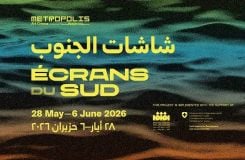
If you somehow haven't heard, Metropolis Cinema is hosting a new edition of its South Screens film festival, where it showcases films from the world's global south.
You can still catch this Thursday the Iranian "Woman and Child," a story of a widow and her breathless fight for her son's sake. On Saturday, start your evening with the South Korean, internationally acclaimed "No Other Choice," which tells the story of what class and work would push us to do. Wrap up your night with "All That's Left of You," in which a Palestinian mother reminisces on the son she lost in a protest in the Israeli-occupied West Bank.
Click here for more information.
Who to hold
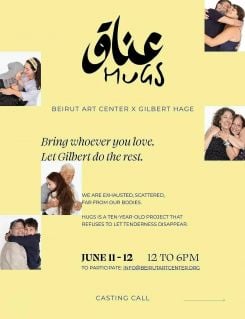
Gilbert Hage has been taking pictures of people hugging since 2014 because he "refuses to let tenderness disappear," the same way we all do.
In bodies we are constantly at war with, in a country constantly at war, the people we love are our only lifeboat. Ma elna gheir baaed (We only have one another). Our hugs are political, a form of resistance. Get your picture taken next Thursday and Friday at Beirut Art Center.
Click here for more information.
Where to go

Stayha, a family-run cultural space from Kfar Roummane in the Nabatieh district, is spending its last weekend on Beirut Art Center's rooftop on June 13 and 14.
This is your last chance to try their herbal bar, rooted in the plants and traditional knowledge of the South, and to watch their pick of artists whom the Israeli war has displaced, and whose studios, practices and means of livelihood it has destroyed. If you're looking for something to do, this is a chance to give your outing a purpose.
Click here for more information.

 7 p.m. recap: 1 person killed near border with Lebanon; 200 kilos of explosives carried by mules; Riyadh shuts its airspace