






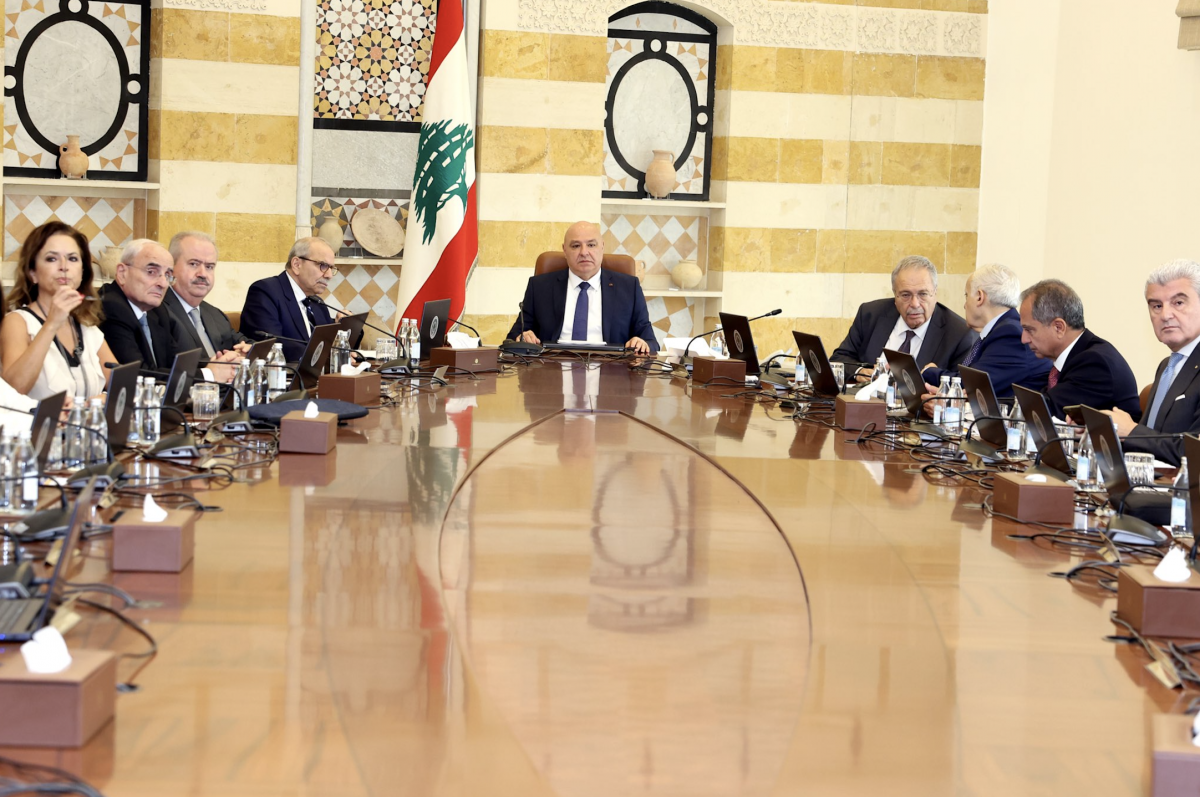
Ministers and President Joseph Aoun (center), during a Cabinet meeting at Baabda Palace, on Oct. 29, 2025. (Credit: @LBpresidency/X)






BEIRUT — During Wednesday's meeting, Cabinet postponed the controversial issue of the expat voting law to the next time minister's are set to meet, in a move likely aimed at finding common ground between the parliamentary majority, which is seeking to have the yet-unimplemented 2017 electoral law amended, and Hezbollah and its allies, who are calling for the law's enforcement.
The law calls for overseas voters to be represented by six additional seats in Parliament designated specifically for the diaspora, while the amendment would maintain that voters abroad would cast their ballots for MPs in their ancestral villages, regardless of the last time they set foot there.
Opponents of the law see it as an attempt to minimize the impact of Lebanon's powerful expat community, while its supporters fear their own base would be excluded from elections seeing as Hezbollah is designated as a terrorist organization in several Western countries.

On Tuesday, in response to Parliament Speaker Nabih Berri's refusal to add the amendment discussion to the agenda, the majority of MPs once again boycotted a Parliament meeting, resulting in a lack of quorum.
During the Cabinet meeting, President Joseph Aoun surprised attendees by criticizing the parliamentary blockade. "President Aoun considered that what is happening in Parliament is preventing decision-making, and that it is unacceptable to invoke privileges to justify the deadlock because the country cannot afford any shocks," Information Minister Paul Morcos said after the meeting, in comments cited by the state-run National News Agency (NNA).
"It was agreed that the government will examine, at its next meeting, a clear report to be submitted by the commission in charge of monitoring the electoral law," the minister noted. The next meeting is scheduled for Thursday, Nov. 6, according to local channel MTV.
The meeting also led to the formation of a ministerial committee "to find a mechanism to fund the reconstruction and compensation of victims of the Beirut Port explosion on Aug. 4, 2020, and the Israeli war," Morcos told reporters.
'Weapons in the camps are a threat to Lebanon'
Ministers also discussed at length the extremely polarized reactions to the fatal shooting of 24-year-old Lebanese Elio Abou Hanna, killed by Palestinian gunmen as he drove through Shatila refugee camp in Beirut's southern suburbs in the early hours of Sunday morning.
While several suspects were turned over to the Lebanese Army on Tuesday, Aoun "emphasized the importance of carrying out the investigations," according to Morcos.
At the beginning of the meeting, Prime Minister Nawaf Salam that "lessons must be learned from this tragedy" — namely, that "the weapons still in the hands of certain factions and armed groups inside the camps are a threat to Lebanon's stability and the security of its people, and serve nothing for the Palestinian cause."
In a message posted on his X account after the session, Salam revealed that seven suspects are now detained.
Cabinet has faced criticism, particularly from the Free Patriotic Movement, for not carrying out the disarmament of Palestinian camps fast enough, but during Wednesday's meeting, Salam pointed to "notable progress" on the issue.
According to the prime minister, "the number of trucks loaded with heavy weapons handed over to the state now exceeds twenty," but, he admitted, "that remains insufficient" and "the process of handing over weapons must continue."
The collection of Palestinian weapons in Lebanon began in August, following a meeting between Aoun and Palestinian Authority President Mahmoud Abbas, who had affirmed his support for Lebanese sovereignty over all its territory and its monopoly on arms. Hamas and other Palestinian factions in Lebanon have stated they wish to see the rights of Palestinians addressed before agreeing to hand over their weapons. Palestinian refugees in Lebanon are banned from owning property and excluded from most of the job market, leaving them with little movement outside of poverty-stricken, overcrowded refugee camps.