





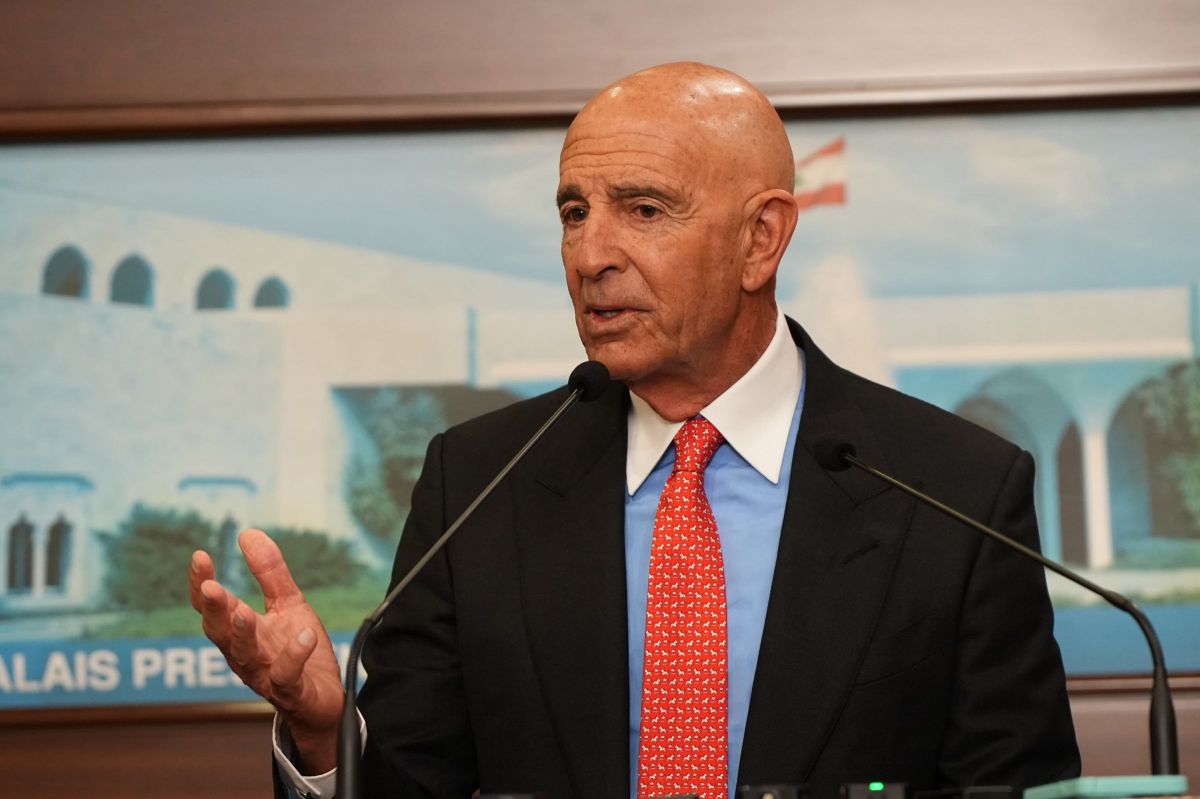
U.S. envoy Tom Barrack in Lebanon, in August 2025. (Credit: Mohammad Yassin/L’Orient Today)






BEIRUT — Ahead of his arrival in Beirut on Wednesday, U.S. envoy Tom Barrack reportedly warned that the window was closing for Lebanon and Israel to launch direct negotiations, according to an article published by the Hezbollah-aligned daily al-Akhbar, which cites "well-informed sources in Beirut."
Concern is mounting in Lebanon regarding a possible reignition of wide-scale Israeli bombardment on the country should it not achieve a swift monopoly on arms, focused mostly on disarming Hezbollah, with which Israel was at war for a little over a year, ending November 2024.
"The president, the prime minister, and the speaker of parliament have their last chance," Barrack is quoted as having said. "Either they learn from the past and decide to start direct negotiations with Israel under U.S. auspices to establish a timetable and mechanism for the disarmament of Hezbollah, or Lebanon will be left to its own devices, and it will remain so for a long time, and no one will care, neither in the United States nor in the region, and no one will be able to pressure Israel to stop it from doing whatever it deems necessary to proceed to disarmament by force."
Barrack made similar comments in a post on X on Oct. 20, warning that if Beirut "hesitates" in its process to disarm the party, "Israel may act unilaterally — and the consequences would be grave.”
According to al-Akhbar, this week's visit to Lebanon will be Barrack's last in his official capacity as U.S. envoy to the country. He is expected to hand the file over to Michel Issa, the new U.S. ambassador to Lebanon, who is set to arrive in Beirut in the coming days.
During his stay, he is expected to meet President Joseph Aoun, Prime Minister Nawaf Salam, Parliament Speaker Nabih Berri and Lebanese Army Commander Rodolph Haykal.
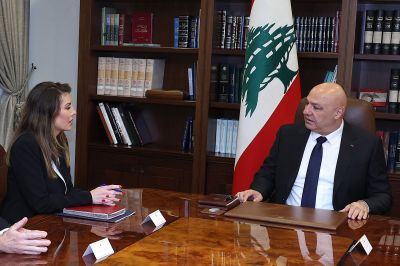
Lebanon has been under pressure to being direct talks with Israel ever since the cease-fire came into effect. Aoun, who was elected president in January, stated in mid-September that "negotiations with Israel are necessary in the crisis resolution dynamic" in the region. His remarks received strong opposition from several figures close to Hezbollah, with some claiming that "any direct negotiation would blow up the country" and others denouncing an attempt at "political submission" disguised under the slogan of peace.
Beware of 'chaos'
This isn't the first 'ultimatum' of this kind to come from Barrack. In his Oct. 20 message, Barrack said Lebanon's intentions to establish a monopoly on weapons in the country is "more aspiration than reality," which is said is due to "Hezbollah’s political dominance and the fear of civil unrest."
While he credited Cabinet with "attempting to make a good faith step forward," which, he said "Israel has completely discounted," he warned that "if Beirut fails to act, Hezbollah’s military arm will inevitably face major confrontation with Israel."
"Correspondingly," he added, "Hezbollah's political wing will undoubtedly be confronted with potential isolation as it approaches the May 2026 elections."
Barrack insisted on Hezbollah's disarmament and the launch of "security and border talks with Israel," after the "failure" of the November 2024 ceasefire agreement. He attributed this failure to the absence of any "direct agreement" between Israel and Hezbollah, which he said prevented the creation of a "real enforcement mechanism" for the arrangements.
A cease-fire monitoring committee, known as "the Mechanism" was established as part of the deal, and is made up of representatives from France, the U.S., Lebanon, Israel, and UNIFIL. However, parallel to the cease-fire agreement, the U.S. and Israel signed a letter of understanding that effectively granted Israel permission to sidestep the monitoring committee and attack Lebanon should it perceive any threats coming from the territory.
Israel attacks Lebanon on a daily basis and has killed more than 320 people since the truce came into effect. It also continues to occupy six areas inside Lebanon, along the Blue Line.
On Tuesday, diplomatic meetings were held successively in Baabda, the Grand Serail, and Ain al-Tineh, on the issue of negotiations with Israel and stopping attacks on Lebanon, alongside parallel visits from U.S. envoy Morgan Ortagus and the head of Egyptian intelligence services, Hassan Rashad, who played a key role in the Gaza truce talks.
This flurry of meetings took place in the wake of intensified Israeli strikes on southern Lebanon and the Bekaa over the weekend, which killed more than a dozen people.
Hezbollah Secretary-General Naim Qassem stated on Sunday that his party did not intend to launch "battles" against Israel, in order to avoid giving it "pretexts" to launch a new open war.
Ortagus is set to attend a meeting of the monitoring committee on Wednesday at the UNIFIL headquarters in Naqoura, along the border with Israel. During a tour with Lebanese officials on Tuesday, the envoy offered a few possible formulas for negotiations with Tel Aviv.

 7 p.m. recap: Iran warns Egypt, Israeli soldiers vote in south Lebanon, Haret Hreik responds to Kataeb