





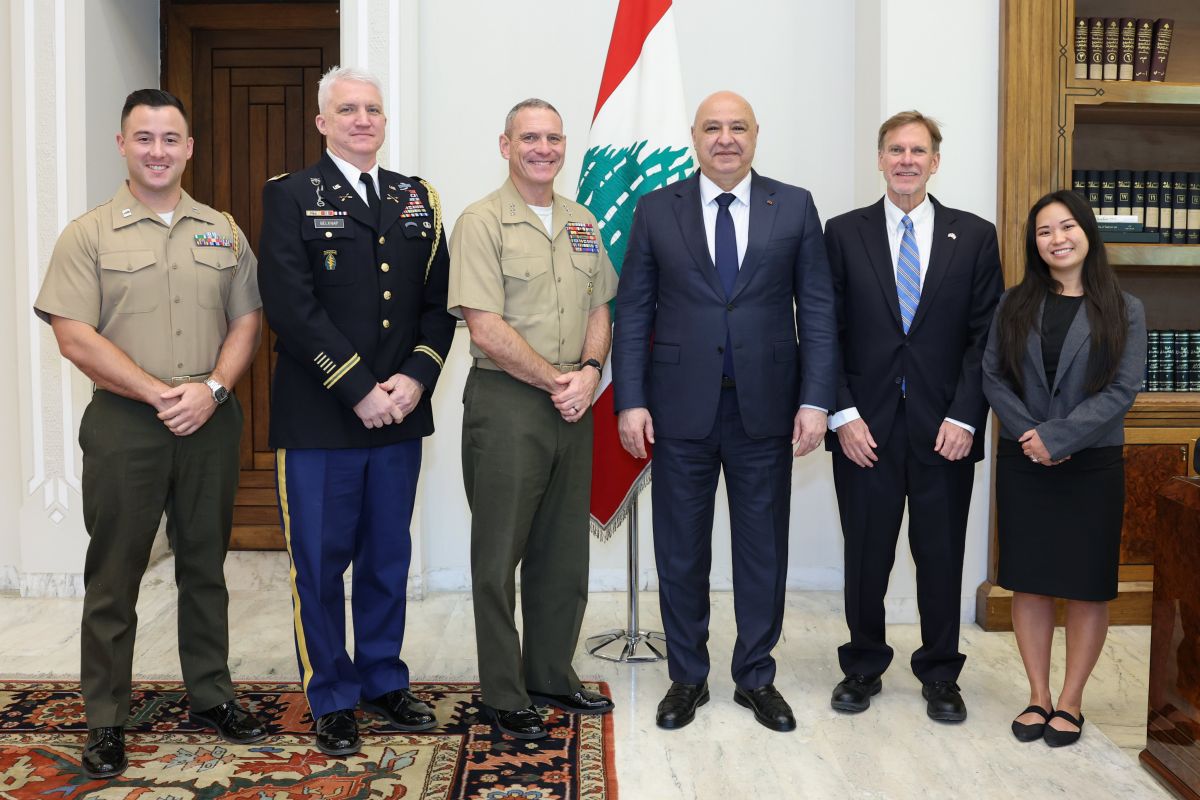
The cease-fire monitoring mechanism meeting with President Joseph Aoun at Baabda Presidential Palace on Oct. 23, 2025. (Credit: @LBpresidency/X)






The new head of the cease-fire monitoring committee, U.S. Gen. Joseph Clearfield, met on Thursday in Beirut with President Joseph Aoun, Prime Minister Nawaf Salam and Parliament Speaker Nabih Berri, the state-run National News Agency (NNA) reported.
During their meeting at Baabda Presidential Palace, attended by U.S. Chargé d’Affaires in Lebanon Keith Haniqan, Aoun told Clearfield that “Lebanon, which has abided by the cease-fire agreement since its announcement, places great hope on the work of the supervisory committee to help restore stability to the South and prevent the unjustified and unacceptable Israeli attacks, particularly those targeting civilians and commercial or industrial institutions.”
Clearfield succeeded Maj. Gen. Michael Leeney, who had led the Mechanism since April.
According to NNA, Aoun urged the mechanism to “intensify its efforts to put an end to Israel’s repeated aggressions against Lebanon and its violations of the agreement reached last November.”
Aoun affirmed that the Lebanese Army “is fully carrying out its duties south of the Litani River and continues to strengthen its deployment day by day.”
U.N. Resolution 1701, which serves as the framework for the current cease-fire agreement between Israel and Hezbollah, calls for Israel’s full withdrawal from Lebanese territory in parallel with the disarmament of all militias, starting with those south of the Litani River.
Aoun also called for “pressure on Israel to withdraw from the territories it occupies so that the army can complete its deployment up to the southern borders.”
He noted the army’s achievements so far, including “clearing the areas it has entered, eliminating armed manifestations, uncovering tunnels, and seizing all kinds of weapons and ammunition, despite the geographic challenges of the South.”
The meeting comes as Israel continues large-scale military exercises along its northern border with Lebanon, particularly in the Galilee region and coastal areas. Meanwhile, Israeli drones have been flying at low altitude over Beirut and its southern suburbs almost continuously in recent days.
‘No one wants to return to a state of war’
Aoun emphasized that “Lebanon remains committed to implementing all the security measures adopted by the Army Command and will continue its efforts. Any assistance provided by the Supervisory Committee will certainly help end the state of insecurity in the border areas, allowing residents to once again enjoy stability and safety. This situation benefits everyone, as no one, especially the people of the South or the Lebanese in general, wants to return to a state of war.”
Clearfield briefed Aoun on the committee’s meetings, noting that they “will become regular to consolidate the cessation of hostilities in the South,” and referred to a series of steps being prepared to achieve that goal.
Salam received Clearfield, Hanigan and the accompanying delegation at the Grand Serail.
During the meeting, Clearfield reviewed the activation of the committee’s meetings and the ongoing coordination with the Lebanese side, noting that “the meetings have become regular and aim to consolidate the cease-fire in the South,” according to the NNA.
Salam emphasized that "Lebanon is committed to completing the disarmament process south of the Litani River before the end of the year, as outlined in the Lebanese Army’s plan." He also stressed that Israel must fulfill its duties and obligations regarding its “withdrawal from the occupied Lebanese territories and stop its ongoing aggressions.”
Berri also met with the same delegation at his residence in Ain al-Tineh, the NNA reported. The discussions included a review of the field situation in the South and the committee’s progress.
Berri raised with Clearfield the issue “of Israel’s ongoing daily attacks, including air strikes targeting civilians and economic, industrial, and agricultural infrastructure in southern Lebanon and across the country.”
He also addressed "Israel’s continued occupation of large Lebanese areas along the border line, which constitutes a clear violation of the cease-fire agreement and obstructs the implementation of U.N. Security Council Resolution 1701.”
In response, Clearfield presented to the speaker the committee’s upcoming agenda and its operational mechanisms, “expressing hope for noticeable progress regarding the cease-fire enforcement and Israel’s withdrawal from the Lebanese territories it still occupies,” NNA reported.
The last war between Hezbollah and Israel officially ended on Nov. 27, 2024, after a year of cross-border fire, with the signing of a cease-fire agreement. But Israel continues to attack Lebanon daily, killing more than 320 people since the truce and destroying homes, buildings, infrastructure and construction equipment.

 7 p.m. recap: Iran warns Egypt, Israeli soldiers vote in south Lebanon, Haret Hreik responds to Kataeb