






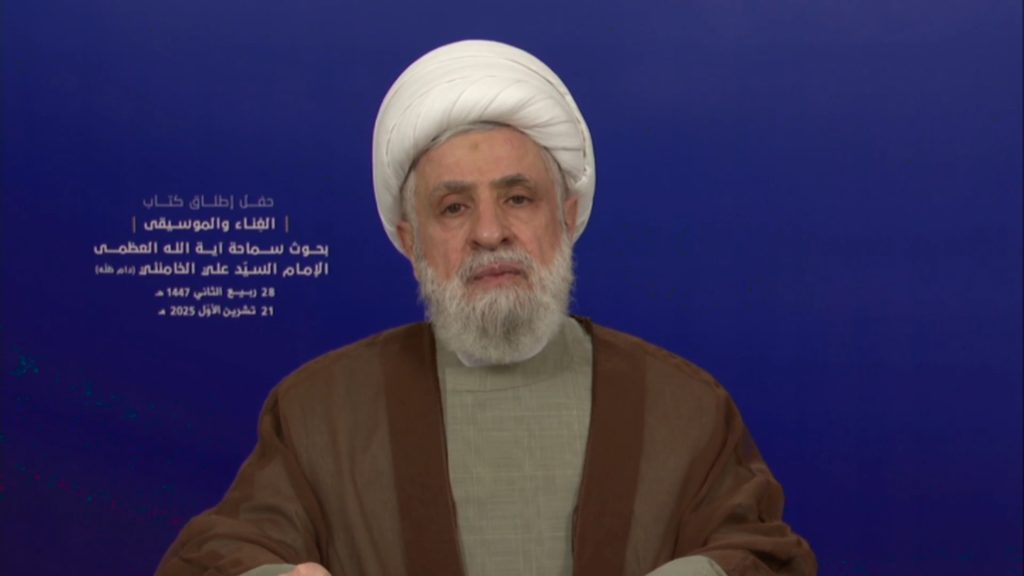
Secretary-General of Hezbollah Naim Qassem during a televised address given during a ceremony honoring Iranian Supreme Leader Ali Khamenei on Oct. 21, 2025. (Screenshot taken from al-Manar broadcast)






BEIRUT — During a televised address on Tuesday evening, Hezbollah Secretary-General Naim Qassem criticized American influence in Lebanon and what he described as the U.S.'s intentions to empower Israeli expansionism in the region, following threats from U.S. envoy Tom Barrack that Israel could restart its war against Lebanon should the party not disarm.
“Should Beirut continue to hesitate,” Barrack warned on Monday, “Israel may act unilaterally — and the consequences would be grave.”
“Lebanese officials are not in the service of the United States,” Qassem retorted during a ceremony held in Iran in honor of Iranian Supreme Leader Ali Khamenei, adding that Hezbollah "does not accept them being so."
"American interference is very harmful to Lebanon and the region," said the former chemistry teacher who became party leader after the assassination by Israel of Hassan Nasrallah. "It leads to massacres and genocides, as it pursues an expansionist project."
"Stop threatening Lebanon in order to destroy its strength and integrate it into Greater Israel," he declared. As for the stability of Lebanon, he said, "it depends on stopping Israeli aggression."
"Lebanon cannot give Israel what it wants, nor to America, as long as there is a proud people ready to make great sacrifices."
According to Barrack, the Lebanese government's intention of achieving a monopoly on arms “remains more aspiration than reality," which he said was due to constraints resulting from "Hezbollah’s political dominance and the fear of civil unrest.”
In August, Cabinet adopted a U.S.-drawn 'road map' for Hezbollah's disarmament and tasked the Lebanese Army with drawing up a detailed plan for carrying out the process.
According to Lebanese Army Commander Rodolph Haykal, who presented a progress report to Cabinet earlier this month, Hezbollah's disarmament south of the Litani River, as mandated by the cease-fire, is 80 percent complete. Haykal said Hezbollah has cooperated with the army in the process, even sharing the locations of weapons caches.
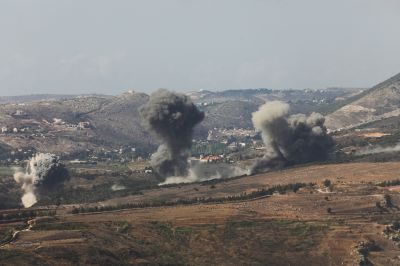
However, Hezbollah maintains its opposition to full disarmament country-wide, insisting that Israel be first held to account for its violations of the cease-fire, which include daily attacks and the occupation of six areas in Lebanon along the Blue Line.
Qassem described U.S. pressure on Lebanon to disarm Hezbollah as par for the course. "In practice, there is nothing new," he said, "except that the United States is trying to achieve through politics what Israel could not achieve through war."
"We are at a turning point in the conflict, marked both by much suffering and by hope, as Israel has not achieved its objectives and will not achieve them," he insisted.
Addressing Israeli Prime Minister Benjamin Netanyahu, Qassem said that he "can say that he kills everywhere, but he cannot say that he has found stability and that the future belongs to the Israeli entity."

 8 p.m. recap: Israel again threatens Beirut’s south suburbs; 2 ships hit near Hormuz; Riyadh football matches canceled