


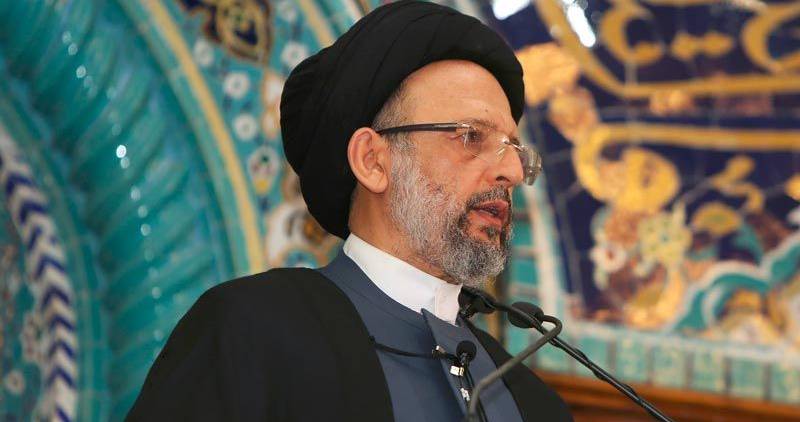
Shiite cleric Ali Fadlallah. (Credit: NNA archive photo)






A week after remarks by President Joseph Aoun, who said that “negotiations with Israel are necessary in the context of regional crisis resolution,” several figures close to Hezbollah broke their silence on Sunday. Some stated that “any direct negotiation would make the country explode,” while others denounced what they saw as an attempt at “political submission” disguised under the banner of peace.
The head of state had thus broken a taboo, amid ongoing efforts to disarm the party, weakened by the recent war. Showing a clear desire not to antagonize the group and Parliament Speaker Nabih Berri, Joseph Aoun also expressed support for indirect negotiations with the Israeli state, as was the case for the maritime border delineation in 2022.
Jaafarite mufti Ahmad Kabalan, a Hezbollah ally, argued that “this is the moment to protect Lebanon against the trap of negotiations that Washington is trying to impose to advance Israel’s interests.” He called the Israeli state “an absolute enemy” and warned that “any direct negotiation would make the country explode,” asserting that “Lebanon has not lost the war and will not lose it.”
He also stated that “those who faced and fought the Zionist army near Khiam will not give, through politics, what they did not yield in war.”

Kabalan also called for “preserving national unity and sovereign interests” in the face of “the worst regional Zionist terrorism,” warning that “without Lebanese unity, internal strength and a national doctrine, Lebanon will lose its identity, its weight, and the heritage of a hundred years of history.”
According to him, “the danger is Israel” and “the solution lies in neutralizing its terrorism.” He emphasized that “the solution lies in maintaining the cease-fire, not in political fire,” and argued that “politically separating Lebanon from its national doctrine could provoke the worst internal explosion.”
Taking advantage of the arrival of Washington’s new ambassador to Lebanon, Michel Issa, the U.S. is reportedly considering drafting a new “work plan” for Lebanon, which would include guidance on the importance of direct negotiations with Israel to resolve issues related to border delineation and Israeli withdrawal from still-occupied positions. This roadmap would complement the one presented this summer by U.S. envoy Tom Barrack and would be inspired by the Gaza agreement.
Ali Fadlallah: “Our problem lies in reliance on foreign powers”
During a ceremony honoring Hezbollah fighters killed by Israel, MP Hassan Ezzeddine spoke in Selaa, in the Hasbaya district (South Lebanon), stating: “Believing that peace with the enemy would bring Lebanon prosperity and well-being is contrary to reality.”
The Hezbollah parliamentarian added: “To those who think that imposing peace by force will lead to stability, we say it is an illusion: those who impose peace by force do not create peace, because true peace requires justice.”
The MP criticized the current discourse in Lebanon, saying that “we now hear speeches about peace, normalization, and direct political negotiations,” describing such statements as “slogans whose appearance is that of peace, but whose substance is submission.” He further stated:
“Whoever engages in the peace of Trump and Netanyahu is in reality engaging in the kind of peace we saw in Gaza, according to the American logic, the logic of imposed force. A peace that leaves the other side only one choice: surrender or death.”
He also emphasized that “in a country like Lebanon, with its confessional and political composition, no single party can impose its choices or align with what the Americans and Israelis want.”
Shiite cleric Ali Fadlallah, speaking at the Islamic Cultural Center of Haret Hreik, said:
“Our problem is that we have built neither a homeland nor a state. We remain a collection of clans vying for power and privileges, each community seeking to dominate the other or rely on foreign powers.”
For him, it is time to “understand that our salvation lies in solidarity and cohesion to face the challenges and projects being orchestrated against this country and the entire region.”
Another Hezbollah MP, Hussein Jechi, stated that: “The enemy seeks to subjugate our people, break our will, and draw Lebanon into negotiations and normalization.”
According to the parliamentarian: “Through its daily aggressions, the Zionist enemy seeks to subjugate our people and break their will, aiming to drag Lebanon into negotiations and normalization so that it first becomes a security and political satellite of the Zionist entity’s project, before imposing, in a second phase, total control over the country and the region under the banner of the ‘Greater Israel’ project. This plan begins with security pressure, then political pressure, followed by normalization, ultimately leading to full lock-in as part of efforts to subjugate our people.”
He concluded: “It is impossible to coexist with this enemy. We are left with only two choices, with no third way: either confrontation or submission; there is no room for submission.”
Finally, during an appearance on the radio station “La Voix de Tout le Liban,” Imad Hout, MP of the Jamaa Islamiya, stated:
“Lebanon will remain the last Arab country able to embark on the path of direct negotiations with Israel,” adding that: “This option is rejected both nationally and popularly, as it contradicts the fundamental principles of the Lebanese state. President Joseph Aoun’s position on this matter is clear and reflects indisputable national constants.”
He also mentioned the possibility of indirect discussions, as occurred during the maritime border delineation, noting:
“This type of dialogue is not new, and the recovery of Lebanese territories occupied by Israel through indirect negotiations remains a feasible option.”

 7 p.m. recap: 1 person killed near border with Lebanon; 200 kilos of explosives carried by mules; Riyadh shuts its airspace