



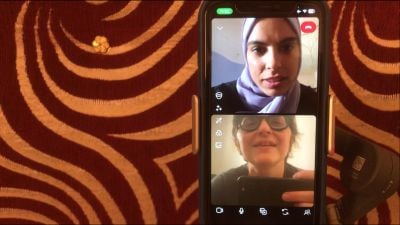
The photographer Fatma Hassona and the director Sepideh Farsi during one of their video conversations. (Credit: Rêves d’eau Productions)






In the year leading up to her death on April 16, 2025, Gaza-based photographer Fatma Hassona maintained a moving virtual dialogue with Franco-Iranian filmmaker Sepideh Farsi. Their exchange forms the heart of a new documentary, released in French cinemas on Wednesday, September 24. Through the screen, Hassona’s radiant smile and quiet resilience endure.
In an interview with L’Orient-Le Jour, Farsi reflects on the final year of Hassona’s life — and the devastating timing of her death, just one day after the film’s Cannes selection was announced.
L’Orient-Le Jour: “Put your soul on your hand and walk” the film's title and also a phrase spoken by Fatma Hassona during your virtual conversations. How did this phrase encapsulate her state of mind?
Sepideh Farsi: “Fatem” once sent me this audio message to tell me what she felt when she was taking photos, what documenting Gaza meant for her.
It struck me. This phrase sums up her determination and the fact that she was aware of the importance of documenting the genocide in Gaza through photography. She knew she was taking a great risk, but described it like this: Putting her heart, her soul, on her hand and walking. It’s a very radiant phrase, full of resilience.
L’Orient-Le Jour: “Fatem,” as her friends and you called her, used to send you most of the photos she captured in the streets of northern Gaza. Which one impacted you the most?
Sepideh Farsi: One of them stayed with me. It shows a child cleaning something that looked like blood and pieces of flesh with a stream of water. When I received it, my brain refused to recognize that it was human remains the child was cleaning.
When I later asked Fatem about it, she explained this child was the sole survivor of a bombing that killed his entire family in a school. So he was washing his relatives’ remains so he could continue sleeping there.
L’Orient-Le Jour: In the film, you don’t hesitate to show Fatem Hassona snippets of your daily life and your travels. At one point she says she dreams of a normal life. How did you feel about this contrast, and why did you choose to keep these moments in the edit?
Sepideh Farsi: I felt it was important for the audience to see this gap, the ordinary things Fatem missed in her day-to-day life. Just as she was born in Gaza and had never left. On the other hand, it was important for her to know where I was and what I was doing. I wasn’t going to hide my life just because she was trapped in Gaza.

It was a way of offering her a little window to the world. She often asked me for pictures from my travels, to tell her where I was and describe places to her. So it was a pact between us I wanted to bring into the film, because the atrocity of this war becomes even more meaningful when set against a “normal” life.
L’Orient-Le Jour: The film makes it clear Fatma Hassona wanted to stay in Gaza. She even says: “Only our home can contain and cradle us.” Where do you think this almost blind attachment to the land comes from?
Sepideh Farsi: During the Nakba, and even before that, under British mandate, there were mass waves of forced expulsions of Palestinian families. The people living in Gaza today are for the most part descendants of these families. And they’ve known for generations that once you leave your land, there’s no going back.
It’s almost in their DNA. As for Fatem, she was thrilled when I offered to try to get her out — she sent me her passport right away. But she also told me there was no way she’d remain outside Gaza. She said, “My Gaza needs me.” It was a very moving phrase: she wanted to stay, to inhabit the land and to document the ongoing destruction and genocide.

L’Orient-Le Jour: Fatma Hassona was killed in her home on the night of April 16, 2025, along with about ten family members, some of whom appear in the film. Do you believe she and her family were personally targeted?
Sepideh Farsi: Yes, I’m certain of it. When the Israeli army was questioned about the attack, they said they were targeting a Hamas member but never revealed an identity, despite repeated requests.
They also claimed to have taken every precaution to avoid collateral damage. Yet the opposite happened: Fatem’s entire family was killed — her father, her brothers (the youngest was 10), her sisters (one was five months pregnant). Only her mother survived.

The NGO Forensic Architecture conducted an in-depth investigation of the attack and concluded that it was a targeted assassination. Two missiles launched by a drone went through the building’s first three floors and exploded on the second, where Fatem and her family lived. I think she was targeted for her work as a photographer.
L’Orient-Le Jour: More than 200 journalists have been killed by the Israeli military in Gaza and Lebanon since Oct. 7, 2023. In your opinion, is the motive behind these killings to eliminate evidence of the atrocities committed?
Sepideh Farsi: Eyal Weizman, the founder of Forensic Architecture, has a phrase I find very accurate: “Genocide begins with the denial of genocide.” The Israeli army executes its government’s orders and is determined to erase evidence of genocide, to make sure the outside world doesn’t know what’s happening there.
These are methods often used by authoritarian regimes. The same thing happened in Iran when the regime blocked foreign journalists from entering in 2009 after massive electoral fraud that led to what is called the Green Wave uprising. As for Iranian journalists, the regime knows it can attack or eliminate them. This is exactly what Israel is doing to Palestinian journalists.
 Israeli army carries out demolition at Jabal Amel School in Houla as strikes continue