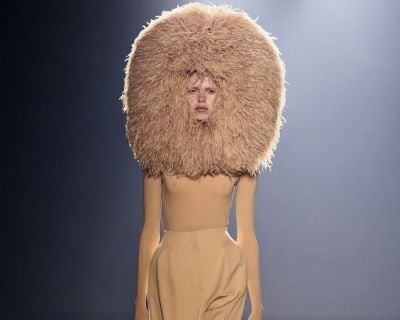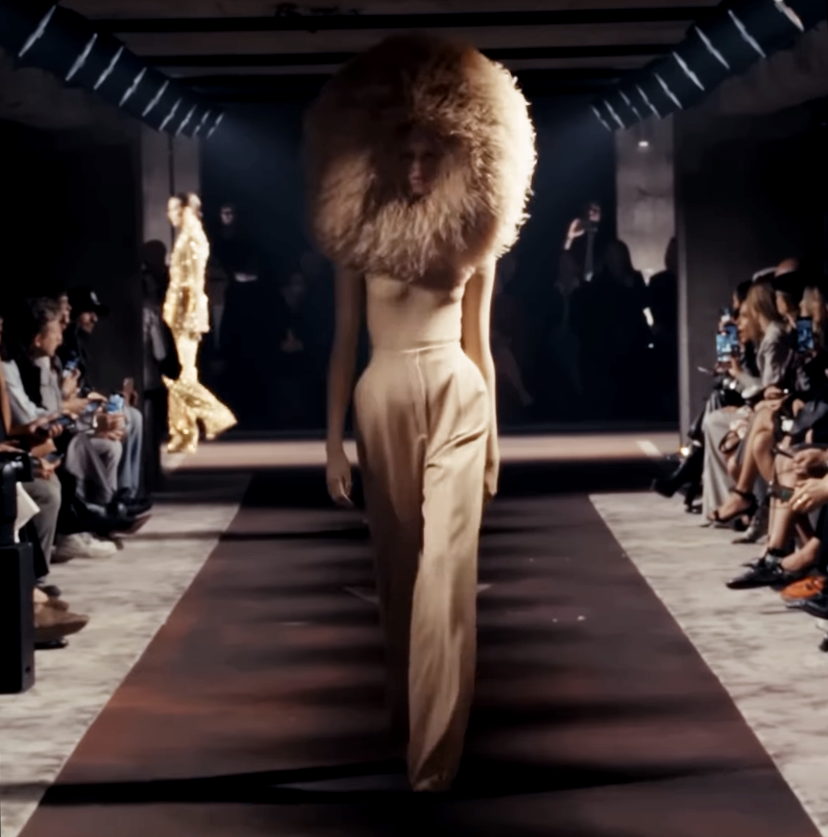
View of the Mugler fashion show under the direction of Miguel Castro Freitas. (Credit: @muglerofficial)






Paris had a rendezvous last Thursday with a rebirth. In the still-warm air of early autumn, Miguel Castro Freitas made his official debut at the helm of the Mugler house.
For the occasion, he chose an unexpected setting: An underground parking lot near Place de la République. With its bare, gray starkness, the space clearly belongs to a different world than that of luxury. But as soon as the first model appeared, everything was reversed: Suddenly, this graceless space turned into a cathedral of glamour.
This was, above all, about glamour — the bold, sculptural kind that allowed Thierry Mugler to upend the codes of haute couture in the early 1990s, after first making his mark in ready-to-wear. It was also the radical glamour that, a decade later, gave rise to those bird-like silhouettes whose daring still resonates in fashion history. For his debut, Freitas set out to reconnect with that very legacy.

His impressive background spoke through every piece. One could sense the shadow of a whimsical Galliano, the discipline of the Raf Simons era at Dior, the possible influence of Max Mara in the beige variations punctuating the collection.
But above all, there was the hand of a true couturier—and the eye of a passionate cinephile. Among the show’s most striking moments was a double homage to the master himself: two birds of paradise, draped in jackets and skirts crafted in collaboration with feather artisan Février. These poetic creations seemed to float between heritage and reinvention, perfectly echoing the show’s theme, "Stardust Aphrodite" — a vision of Aphrodite dusted in stardust, rather than a Venus in furs.
Everywhere, feathers were present — although they had tended to disappear under pressure from animal rights groups — here dancing along the edge of a ruffled dress, there as a mane, floating gloriously around the face of a model simply dressed in loose beige pants and a slightly lighter form-fitting tank top.
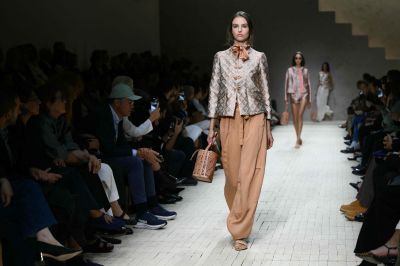
The collection drew from a wide range of references: Cocktail dresses in second-skin leather, draped and ruched as if poured over the body; long evening gowns embellished with leather flowers and stars, theatrical to the extreme. There were sculpted shoulders, necklines detached from the bust, and hips exaggerated with silicone. A series of semi-transparent dresses toyed with the tension of concealment and revelation, subtly — yet boldly — suggesting a glimpse of cleavage. Throughout, the body was celebrated as both architecture and spectacle.
Last March, Freitas succeeded Casey Cadwallader, whose era had been marked by a fascination with S&M imagery, latex, and fetishistic cutouts. With him, Mugler changes tone: The register becomes more grandiose, almost operatic. Less obsessed with straightforward provocation, more focused on the idea of a total spectacle in which couture and fantasy converse.
The context also sheds light on this choice. Since the house joined the L'Oréal group, the beauty giant, its new direction seems to bet on visibility, image power, the spectacle of the red carpet.
Here, fashion must first seduce stars, influencers, and magazine pages. It's a strategy that makes the collection a vehicle for influence rather than a line aimed at dominating ready-to-wear sales. In this respect, Freitas's gamble is perfectly aligned: His collection has all the makings of a manifesto designed for the spotlight, with the essential aura to place Mugler firmly in the present, while honoring its founder’s flamboyant heritage.
By choosing a gloomy underground parking lot as a setting, he powerfully played with the contrast of his feathered display. Through his vision, Mugler marks its return to absolute glamour, stripped of worn-out porno-chic connotations, focused solely on the light.