



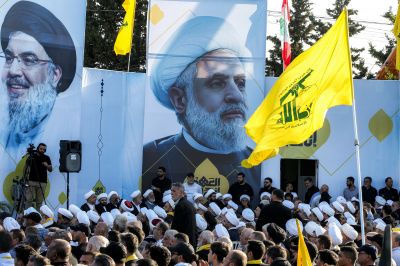
A photo of the Hezbollah chief, Naim Qassem, during a commemoration in the southern suburbs of Beirut, on Sept. 27, 2025. (Credit: Mahmoud Zayyat/AFP)






BEIRUT — Hezbollah Secretary-General Naim Qassem accused Washington on Saturday of trying to provoke a confrontation between the party and the Lebanese Army, and later praised the military for acting with “wisdom.”
“The Americans wanted to provoke discord with the Lebanese Army, to push the army to fight the resistance and its people under the pretext of monopoly on arms,” Qassem said in a speech commemorating the assassinations of Souheil Husseini, a former Hezbollah headquarters commander, and Nabil Kaouk, a former member of the group’s Executive Council, both killed by Israeli strikes.
“But the army acted with wisdom,” Qassem added.
His comments come as the army is tasked with implementing a government-approved plan to disarm Hezbollah and other militias, part of the Cabinet’s Aug. 5 decision to reaffirm the state’s monopoly on weapons. The military also faced criticism last week after Hezbollah projected images of its assassinated leaders onto Beirut’s Raouche Rocks in defiance of a ban. The army defended its decision not to intervene, saying it acted to preserve civil peace.

Qassem accused the United States of trying to weaken Hezbollah under the guise of strengthening the Lebanese state. “They were surprised to see that we played an active role within the state, that we are now an integral part of its structure and that we contribute to its rebirth,” he said.
After 13 months of war with Israel, he acknowledged that Hezbollah was militarily weakened, with many senior leaders killed.
Despite a cease-fire reached in November, Israel continues to occupy positions in southern Lebanon and launch near-daily attacks. Hezbollah has refrained from retaliating. “We decided it is up to the state to assume this responsibility and that we needed to be patient,” Qassem said on the issue, arguing the tactic prevented Israel from escalating.
Qassem also urged the government of Prime Minister Nawaf Salam, with which Hezbollah’s ties are strained, to prioritize sovereignty and reconstruction.
On elections, he rejected calls to amend the 2017 electoral law to expand expatriate voting. “There is an electoral law that stipulates six seats are reserved for expatriates, and this provision is well established,” he said. “We are in favor of fair representation, but if others demand representation dictated by foreign pressures, it cannot succeed.”
Turning to U.S. policy, Qassem dismissed President Donald Trump’s proposed peace plan for Gaza, which calls for a cease-fire, hostage releases, Israeli withdrawals, Hamas disarmament and the exile of its fighters. He described it as “an Israeli project under American cover … full of dangers.”
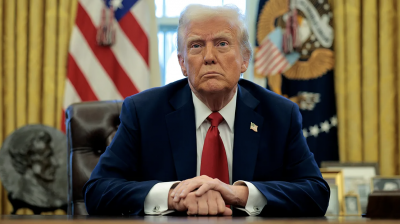
“This is Israel’s plan, which it failed to achieve militarily through aggression, genocide and famine, and now seeks to achieve politically,” he said.
He stressed Hezbollah would not interfere in Hamas’ response to the proposal but warned against what he called the “Greater Israel project,” referring to the call of some Israeli ultranationalists to expand Israel’s borders, occupying the West Bank and parts of Jordan, Lebanon and Syria.

 7 p.m. recap: Netanyahu seeks mastermind behind Flydubai incident; Washington sanctions 2 French nationals; Ben Gvir's 'I want to kill you' threat